Bhim Jayanti: A Personal Celebration


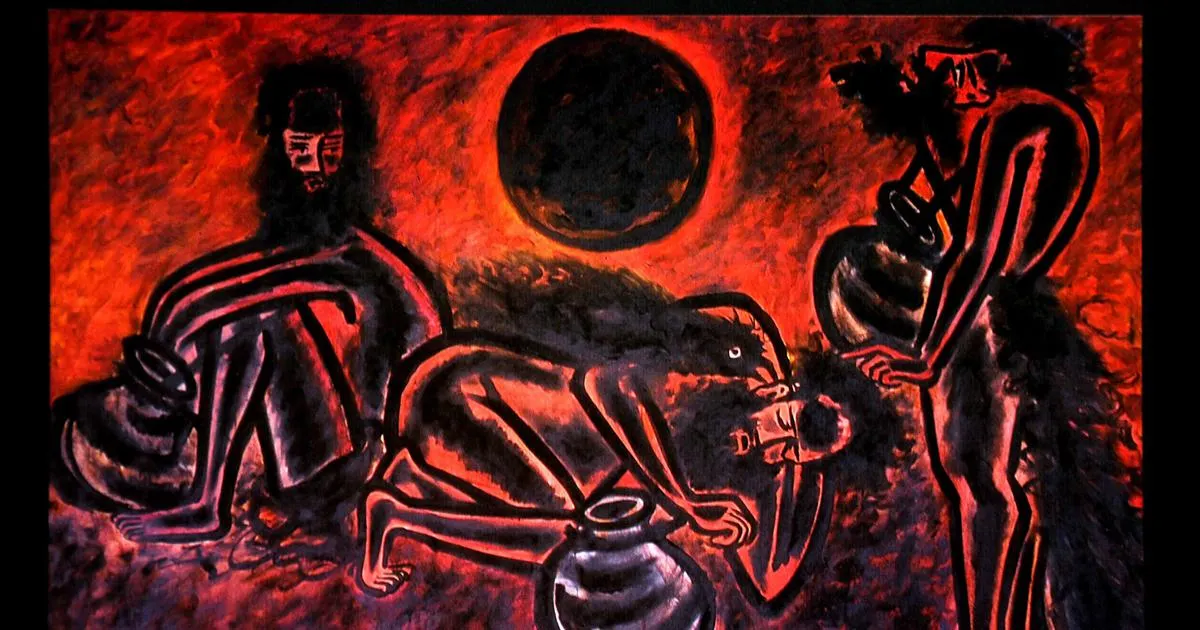
[Art by: Rahee Punyashloka]
Happy Bhim Jayanti, everyone! Today, I want to share what Babasaheb Ambedkar means to me on his Jayanti each year. Whenever I write, I always play a song on loop to keep my thoughts and feelings intact until I finish the piece. I’ll reveal the name of this song at the end of my writing, so please stay with me.
“I’ve seen people abuse power, use power
Misuse and then lose power
Power to the people at last; it’s a new hour.”
Ever since I was a kid, I was taught about Brahmin-Kshatriya heroes who were depicted as larger than life, but their influence seemed confined within the walls of my school. Gandhi’s portrait was prominent in the principal’s room, while classrooms featured images of Bose and Vivekananda. However, every summer when I visited my nana-nani’s (grandparents’) place in Uttar Pradesh, a different figure captivated me-the iconic image of Babasaheb Ambedkar, depicted against a blue backdrop, holding the Constitution. My nana would narrate stories about Babasaheb to me at bedtime, and I cherished those moments. However, back home in Uttarakhand, his name was conspicuously absent. This discrepancy puzzled me deeply. My nana shared numerous great stories about a man he held in high regard. Though I can’t recall many details now, I remember the pride on his face whenever he spoke about him. Despite my father’s frequent transfers within Uttarakhand, his collection of Hindi books about Babasaheb reinforced his significance within our family.
‘’The freedom of mind is the real freedom. A person whose mind is not free, though not in chains, is a slave. One whose mind is not free, though not in prison, is a prisoner. One whose mind is not free, though alive, is dead. Freedom of mind is proof of one’s existence. What is the proof, then, to judge that the flame of mental freedom is not extinguished from a person? Of whom can we say that his mind is free? I call him free, who with an awakened consciousness realizes his rights, responsibilities, and duties; he who is not a slave of circumstances and is always bent upon changing them in his favor, I call him free. One who is not a slave of usage, customs, and traditions, or of teachings because they have come down from his ancestors, whose flame of reason is not extinguished, I call him a free man. He, who has not surrendered himself, who does not act on the teachings of others, who does not believe in anything unless it is examined critically in the light of the cause and effect theory, is a free man. Who is always prepared to protect his rights, who is not afraid of public criticism, who has enough intellect and self-respect so as not to become a tool in the hands of others, I call such a man a free man. He, who does not lead his life under the directions of others, who carves out his own aim of life according to his reasoning and decides for himself how and in what way his life should be led, I call him a free man. In short, a man who is his own master, him alone, I consider a free man.’’ — Babasaheb Dr. B.R. Ambedkar, Writing and Speeches (What Way Emancipation)
When I started college in 2012, I faced judgment based on my qualifying rank for the college I entered. Following a heated argument with my father after I finished school, I was determined to prove him wrong. Despite this, I secured admission to one of the best colleges without his assistance and guidance. However, proudly sharing my achievements with others often led to ridicule or swift topic changes. During this time, one of my first college friends, who was also a Dalit, explained why they reacted this way. He supported me throughout my first year, and I deeply value his friendship to this day.
“Every man should have a philosophy of life, for everyone must have a standard by which to measure his conduct. And philosophy is nothing but a standard by which to measure. Negatively, I reject the Hindu Social Philosophy propounded in the Bhagvat Geeta based, as it is, on the Triguna of the Sankhya philosophy, which is, in my judgment, a cruel perversion of the philosophy of Kapila and which had made the Caste System and the system of graded inequality the law of Hindu social life. Positively, my social philosophy may be said to be enshrined in three words: Liberty, Equality, and Fraternity. Let no one, however, say that I have borrowed my philosophy from the French-Revolution. I have not. My philosophy has roots in religion and not in political science. I have derived them from the teachings of my Master, the Buddha. In his philosophy, liberty and equality had a place; but he added that unlimited liberty destroyed equality, and absolute equality left no room for liberty. In his philosophy, law had a place only as a safeguard against the breaches of liberty and equality, but he did not believe that law can be a guarantee for breaches of liberty or equality. He gave the highest place to fraternity as the only real safeguard against the denial of liberty, equality or fraternity which was another name for brotherhood or humanity, which was again another name for religion. law is secular, which anybody may break, while fraternity or religion is sacred, which everybody must respect. My philosophy has a mission. I have to do the work of conversion; for, I have to make the followers of Triguna theory to give it up and accept mine. Indians today are governed by two different ideologies. Their political ideal, set out in the Preamble to the Constitution, affirms a life of Liberty, Equality, and Fraternity. Their social ideal embodied in their religion denies them.” — Babasaheb Dr. B.R. Ambedkar (All-India Radio broadcast of speech on October 3, 1954)
Gradually, I delved into Babasaheb’s writings more and more, which bolstered my sense of identity. I began discussing caste more openly with my Savarna friends, creating a space for dialogue around me. Now that I was breaking the chains and wasn’t leading my life under anyone’s directions, I carved my own path in my life with my own reasoning and decided for myself how and in what way I should be leading myself. I was finally a free man. Today, with Babasaheb’s portrait proudly displayed in my living room in Ireland, thanking him every day for making it possible for us to dream bigger than life and making it possible for me to achieve and live in my dream country, completing my post-graduation here, and now working here for the last 4 years, I can confidently say that my journey here is a testament to his legacy.
Get randomdalit’s stories in your inbox
Join Medium for free to get updates from this writer.
Thank you, Baba, now and forever.
As I conclude, I leave you with Ambedkar’s words on the relationship between individuals and society.
“What should be the relation between a man and society? The modem social philosophers have postulated three answers to this question. Some have said that the ultimate goal of society is to achieve happiness for the individual. Some say the society exists for the development of the inherent qualities and energies of man and to help him develop himself. However, some claim that the chief object of social organization is not the development or happiness of the individual but the creation of an ideal society. The concept of Hindu religion is, however, very different from all these concepts. There is no place for an individual in Hindu religion. The Hindu religion is constituted on a class-concept. Hindu religion does not teach how an individual should behave with another individual. A religion that does not recognize the individual is not personally acceptable to me. Although society is necessary for the individual, mere social welfare cannot be the ultimate goal of religion. According to me, individual welfare and progress (individual development) should be the real aim of religion. Although the individual is a part of the society, the relation with society is not like the body and its organs, or the cart and its wheels.” — Babasaheb Dr. B.R. Ambedkar, Writing and Speeches (What Way Emancipation)
Happy Jayanti, Babasaheb Dr. B.R. Ambedkar!
And if you’ve stayed with me this far, the song I mentioned earlier that kept me inspired while writing this piece is ‘Main Bhim Ka Deewana Hoon’ by Anand Shinde.
You can listen to it here: https://www.youtube.com/watch?v=5IeqsQczLJY).
Maine Jeewan kiya aarpan, Bhim ji ke charno mein, [I have dedicated my life at the feet of Bhim ji,] Mujhe kissi ki nahi hai parwah, koi jaye mehlon mei, [I do not care about anyone; let others go to palaces,] Yahi hain mera karuna kamal, [This is my resolve; I will achieve greatness,] Main Bhim ka Deewana hu. [I am a devotee of Bhim (Ambedkar).]
JAI BHIM!
JAI BHIM!
JAI BHIM!
JAI BHIM!

Originally published at https://buymeacoffee.com.