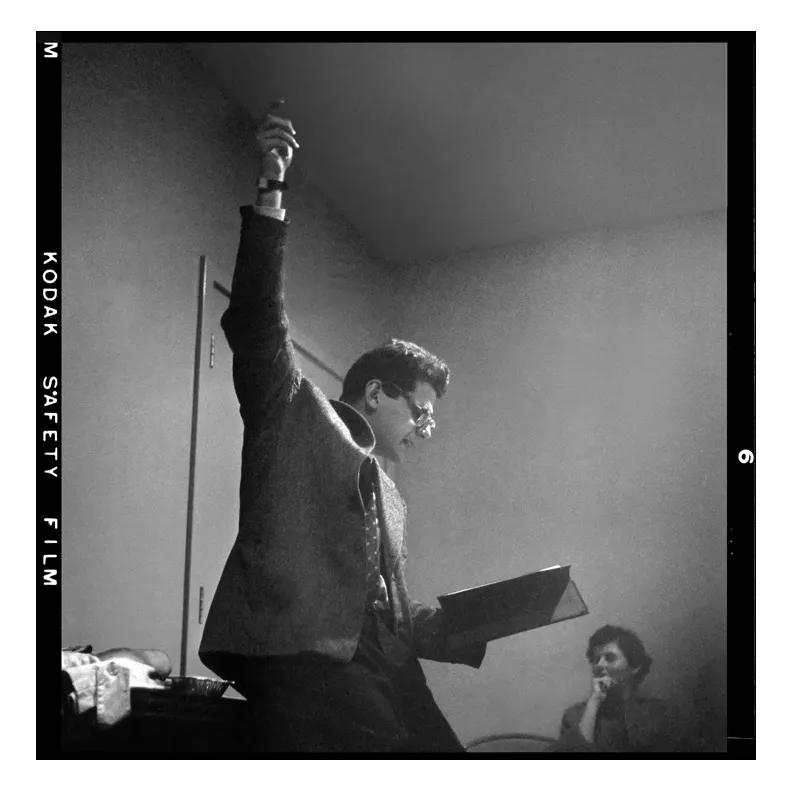
Michael McClure: Space, Time, and Peyote


In his peyote poem, Michael McClure continually references both “space” and “time.” When people usually think of space and time, they think of space being a designated area, and time being the passing of the clock. Even the Merriam-Webster definition of “time” lends itself to this understanding: “the period during which an action, process, or condition exists or continues: duration.” Similarly, space is defined in a way conventionally understood by most people: “a limited extent in one, two, or three dimensions : distance, area, volume.” Despite these definitions, the way in which McClure uses these terms alludes to something beyond these limited definitions. In a work of transcendent experience such as “Peyote Poem,” these two concepts must be more than what is conventionally thought of them. By using the synecdoche of “time” and “space,” McClure evokes the philosophical meaning of these terms to describe the experience of both transcending and having an alternate experience of reality when taking peyote.
The philosopher Arthur Schopenhauer defines the division of time as “the sequence of… moments,” and space as “the position of… parts” (7). This may seem not so different than the dictionary definitions, however Schopenhauer further describes time, stating “each moment in time exists only in so far as it has effaced the preceding one” (7). In time’s procession, each moment that passes is extinguished and replaced by the subsequent one continually; a bit more profound than the dictionary definition. The intersection of space and time in Schopenhauer’s framework “determine [our] experience as the law of causation and of motive” (7). The law of causation is the foundation of our reality, every event happens because it is caused by another, and this law is formed at the fusion of space and time.
Get Riley Willsey’s stories in your inbox
Join Medium for free to get updates from this writer.
When the speaker in “Peyote Poem” states
“there is no Time!” (265).
they certainly mean more than that they have merely thrown their clock away, or that the clocks have stopped altogether, or that duration has ceased. The speaker’s idea is further elucidated when he states
“I am free from time” (266)
He doesn’t seem to be thinking that time simply doesn’t matter to him. One cannot be “free from time” as long as the clocks are ticking. This statement is nonsensical, but the speaker says it with the earnestness of what he is experiencing. “Time” here cannot be understood as how it is thrown around: “I have no free time,” “I’ll do it if I have time.” The speaker may be trying to make a point about this, but not in the sense that all of his time is now free, but that he is actually free from time itself. He has surpassed the frameworks of reality. He is not free from durations and the passing of the day, but that he is separate from the whole space-time causality framework of reality. He has transcended the laws of causation that determine the standard corporeal experience. The speaker further explains his experience in stating
“I am separate… I fill / space with myself” (266).
The space-time framework that determines the laws of causality and comprehensibility of experience are not merely transcended, but replaced with the fulfillment of the individual. The speaker is separate from the laws that are the framework of reality, but instead of being in a void, he has replaced this framework with himself. He fills what should be the void with himself, while being separate from the conventional framework. Rather than each moment of his life being extinguished in its procession of moments, the speaker is in a continual moment of himself. He is fulfilled merely in his own existence independent of the cause and effect limitations of reality.
McClure, Michael. “Peyote Poem.” The Portable Beat Reader, edited by Ann Charters, Penguin Books, 1992, pp. 265–273.
Schopenhauer, Arthur. The World As Will and Idea. Translated by Jill Berman, Everyman, 1995.
“Space.” Merriam-Webster.com Dictionary, Merriam-Webster, https://www.merriam-webster.com/dictionary/space. Accessed 2 Oct. 2026.
“Time.” Merriam-Webster.com Dictionary, Merriam-Webster, https://www.merriam-webster.com/dictionary/time. Accessed 2 Oct. 2026.