Woody Guthrie Memorial Concert
Art Show Episode Four


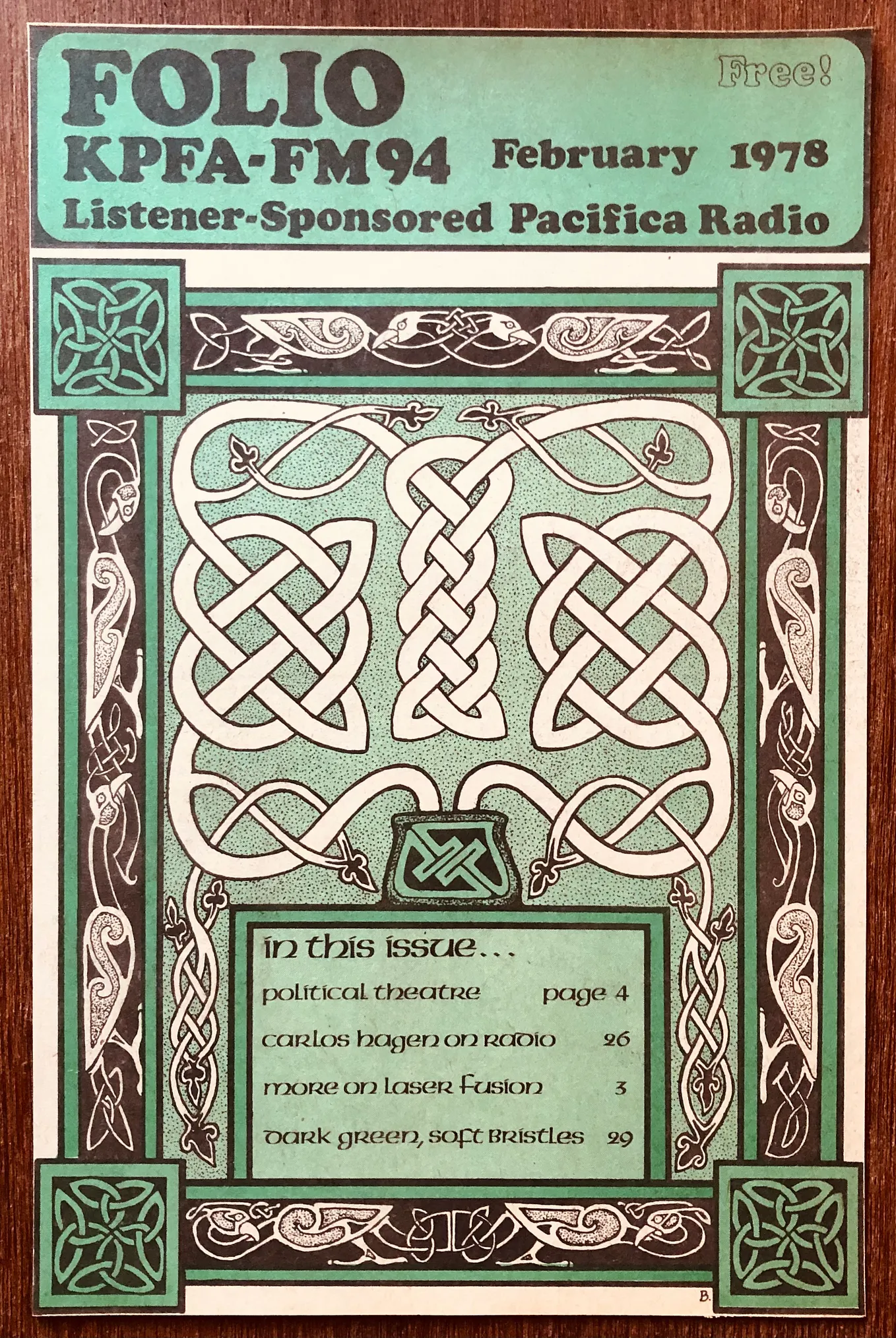
In summer of 1978, still volunteering at the KPFA Folio department, I landed the assignment of designing the graphic art for a benefit concert featuring the music of Woody Guthrie. I had the details and the list of performers, and otherwise free rein with the design. That was fortunate. I was learning a lot in those days about my patience with KPFA department committees to determine simple agendas and collective house meetings to determine which food co-op had the most correct line on bulk peanut butter, and if it had required a group to determine how this assignment got completed, it wouldn’t have gone to press with a B. in the bottom corner.

I can’t remember where I found this photo of Guthrie. Just now, online, the search took about 4 seconds. Back then I must have looked around at the Berkeley Public Library on Shattuck Avenue, and taken the books over to the copy machine, where I’d choose the likely images, adjust for size and contrast, and leave with all the pages of options that I could imagine might be useful when I got back to the drawing board.
Besides the obvious graphic advantage of simplicity and a readable silhouette, I liked the fact that Woody was not in his familiar energetically charged singing pose, guitar raised and head cocked, Being The Singer. Instead I imagined that he might be paying attention — watching and listening, eleven years after his death, to his own memorial.

The drawing took about a week of drafts before I felt right about it. This version was the best representation of his face. There was another one that captured his shirt much better, but I wasn’t selling shirts, here.
Get Richard Brandenburg’s stories in your inbox
Join Medium for free to get updates from this writer.
It felt a little dispiriting to be making images which achieved an abstract, numerically broad but silent splash of public viewing, and then disappeared into a recycling pile of Folios. Thousands of KPFA subscribers were at least glancing at my work. I can now admit to imagining scenes of folks stopping to look closely at the details, and speculative conversations about the true identity of this enigmatic “B.” That was a recurring fantasy, but I don’t recall being sought out for particular praise. I was essentially making secular sand mandalas out of newsprint and soy ink. More to the point, I was working hard at this stuff, but still feeling lonely bumping around town.

I was very proud of the ad placement in Peoples World, for which Woody himself had been a columnist in 1939. It seemed un-comradely to gloat about it, though I did send copies to my parents.

The night of the concert, looking for material, I brought a cassette recorder, and stood in the balcony, where the sound seemed best. I didn’t think Woody would mind. From the recording I took home, there were two stunningly good songs Kate Wolf sang that that Woody wrote. “One By One” (with melody by Gil Turner), and “Forsaken Lover”. I’ve sung both songs ever since.
Both are featured on Wolf’s “Carry It On” album from 2007, recorded from the Woody Guthrie Memorial.
A fine trio version of “Forsaken Lover” is also on the excellent 1998 recording “Heart of a Singer” by Hazel Dickens, Carol Elizabeth Jones, and Ginny Hawker. A highly recommended album.
A different version of the lyrics of “One by One” was recorded by Billy Bragg and Wilco, on the 1998 “Mermaid Avenue” album, with a melody by Jeff Tweedy which seems to borrow heavily and none too well from Dylan’s “Time Passes Slowly”.