How to Calculate Nadi Planetary Combinations by Hand
Nadi planetary combinations can look complicated when we see the final output generated by software.
But the underlying calculation is actually quite systematic.
The basic idea is simple:
Take a planet, project its degree into the 1st, 5th, 7th, and 9th positions, check whether another planet falls within the allowed range, and then calculate the strength of that connection.
This article explains the complete process step by step.
No programming is required. You can do the calculation with a birth chart and a calculator.
1. Convert the planet’s position into 360°
The first step is to convert every planetary position into a single longitude between 0° and 360°.
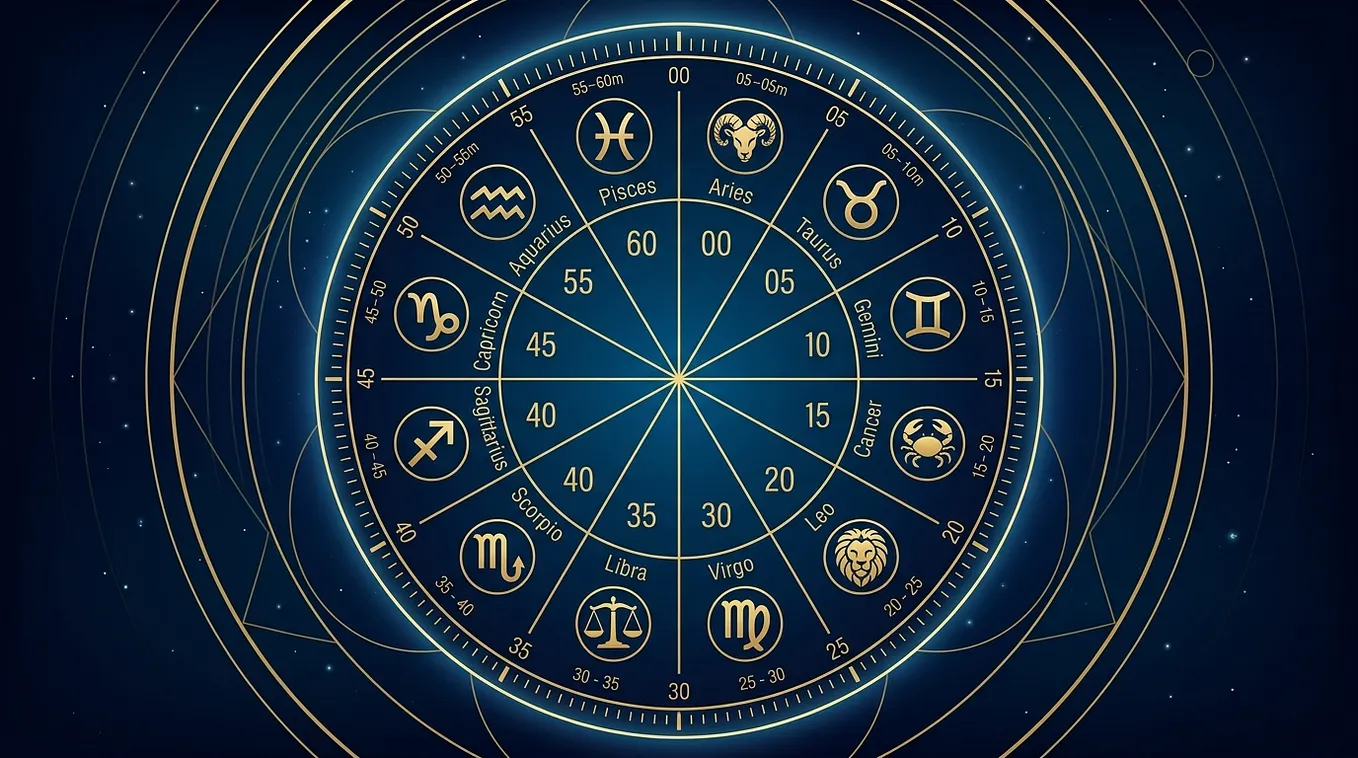
Each zodiac sign occupies 30°.
For example:
- Aries starts at 0°
- Taurus starts at 30°
- Gemini starts at 60°
- Cancer starts at 90°
- Leo starts at 120°
- Virgo starts at 150°
- Libra starts at 180°
- Scorpio starts at 210°
- Sagittarius starts at 240°
- Capricorn starts at 270°
- Aquarius starts at 300°
- Pisces starts at 330°
The formula is:
Absolute Longitude = (Sign Number − 1) × 30° + Degree
For example, suppose the Sun is at 12.63° Scorpio.
Scorpio is sign number 8.
So:
(8 − 1) × 30 + 12.63 = 222.63°
Therefore, the Sun’s absolute longitude is 222.63°.
Do this for every planet before starting the combination calculation.
2. Find the direction of the planet
Next, determine whether the planet is moving forward or backward.
A direct planet has a direction of:
+1
A retrograde planet has a direction of:
−1
For this calculation, Rahu and Ketu are also treated as retrograde, so their direction is −1.
This direction becomes important when we project the planet toward the 5th, 7th, and 9th positions.
3. Add the special Mars and Saturn points
There are four additional points that need to be calculated.
These come from the special aspects of Mars and Saturn.
For Mars:
Mars4 = Mars + 90°
Mars8 = Mars + 210°
For Saturn:
Saturn3 = Saturn + 60°
Saturn10 = Saturn + 270°
If the result goes beyond 360°, subtract 360°.
For example, if Mars is at 141.40°:
Mars4 = 141.40° + 90° = 231.40°
Mars8 = 141.40° + 210° = 351.40°
These are treated as virtual aspect points.
Importantly, these special points connect only with planets in the same sign.
4. Check the 1st, 5th, 7th and 9th positions
Now we come to the main part of the calculation.
From each source planet, check these four positions:
- 1st
- 5th
- 7th
- 9th
For a direct planet, the projection moves forward through the zodiac.
So the base points are:
1st = same degree
5th = +120°
7th = +180°
9th = +240°
For a retrograde planet, the direction is reversed:
1st = same degree
5th = −120°
7th = −180°
9th = −240°
This is one of the most important parts of the calculation.
A retrograde planet does not project these positions in the normal forward direction.
5. Measure the difference from the base degree
Once the base degree is found, compare it with the actual degree of the target planet.
First calculate:
Raw Difference = Target Longitude − Base Longitude
Then bring the result into the range of −180° to +180°.
After that, apply the planet’s direction:
Offset = Direction × Raw Difference
This gives us the directional distance between the projected degree and the target planet.
6. Check whether the planet is within reach
Not every planet found in the 1st, 5th, 7th or 9th position creates a combination.
The target planet must fall inside a specific 30° window.
The basic condition is:
Reach Limit ≤ Offset < 30°
There are three different reach limits.
For the special Mars and Saturn aspect points, the limit is:
−2°
The same −2° limit applies to Saturn and Jupiter when they are in movable signs.
For Saturn and Jupiter in fixed or dual signs, the limit is:
−1.5°
For the other regular planets, the limit is:
−1°
So, for example, if a regular planet has an offset of −1.5°, it does not qualify because it is outside the −1° reach.
But an offset of +10° qualifies because it is between −1° and +30°.
7. Calculate the affinity percentage
Once a connection is confirmed, calculate its strength.
First take the absolute value of the offset.
For example:
Offset = +8.77°
The distance is therefore:
8.77°
Then:
Affinity = (30 − Distance) ÷ 30 × 100
So:
(30 − 8.77) ÷ 30 × 100 = 70.77%
Therefore, the connection has an affinity of approximately:
70.77%
The closer the target planet is to the projected degree, the higher the percentage.
A connection very close to the base degree will therefore have a much higher affinity than one near the end of the 30° window.
A Complete Example
Let’s take this birth chart:
28 November 1996, 15:20:32
The planetary positions used in the example are:
Sun — Scorpio 12.63°
Moon — Gemini 20.21°
Mars — Leo 21.40°
Mercury — Scorpio 27.11°
Jupiter — Sagittarius 23.99°
Venus — Libra 12.79°
Saturn (R) — Pisces 6.82°
Rahu — Virgo 11.02°
Ketu — Pisces 11.02°
The corresponding absolute longitudes are:
Sun — 222.63°
Moon — 80.21°
Mars — 141.40°
Mercury — 237.11°
Jupiter — 263.99°
Venus — 192.79°
Saturn (R) — 336.82°
Rahu — 161.02°
Ketu — 341.02°
Example 1: Sun
The Sun is at 222.63° and is direct.
Let’s check its 1st position.
The base degree remains:
222.63°
There are three relevant points in the same sign:
Mars4 = 231.40°
Mercury = 237.11°
Get Rishabam school of astrology’s stories in your inbox
Join Medium for free to get updates from this writer.
Saturn10 = 246.82°
Sun → Mars4
Difference:
231.40 − 222.63 = 8.77°
This is within the allowed range.
Affinity:
(30 − 8.77) ÷ 30 × 100 = 70.77%
So we get:
Mars4 [1] — 70.77%
Sun → Mercury
Difference:
237.11 − 222.63 = 14.48°
Affinity:
51.74%
So:
Mercury [1] — 51.74%
Sun → Saturn10
Difference:
246.82 − 222.63 = 24.19°
Affinity:
19.38%
So:
Saturn10 [1] — 19.38%
Therefore, the Sun’s combinations are:
Sun = Mars4 [1] (70.77%) + Mercury [1] (51.74%) + Saturn10(R) [1] (19.38%)
Notice that the three connections have different strengths because their distances from the Sun’s base degree are different.
Example 2: Moon
The Moon is at 80.21° and is direct.
Let’s look at its 7th position.
The 7th position is 180° ahead:
80.21 + 180 = 260.21°
Jupiter is at:
263.99°
Therefore:
263.99 − 260.21 = 3.78°
Affinity:
(30 − 3.78) ÷ 30 × 100 = 87.41%
So the Moon connects with Jupiter in the 7th position with:
Jupiter [7] — 87.41%
The Moon also has connections in the 9th and 5th positions.
In the 9th position, Saturn gives:
Saturn(R) [9] — 44.65%
Ketu gives:
Ketu [9] — 30.65%
And in the 5th position:
Sun [5] — 25.27%
Therefore:
Moon = Jupiter [7] (87.41%) + Saturn(R) [9] (44.65%) + Ketu [9] (30.65%) + Sun [5] (25.27%)
Example 3: Retrograde Saturn
Now let’s see why direction matters.
Saturn is retrograde at:
336.82°
Its direction is therefore:
−1
For the 7th position, instead of adding 180°, we subtract it:
336.82 − 180 = 156.82°
Mars is at:
141.40°
The raw difference is:
141.40 − 156.82 = −15.42°
Because Saturn is retrograde, multiply by −1:
−1 × −15.42 = +15.42°
The distance is therefore:
15.42°
Affinity:
48.61%
So:
Mars [7] — 48.61%
This is a good example of why simply looking at the zodiacal distance is not enough.
The direction of the source planet changes the calculation.
Saturn also connects with:
Moon [9] — 44.65%
and
Venus [5] — 19.90%
Therefore:
Saturn(R) = Mars [7] (48.61%) + Moon [9] (44.65%) + Venus [5] (19.90%)
Example 4: Ketu
Ketu is at:
341.02°
Like Rahu, Ketu is treated as retrograde.
There is another important rule here:
Rahu and Ketu check only the 1st, 5th and 9th positions.
They do not use the 7th position.
For Ketu’s 1st position, the base remains:
341.02°
Saturn is at:
336.82°
Raw difference:
336.82 − 341.02 = −4.20°
Because Ketu is retrograde:
−1 × −4.20 = +4.20°
Affinity:
85.99%
Therefore:
Saturn(R) [1] — 85.99%
Ketu also connects with:
Moon [9] — 30.65%
and
Venus [5] — 5.90%
So:
Ketu = Saturn(R) [1] (85.99%) + Moon [9] (30.65%) + Venus [5] (5.90%)
One More Rule: Rahu and Ketu
There are two special rules to remember.
First, Rahu and Ketu only evaluate:
1, 5 and 9
The 7th position is excluded.
Second, when regular planets look toward Rahu or Ketu, the 7th-house connection is also excluded.
This keeps the nodal 1–7 axis separate from the regular opposition calculation.
What About a Planet With No Connection?
Sometimes a main planet does not form a connection with any regular planet.
In that situation, the calculation uses a fallback rule.
The planet is connected to the nearest advancing planet in the zodiac.
This is represented as:
Target [NaN] (NaN%)
This is not the same as a normal calculated combination. It is simply the fallback result when no regular connection is found.
The Calculation in Simple Terms
The entire process can be remembered like this:
1. Convert the planet’s position to 360°.
2. Check whether the planet is direct or retrograde.
3. Calculate the four special Mars and Saturn aspect points.
4. For every source planet, check the 1st, 5th, 7th and 9th positions.
5. Project the degree according to the planet’s direction.
6. Measure the target planet’s offset from that projected degree.
7. Check whether the offset falls inside the allowed 30° window.
8. Calculate the affinity percentage.
That’s the entire calculation.
The formulas may look complicated at first, but once the process is repeated for a few planets, it becomes quite mechanical.
The Most Important Formula
The final affinity calculation is simply:
Affinity % = (30° − Distance) ÷ 30° × 100
For example:
If the distance is 5°:
(30 − 5) ÷ 30 × 100 = 83.33%
If the distance is 20°:
(30 − 20) ÷ 30 × 100 = 33.33%
So a smaller distance means a stronger affinity.
Final Takeaway
Nadi planetary combinations are easier to understand when the calculation is broken into small steps.
You don’t need to calculate everything at once.
Start with the planetary longitudes.
Then determine direction.
Then project the 1st, 5th, 7th and 9th positions.
After that, check the reach window and calculate the affinity.
Once you understand these seven steps, you can reproduce the combinations manually instead of depending entirely on software.
The key is not to skip the direction and reach rules. Those two details can completely change whether a planetary connection is counted and how strong that connection becomes.