Purgatory in Paradise
How I wasted 3 years in grad school to become a man.


As graduation from Kansas State University loomed in 2003, I took stock of my years there and concluded they had been good, but not great. My grades were above-average, but not stellar; I volunteered, but did not lead; I dabbled in new things, but did not stretch myself; I had many friends but no true, deep friendships. My parents were proud, but I was not, because I knew I hadn’t given it my best. My classmates in chemical engineering justifiably felt they had worked too hard for too long to take a job that didn’t pay well, but I had gone to college so that I could do something that I truly enjoyed, and none of the jobs that I could obtain excited me. Not knowing what I wanted to do, and with a vague sense that I was not finished growing up, I applied for graduate school.
The day of the deadline, I finally called the University of California at Santa Barbara to tell them I was coming. I chose them, over the two other universities where I was accepted, solely because on the recruiting visit I had connected with Pat, a fellow evangelical Christian graduating from Purdue, and agreed that if we both went there then we would room together. Whatever happened, I would have a friend.
I will never forget the sense of wide-open opportunity as I drove westward from Kansas, all my possessions crammed into a 2-door Ford Escort, with Pat following in his car. My shortcomings in college were behind me. I would be at a globally-ranked PhD program, between the San Gabriel Mountains and the Pacific Ocean, surrounded by world-class scientists and eager entrepreneurs. I was starting fresh in a new place where I could achieve anything.
Like countless Americans before me, I went west to reinvent myself — and discovered that, unlike redemption, reinvention has limits.
I aced my qualifying exams the first year — one of the few students to demonstrate complete proficiency in transport phenomena, thermodynamics, and reaction engineering — but that was the apogee of my graduate student career. After a brief stint in Brad’s lab, I concluded we would have too much conflict to work together, and I did not know how to manage two bosses (he was my co-advisor with another professor). I eventually joined a research group where 80 hours a week was the norm. The primary goal was photoelectrochemical hydrogen generation — using solar energy to split water and create renewable chemical energy. The work involved materials science, electrochemistry, semiconductors, catalysis, and building custom equipment that could run a large number of experiments at once. The lab included Tom, a Puerto Rican with inexhaustible energy who was a natural leader; Alan, a Mexican Jew who could build anything but sent me irate emails from 1 meter away; Wei, who poured out her frustrations to me even though I teased her relentlessly; a gaggle of post-docs and undergrads; and The Professor, who ran a startup company by day, worked a second full-time job as an academic, and (being an MD as well) occasionally practiced medicine in the ER of the local hospital.
Emblematic of my experience was the Illuminator. The Professor ordered me to “find a way to illuminate multiple samples at once” so that we could simultaneously test different catalysts, suspended in water, that would adsorb light and use the energy to split water into hydrogen and oxygen. He grew impatient as I toyed with multiple approaches and searched for a good design, struggled to find needed parts and communicate my design to the machine shop, spent weeks personally modifying the shop’s product, and then attempted — in vain — to develop an experimental approach that could demonstrate consistent data from 8 identical samples. The haphazard results stumped everyone, including Pat; the one helpful suggestion came from a postdoc who once ran a Russian software-piracy scheme on the lab’s computers, but even it was insufficient.
Once, after an entire weekend of wasted effort, I walked from the lab to my car and began driving north with no plan or destination. Another day, Pat returned to our apartment to find me staring at a giant glass full of whiskey. When I shared my frustrations with my Dad, I told him, “I’ve just never been very good at building things” — to which he replied, “Well, I could have told you that!”
But even if the Illuminator did work, I did not know how to integrate it with the electrodeposited thin-film materials that I had worked on for over a year (and that were showing little promise). Like a solar cell, the thin-films adsorbed light and sent positive and negative charges in opposite directions, except to generate oxygen and hydrogen (respectively), but in a catalyst suspended in water, how could we ensure that the positive and negative charges went separate ways instead of recombining?
Worse still, splitting water directly into H2 and O2 simply generated a highly explosive mixture that could not be handled without catastrophe. While some delicately described this as a “separation problem,” in reality it was simply a bomb. A year passed before I came across a plausible light-driven chemistry for generating hydrogen and oxygen separately in different stages of a cyclic reaction. The Professor wanted us to believe that our research could change the world, and thus dedicate ourselves to it with a single-minded passion to the exclusion of all else. How could I wholeheartedly pour myself into a project that, even if it succeeded, would solve nothing?
Biking 5 miles to campus and back, and hiking frequently, kept me sane. Pat’s loyalty, excellence, and honesty challenged me, and we enjoyed doing science demonstrations for kids at a local tutoring center run by a pastor. I stepped into a leadership role in the college-age group at my church, where the congregation included everyone from Ryan, a dog groomer, to John, a physics professor. I prayed weekly with Ryan and Nick, an auto mechanic who struggled to read aloud but was fascinated by cutting-edge physics, and traded frustrations with Bernard, who was fluent in 4 languages but had been disowned by his parents twice (the first time for becoming a Christian, the second for joining the Navy). I was in a beautiful place, with great friends, but my life was headed nowhere. My Sabbath — typically comprising the 24 hours from the end of our research group meeting on Saturday until I returned to the lab on Sunday evening— was the highlight of my week.
Pat passed his PhD candidacy exam and married his girlfriend from Indiana. Serving as Best Man at his wedding remains one of the highlights of my life. Tom — whom The Professor described as “a model graduate student” and to whom I could never measure up — published his 26th paper and headed (with his wife) to Denmark for a postdoctoral fellowship, having accepted a faculty position at Stanford. I kept teasing Wei, who begged me to bring her to church. Alan ran the lab with his characteristic dearth of interpersonal skills, but never stopped lending a hand to everyone who needed help. They all had things they were good at and goals they were working towards, and in cases someone whom they loved, but I could not envision a future for myself.
I had wanted to be a scientist ever since the movie Back To the Future (1985) piqued an interest in electricity. In 2nd grade, I got my first chemistry set. In middle school, I took physics and chemistry at the high school. Now I was discovering that I no longer enjoyed doing science and wasn’t much good at it. To this day, I cringe at the memory of presenting my work in our weekly meeting.
I felt trapped. I was convinced that God wanted me to stay in my PhD program; I could not give up simply because it was difficult. I had never quit anything in my entire life. In the airport after Pat and Violet’s wedding, knowing what I was returning to, I was on the verge of tears.
Get Scott M Roney’s stories in your inbox
Join Medium for free to get updates from this writer.
One Sunday morning in November, I heard John 2:20 read aloud,
“It took 46 years to build this temple. You say that you will rebuild it in 3 days?”
The number stood out because I had finally completed my PhD candidacy exam. I found it strangely amusing that my written report, which was to be 20–30 pages long, was in fact 46 pages. (A classic case of substituting quantity for quality). Suddenly, a thought entered my mind like an alien whisper: I’m going to tear down what you’ve been doing and build something new. It was so bizarre that I did not know what to make of it.
That afternoon in his office, the Professor handed me the candidacy letter from my thesis committee. I read it in disbelief. For the first time in my life, I had failed a test. I was to wrap up my work, submit it for an M.S. degree, and leave. But as soon as the shock passed, I felt a sense of relief. I don’t have to do this anymore!
I went to straight to the gun range in the mountains where my friends were waiting. Denise, a fellow grad student in my department, asked what happened. Her face fallen, she told Ben, a delivery truck driver, who smiled sympathetically and handed me a fully-loaded .44 Magnum. An obsolete big-screen TV sat in the field. When I was done, smoke poured out of it.
I had not succeeded, but I had given it all I had. And now I was free to find something new.
Within months, I accepted a job that involved 100% international travel. It tied together my profession, my years in InterVarsity and my experience at Urbana, and a sudden new passion to travel the world and experience its cultures. When I graduated from college, I would not have wanted that job. After 3 years in graduate school, there was nothing that I wanted to do more. And with a move to Chicago on the horizon, for the first time I thought, Now that I know what I am doing with my life, if I met the right woman there is no reason we couldn’t get married.
Only one thing stood between me and my future: the Illuminator. The Professor demanded that I make it work in order to graduate. He later informed me that he could no longer pay me for my work. After a month, I was overdrawn on my bank account. The stress began to affect my body: my voice cracked, becoming high and raspy, and I began my mornings with a half-hour in front of a heater on full blast. When this illegal arrangement was exposed, I gave him the option of paying me to keep working and solve the problem — which I preferred — or allowing me to stop and write my thesis.
He chose the latter, and I was finally released.
On June 1st, I awoke in Pat and Violet’s living room, my new car packed for the move. Pat had shown the college group at church a PowerPoint (the medium in which he proposed to Violet) that was subtitled, “Three years of friendship, fun, fellowship, frustration and free food in Santa Barbara.” We went for one final beach run, and then I began my drive up the coast.
I returned 8 months later, so my friends could meet the woman to whom I planned to propose and so that she could see the place that shaped me. We gazed at the Pacific, hiked to Tangerine Falls, visited wineries, and I rode the steep bike path (with Pat) in a sort of pilgrimage to our old apartment. Then, we went to the UCSB library and found a copy of my thesis.

In that moment, it came together for me. This was why I spent 3 years in a beach town where I was too busy to visit the beach, with half my minimum-wage earnings going towards rent. One of the most persistent and incisive criticisms of American culture is that we have no common ritual, no established rite of passage, by which a boy becomes a man. Jews have the bar mitzvah, Mormons have their mission, American-Indians do a vision quest, but I was handed a diploma and walked off the stage. I learned more at K-State about chemical engineering, but I left Kansas as an educated boy. After persevering through 3 years of frustration and crushing expectations, building deep friendships of loyalty and vulnerability, stepping up as a leader, navigating life on my own and finding my own support structures, failing repeatedly and getting up again, I left California as a man.
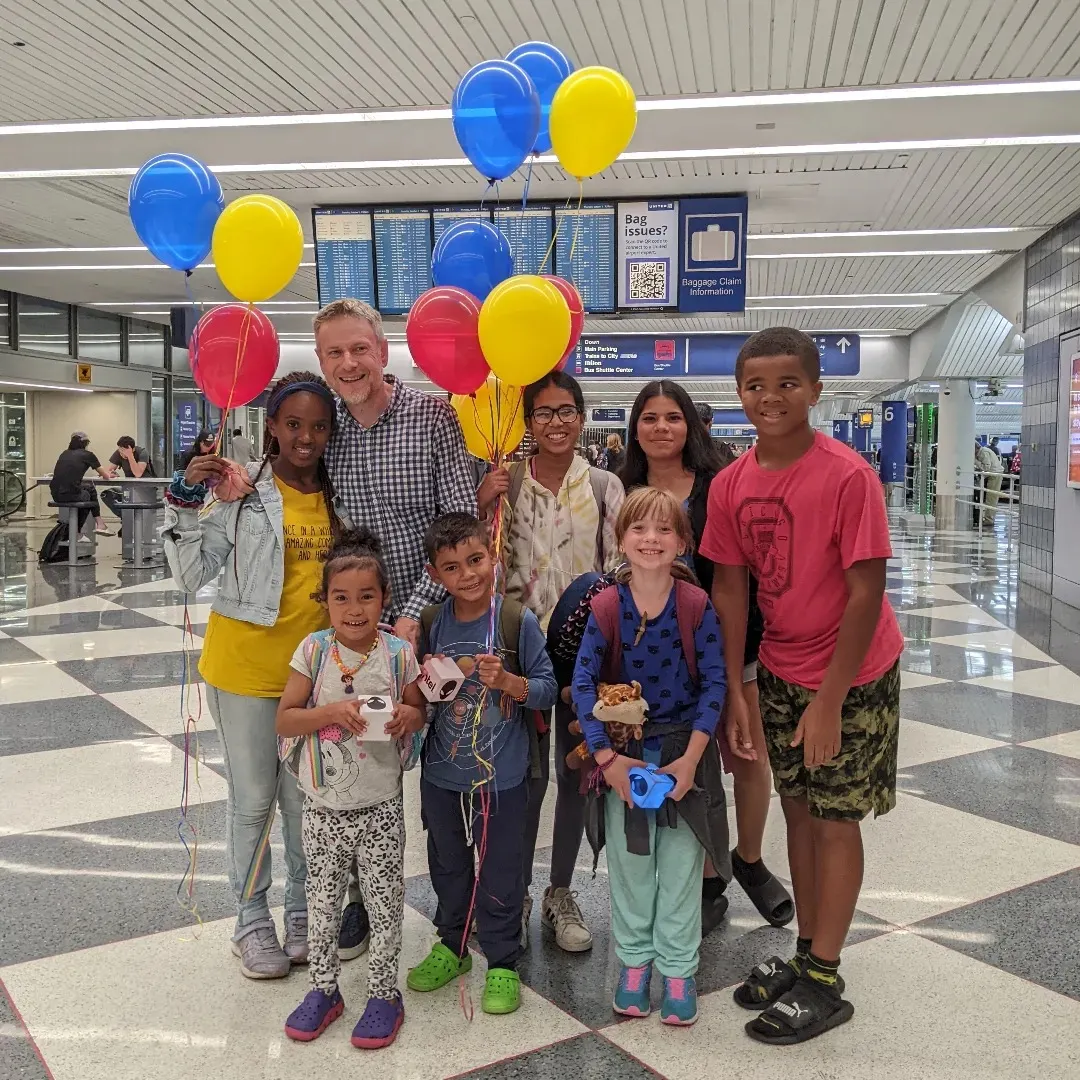
At times I have wondered — what if I had found an area of research that built upon my strengths rather than my weaknesses, or an advisor who better fit my personality, or an approach to the problem that was workable and scalable? I can mostly speculate on the life of a hypothetical Dr. Roney. But Dr. Roney would not have even met The Lady, would not have lived in India, would not have adopted 6 kids from 4 countries. Even if he achieved notoriety in his field, his life would be impoverished by comparison.
EPILOGUE
No one ever made the Illuminator work, or figured out why it didn’t. Tom is a professor at Stanford with a 30-person lab; he told me that work on colloidal photocatalysis came to a dead end because of recombination. Brad gave a research talk at my employer and was so overjoyed to see me that he was speechless. Alan and Wei finished their PhDs and married each other. John shared the Nobel Prize in Physics in 2025. Ryan was a groomsman in my wedding, and now has a family in Santa Barbara, where he does decorative cement work with his dad. Nick moved to Colorado Springs, where he still works on cars and reads about theoretical physics. Pat was recently awarded his 100th patent for work on laundry detergent at Proctor & Gamble; our families get together annually. I work as a chemical engineer in the energy industry and have 8 children, 6 of them adopted, with The Lady.