On Language and Thought


One of my deepest interests is the relationship between language and thought. When I say “thought”, I mean a cognitive activity that handles conscious reasoning. And by “language”, I mean the medium by which any thought is communicated. I hope these definitions set the stage for the ramblings that will proceed.
Some argue that language is a mirror of one’s mind and not its origin whereas others believe language plays a heavy role in formulating thought. Stuck between the two views, I fancy the latter, considering how the representation of spatial relationships, time, and evidentiality differ greatly from language family to language family. In Kuuk Thayorre, (the language of the Thayorre people in Prompuraaw, Australia), cardinal directions are used for all spatial descriptions. Korean and Turkish employ suffixes to show evidentiality. I would assume the Thayorre people have a fantastic sense of orientation and Korean and Turkish speakers are constantly aware of their sources of information. Gendered languages may subtly shape associations when it comes to inanimate objects. One of my many favourite things about the dystopia George Orwell created in “1984” is the attempt to use language to control people (even though it didn’t work).
But since I am no linguist and do not speak any of these languages, I have next to no evidence for these assumptions. What I can say for sure is that each language warps reality in its own way. If reality can be described as infinite detail, language is what divides it into categories. It is a representational code that compresses human experiences and thoughts and is evidence of consciousness.
Get Ruth Sharon’s stories in your inbox
Join Medium for free to get updates from this writer.
“The capacity to report information through language is universally considered as one of the clearest signs of conscious perception…” [A]
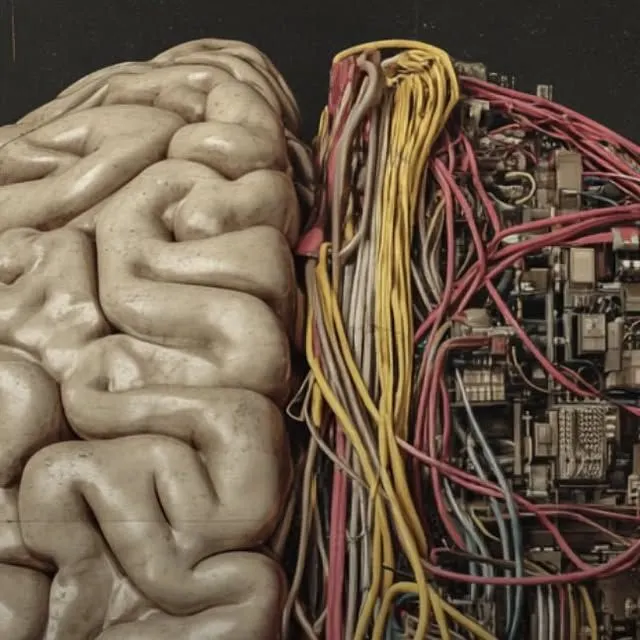
But not all language is a sign of conscious perception. Most of us are aware of the advent of a new type of language-thought conflation. I myself am fond of drawing parallels between human cognition and a language model’s cognition. Humans use a combination of language and inference to make sense of any natural language statement. This is because, for humans, natural language is a channel that is part of their much richer and more complex cognitive system. LLMs, on the other hand, use only language because language is itself the entire system. There is thus no real thought behind the language here since a language model merely mimics reasoning.
Language based intelligence naturally runs the risk of language based biases. One of the most frustrating biases is contextual fixation. I recently asked ChatGPT to generate ideas for a painting based off of an example I provided. That first piece of information (the example, in this case) shapes all subsequent thinking. It was quite the challenge to get it to think outside of that one example. The root cause is obviously the training objective and how it rewards “complete” answers and not epistemic humility. Alas, a model that I expected thought partnership from was reduced to a mere thought tool.
Both humans and machines exhibiting biases, despite having different substrates, suggests that bias is not a byproduct of consciousness. In that same vein, language trained systems are biased by the frame of language itself. Thus, studying how models encode concepts enables us to understand how biases emerge. Since the limits of language are usually also the limits of perception, this boundary of human perception is passed down through data. As Ludwig Wittgenstein said, “The limits of my language mean the limits of my world.”
And finally, whether or not these thoughts came out coherent matters less than the relief of finally putting into words what’s been circling in my mind lately.