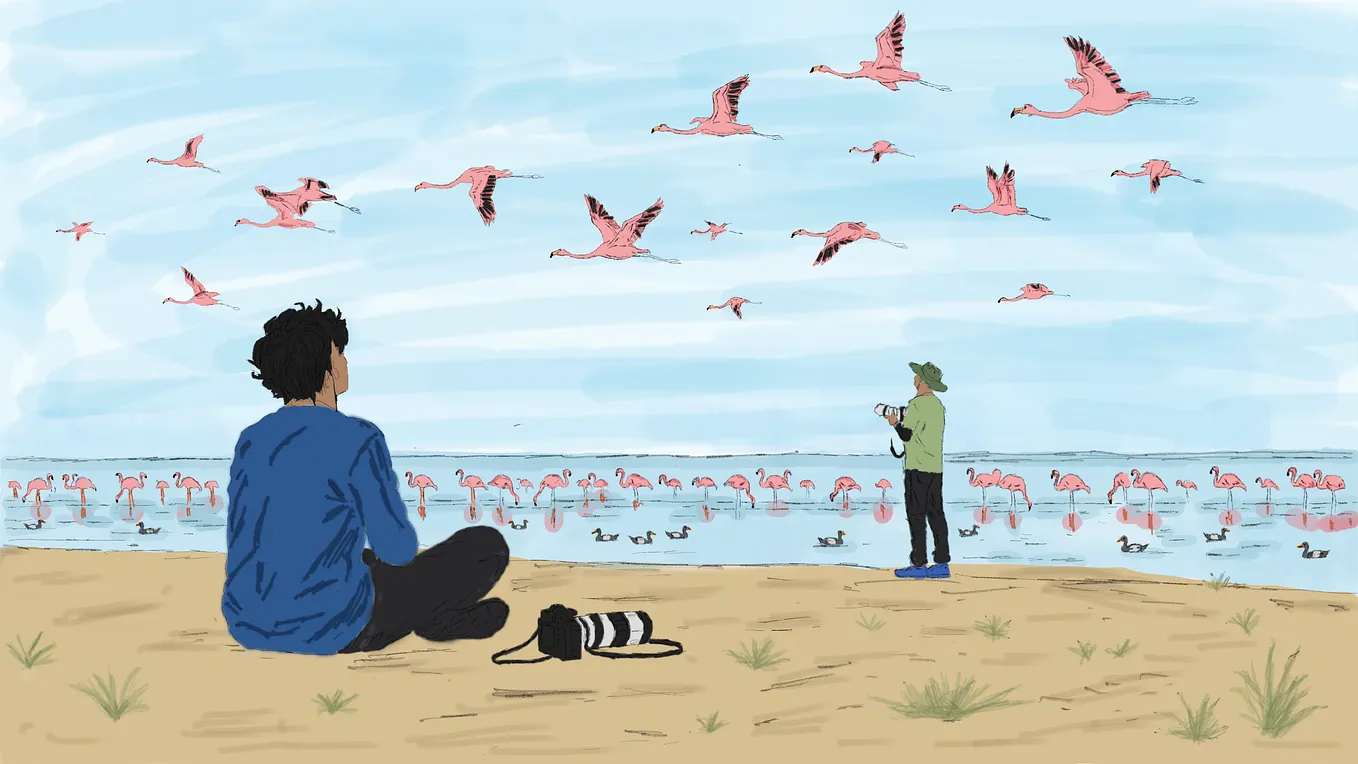
The Boy and His Birds
ft. Spoonbill

It was during my childhood that I first came across the bird I would eventually spend so much time hoping to see in the wild. In school, we had a subject called General Knowledge, or GK, and every year, when we moved to the next class, we received a new book filled with facts, pictures, and questions. I remember looking at a picture of a large white bird in one of those books, probably when I was in Class 3. Our teacher asked us to identify it. I looked at the picture and confidently said, “Crane.” My teacher corrected me: it was neither a crane nor an egret but a spoonbill.
At that age, I had very little idea about bird identification. I had noticed the white body but had paid no attention to the shape of the bill. I did not even know the word “egret” properly, and I thought of most large, white birds as cranes. I had not yet learnt that cranes and egrets belong to very different groups, or that the shape of a bird’s bill can often tell us something important about its identity and way of life. The correction stayed with me for a moment, but, as happens with many things we encounter in childhood, I eventually forgot the bird altogether. I would return to the story of cranes and egrets another day, perhaps when I write about the Sarus Crane. For a long time, the spoonbill remained only a picture in an old GK book.
My story with the bird began again much later, when I joined Dr Kartik Shanker’s lab for my master’s project and met Alok Paul. A great deal of what I know about birds, from identification and taxonomy to the questions one can ask about their behaviour and ecology, has come from learning alongside Alok. I still learn from him, and many of my birding experiences have been shaped by the time we have spent in the field together.
We had already completed our fieldwork in Odisha, but one small item on our birding wish list remained unchecked: neither of us had managed to see a spoonbill properly. We returned to Bengaluru to enter data, work in the lab, and prepare for our next fieldwork at Keoladeo National Park. I thought perhaps Bengaluru would give us another chance. Spoonbills are reported regularly at Hebbal Lake, and eBird records suggested that someone or another was spotting them there almost every day. The problem was the timing. The lake opened to the public in the morning, and we somehow never managed to get ourselves out of bed early enough. Bengaluru had become our comfort zone, and early mornings were not exactly our strength. Several people in the lab at the Centre for Ecological Sciences had already seen spoonbills at Hebbal. Alok and I were among the few who had not. I even tried to enter the park area in the evening, when access was not permitted, hoping I might find the birds, but the section where they were usually seen was beyond several barriers. That attempt failed too, and eventually we gave up on the Bengaluru plan. In the lab, Siddharth would sometimes joke about the spoonbill’s crest, comparing it to a feature associated with a Hindu caste. His jokes were funny, and they made us laugh and kept the bird in our conversations. Still, a joke and a photograph on someone else’s phone were not the same as seeing the bird ourselves. We would have to wait.
On 30 March 2026, after two exhausting days of train travel and almost a month of waiting for permits, we finally reached Bharatpur, Rajasthan. My fieldwork in Odisha had come to an end, at least as far as collecting data for my master’s thesis was concerned. I had only a few days left to analyse the data, write the thesis, and prepare it for submission. Yet, before returning to those responsibilities, another field experience awaited me. I had travelled to Bharatpur to help Alok with his research, and I jokingly called myself his unpaid field intern. I did not realise how much I would enjoy those days or how many small memories I would carry back with me.
Our destination was Keoladeo National Park, one of India’s best-known wetland landscapes. Its mosaic of wetlands, woodland, grassland, and other habitats supports resident birds as well as migratory waterbirds. For someone who enjoys watching birds, a place like Keoladeo offers much more than a checklist. Every trail holds the possibility of seeing a species for the first time, observing a familiar bird behaving in a different way, or witnessing something that turns an ordinary survey into a memorable day. At that point, however, the spoonbill was still just another species we hoped to find. I had no idea how our eventual encounter would unfold.
The Eurasian spoonbill (Platalea leucorodia) is a large, mostly white wading bird in the family Threskiornithidae, which also includes ibises. At first glance, its body may remind someone of a stork or a large egret. It has long legs for wading, a long neck, and a white body, but its bill makes it distinctive. Instead of tapering to a narrow point, the bill broadens at the tip into a flat, spoon-shaped structure. Once someone points out this feature, it becomes much easier to understand why the bird has its name.
The bill is not simply an unusual feature that helps us identify the species. It is closely linked to how the spoonbill feeds. In shallow water, a spoonbill moves its partly open bill from side to side, searching for prey. Small fish and aquatic invertebrates, including insects and crustaceans, can form part of its diet. The bird’s bill helps it detect and capture prey as it sweeps through the water. Its long legs allow it to wade through suitable shallow areas, while the shape and movement of the bill provide a feeding method different from that of birds that pick up individual prey items with a pointed bill.
This makes the spoonbill an interesting example of the relationship between an animal’s form and its ecology. Its bill is useful for identification, but it also tells us something about how the bird interacts with its environment. The availability of suitable feeding habitat depends on water depth, the presence of prey, and the condition of the wetland. A shallow, open patch of water may offer good foraging opportunities, while a deeper or densely vegetated area may be used differently by other species. Wetlands are not simply bodies of water where birds gather; they contain a range of conditions that different animals use in different ways.
Keoladeo is particularly interesting because it is a managed wetland. Its network of channels helps maintain water across different parts of the park, and water management plays an important role in the habitats available to aquatic and semi-aquatic birds. The park supports many kinds of waterbirds, and the availability of water can influence where they feed, rest, and breed. The Eurasian Spoonbill has a broad distribution across parts of Europe, Asia, and northern Africa, and different populations make seasonal movements between breeding and non-breeding areas. India’s wetlands provide habitat for these birds, and Keoladeo is among the places where they can be encountered.

These details help explain the natural history of the species, although I was not at Keoladeo to study spoonbill feeding behaviour or measure their use of different water depths. My own encounter began much more simply: with a group of birds flying overhead and an unsuccessful attempt to photograph them.
By 1 April, we had started settling into our field routine. Our mornings were organised around transects, during which we recorded bird groups along the trails inside the park. We had to manage our time carefully, particularly as the heat began building early in the day. That morning, we started our transect on Trail 2 at around 7:15 a.m. We encountered several mixed-species bird groups and continued through the park, recording what we saw and paying attention to the landscape around us.
While returning from the morning transect, we saw spoonbills flying above our heads. There they were at last: the birds we had hoped to see in Odisha failed to find properly in Bengaluru and are now encountered during our work in Bharatpur. The sighting was brief, and we could not photograph them. They passed overhead before we were able to get a proper picture, leaving us with the memory of their flight but no image to show for it.

That is one of the small frustrations of fieldwork. Wildlife does not wait for us to get the camera ready. A bird may appear unexpectedly, move quickly across the landscape, or disappear before we can focus. Seeing a species and photographing it are two different experiences. A sighting can be meaningful on its own, but a photograph gives us something to look back at and helps document the encounter. On that morning, we had the sighting but not the photographs. The spoonbills continued on their way, and we continued with our work, completing transects and recording other bird groups. Still, the encounter felt unfinished. We had finally seen the species, but we had not managed to document it properly.
Three days later, on 4 April, we went out for another morning transect, this time exploring Trail 1. It was already a productive morning. We encountered an adult black-necked stork at a much closer distance than I had expected and managed to photograph it. I also spotted the Indian Spotted Eagle again. I will write there story some other day. As we continued along the trail, we saw a group of birds flying overhead. At first, they looked like egrets, but when we looked more carefully, we realised they were Eurasian Spoonbills.
Get Sabyasachi parija’s stories in your inbox
Join Medium for free to get updates from this writer.
There they were again, and this time we had a chance to photograph them. As the birds flew close to us, I managed to take a few pictures. They were not perfect photographs, but they were good enough to document the sighting, and I was delighted. The contrast with our earlier encounter made the moment especially satisfying. On 1 April, I had watched the spoonbills fly over my head without getting a photograph. Just three days later, I had finally managed to capture some images. It was a small success, but it mattered to me. When you have only a limited number of days at a field site, even an ordinary photograph can become a meaningful record of the experience.
There is something rewarding about seeing a species more than once. The first encounter introduces you to the bird in a particular place and moment, but it can be over so quickly that you barely have time to take it in. A second encounter allows you to appreciate the sighting without the same uncertainty about whether you will see the species at all. For me, the spoonbills had gone from birds we were hoping to find to birds we had now seen and photographed in Bharatpur.
But the morning had another surprise waiting for us. While we were observing the spoonbills, Alok spoke with a nearby guide. During their conversation, the guide told him about a spoonbill nesting site outside Keoladeo National Park, near his village. The information caught our attention because it suggested the possibility of seeing the birds in another setting. Until then, our encounters had been limited to observing spoonbills during transects: first flying overhead and then coming close enough for photographs. A nesting site offered a different possibility, one that could help us learn more about where they breed and how they use the surrounding landscape.
Spoonbills are colonial breeders, which means they may nest in groups rather than only as isolated pairs. They can breed alongside other waterbirds, including herons, egrets, and storks, and their nesting sites may include trees, reedbeds, or other suitable places depending on the habitat. A nesting colony brings together several aspects of a bird’s ecology. Suitable nesting structures matter, but so do access to food, water conditions, and disturbance around the site. The surrounding landscape can be important too: a nesting area must be connected to feeding habitats that adult birds can reach while raising their young. Protecting a nesting site in isolation may not be enough if nearby wetlands and feeding areas deteriorate.
These are general ecological considerations, not conclusions from our own observations. We did not visit the site, count nests, or record breeding behaviour. What we had was information shared by a local guide about a possible place to explore. Nevertheless, the conversation made the spoonbill more interesting to me. It was no longer only a bird appearing along our transect; there was another part of its natural history that we might have an opportunity to investigate. For the moment, though, we continued our survey.

Near the end of our transect on 4 April, we encountered another group of birds. Alok screamed in happiness, but the screen was so low and in an excited way that the bird which we wanted to see was very near to us. This time, they landed very close to us. They were accompanied by black-headed ibises and egrets, and the group was much nearer than we had expected. After the earlier sighting, when we had managed to photograph spoonbills in flight, seeing them land nearby felt like an unexpected reward. We had wanted to encounter these birds during our fieldwork in Odisha and Bharatpur, and now we had the opportunity to observe them at close range. It was one of those birds which was on the bucket list, but others too, but other birds never came this near to us, like the flamingo and all, but these guys came near to us. It was the moment I found myself thinking that it almost felt as if the spoonbills were saying, “We are here. Take as many pictures as you want.” Of course, that was only my own playful interpretation of the encounter. We could not know from their presence alone what the birds were responding to, and our observations did not establish whether they were feeding, resting, or simply moving through the area when they landed. But that did not make the moment any less enjoyable. A few days earlier, the spoonbills had passed overhead and disappeared before we could photograph them. Now they had landed so close that we could take pictures without settling for a distant view.
The encounter reminded me of something I have come to appreciate about birdwatching and fieldwork: observations rarely unfold exactly as we expect. We had not planned for the spoonbills to land in front of us, and we had not known where they would appear or how close they would come. We simply continued our work, and the opportunity arrived. Among the many birds we observed during our time in Bharatpur, this was one of the encounters I knew I would remember.
It would be easy to describe the experience simply as a successful bird sighting. We saw the spoonbills, photographed them, and continued with our fieldwork. But there was more to the memory than that. A field season is made up of many small events. Some matter because they provide useful data or observations. Others remain memorable because they introduce us to a species for the first time. Still others become meaningful because an initially ordinary moment connects with something we have been waiting for over a long time. The spoonbill encounter belonged to that last category.
When we enter a field site, we often carry a mental list of species we hope to find. We imagine the photographs we want to take or the behaviours we hope to observe. But the field rarely follows our expectations exactly. Some species remain elusive; some appear when we are least prepared; some offer only a fleeting glimpse, while others remain nearby long enough for us to watch them carefully. A missed photograph does not make an encounter meaningless, just as a successful photograph does not tell us everything we might want to know about a bird.
A photograph can preserve an image of an individual or a group, but understanding a bird’s ecology requires more than a picture. We need to consider the habitats it uses, the food it obtains, its behaviour, and the ecological processes that allow it to persist in a landscape. For the Eurasian spoonbill, that means looking beyond its striking appearance to the wetlands that sustain it. Its spoon-shaped bill is a specialised feeding structure, and its long legs and wading behaviour suit it to shallow-water environments. Its breeding ecology links nesting sites to the surrounding landscape and the feeding areas available to adults. These features help explain why wetland conservation matters for the species.
Wetlands are dynamic ecosystems. Water levels rise and fall, vegetation grows and recedes, and the distribution of prey changes with the availability of suitable aquatic habitat. These changes influence where birds can feed, rest, and breed. Keoladeo National Park illustrates the importance of water management in wetland ecology. Its habitats support a wide variety of birds, and the distribution of water helps create different conditions across the landscape. At the same time, the park depends on a regulated water supply, making water availability an important part of its long-term ecological future.
For spoonbills and other waterbirds, changes in wetland condition can affect the availability of feeding habitat. Wetland degradation, changes in water management, and the loss of suitable nesting areas can threaten the ecological conditions on which waterbirds depend. Conservation therefore requires attention not only to the birds themselves but also to the habitats and ecological processes that support them. There is also a difference between a species’ global conservation status and the situation of its populations in a particular region. A species may be assessed as being at relatively low risk globally while still showing concerning trends in some parts of its range. These broader concerns were not something we measured during our transects, and I would not claim that our sightings reveal anything about population trends. Seeing spoonbills in Bharatpur tells us that they were present at the locations we visited; it does not tell us how their population is changing or whether their habitat is secure.
Still, the encounter gave me a reason to think about the larger ecological story behind a bird that I had once known only from a schoolbook. A birdwatcher may first notice a spoonbill because of its unusual bill or elegant appearance in flight. An ecologist might ask how its feeding behaviour changes with water depth or how its presence relates to prey distribution. A conservationist might ask whether the wetland is being maintained well enough to support the species in the future. These are different ways of looking at the same bird, and each can reveal something important. Our spoonbill sighting also took place at a time when I was trying to balance several responsibilities. My master’s thesis submission was approaching, and I still had data from Odisha to analyse. At the same time, I was helping Alok with his fieldwork in Bharatpur, completing transects and documenting the bird groups we encountered. The days could be tiring. We had to organise our field schedules, travel through the park, and work around the heat. Honestly, Alok did more work than me doing transects twice daily in scorching heat. I came as a help for him, but he was helping me look like. Some days brought exciting sightings, while others were quieter or less productive than expected. Then came the unexpected sighting of the spoonbills landing close to us alongside Black-headed Ibises and egrets.
When I think back to Bharatpur, I remember much more than the spoonbills. I remember the long transects, the cycling, the heat, the conversations, the other birds, and the feeling of exploring a landscape that was new to me. The fieldwork was not only about finding particular species; it was also about being present in a place, paying attention, and learning to appreciate the things that happened along the way. The spoonbills became a particularly memorable part of that experience because they connected a childhood memory to a real encounter many years later.
In Class 3, I had looked at a picture and mistaken a spoonbill for a crane. My teacher corrected me, and then I forgot about the bird. Years later, I found myself hoping to see it during fieldwork in Odisha, searching for it in Bengaluru, and finally encountering it in Bharatpur. The journey was not dramatic in the usual sense. It involved missed opportunities, early mornings we failed to manage, long travel, permits, transects, and a few photographs. But that is often how a personal connection with natural history develops: through small moments that gradually become part of a much longer story.
For now, the spoonbills of Bharatpur remain a memorable chapter in my field diary. Perhaps one day I will encounter them again somewhere else, under different circumstances. I may have the opportunity to observe their feeding behaviour more closely, visit a nesting colony, or learn more about their ecology. Until then, I have the photographs and the memory of that morning when the birds we had been hoping to see finally landed close enough for us to photograph them properly.
Sometimes, a bird begins as nothing more than a picture in a schoolbook. You misidentify it, get corrected, and move on with your life. Years later, you find yourself in a wetland, looking at the same bird through your own binoculars, and realise that the little detail you once overlooked has become part of a much larger journey. For me, that is the story of the spoonbill: a childhood mistake, a long wait, and a field encounter that made the wait worthwhile. For some other day I will write the Sarus Crane story and illustration.
This is one story from my field notes; there are more to be written. The art of converting the field notes to a story, I learnt during a workshop in SSCS BNG 2025 from two faculty members and researchers, Dr Venkat Ramanujam Ramani, Assistant Professor, Shiv Nadar University and Dr Budhaditya Das, Assistant Professor, Dr B. R. Ambedkar University Delhi, whose discussions on storytelling, observation inspired me to look beyond scientific observations and preserve the emotions, people, and moments connected to fieldwork through writing.
All Images and Illustrations by Sabyasachi Parija.