Enterprise Integration: Extending the APIM Landscape with Azure Logic Apps
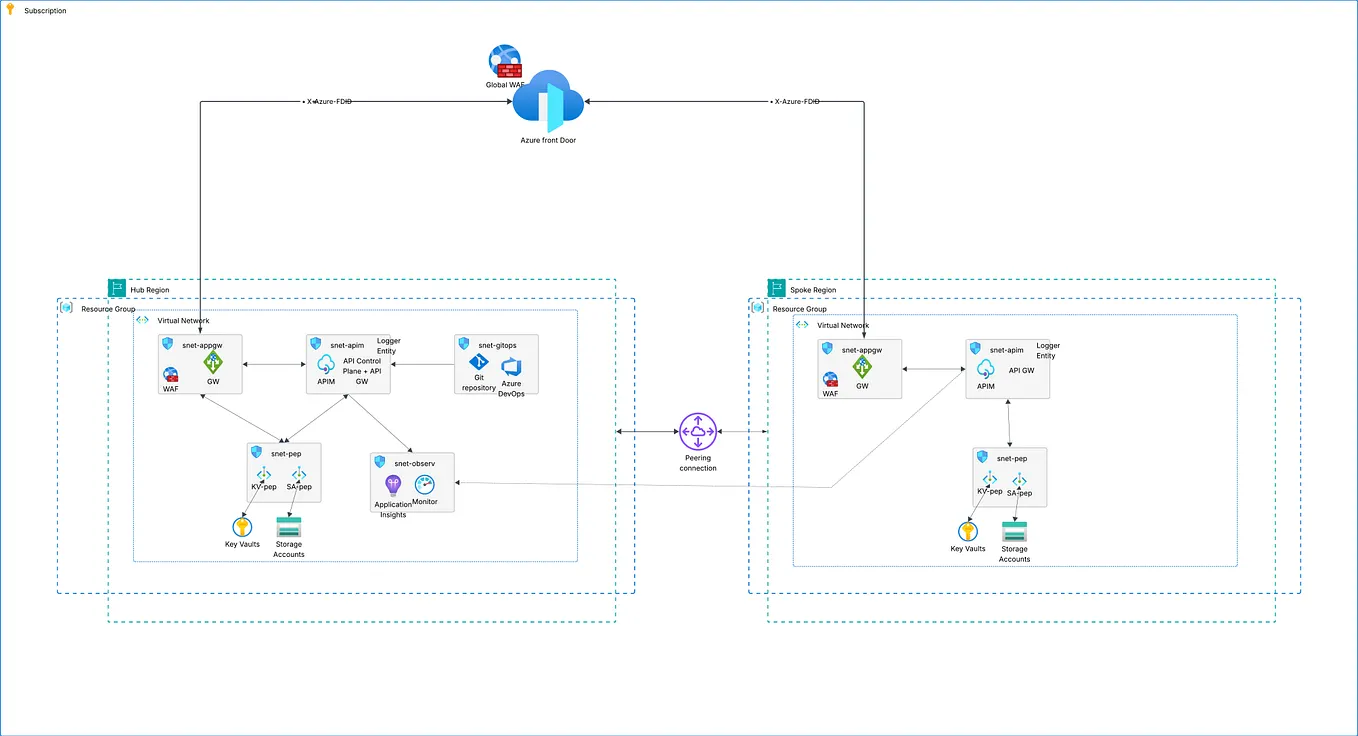
In our previous session, You established a resilient Azure API Management (APIM) architecture. You now extend this ecosystem by introducing a dedicated Integration Layer powered by Azure Logic Apps.
1. Integration Hosting Models: A Strategic Overview
To deliver a scalable integration capability, I evaluated four primary deployment models:

- Consumption Plan (Multi-tenant): A server-less, event-driven model suitable for proof-of-concepts (PoCs). While cost-effective for low-volume tasks, it lacks the network isolation required for enterprise-grade security.
- Standard Plan (Workflow Service Plan): The Recommended Enterprise Choice. This model offers dedicated compute resources with deep VNet integration, allowing for fully private inbound and outbound communication.
- App Service Environment (ASE v3): Provides an ultra-isolated, single-tenant environment. While offering the highest level of security and scale, it incurs significant infrastructure overhead and cost.
- Hybrid (Azure Arc-enabled): Facilitates hosting Logic App containers in customer-managed environments (on-premises or 3rd-party clouds). Note that this model may introduce latency due to cross-cloud network hops.
2. Target Architecture: Detailed Design (Standard Plan)
Based on the trade-off analysis of security, latency & cost and assuming that there is no heavy data egress between Azure and local network and no regulatory mandate of processing the data locally**, I have chosen the Logic App Standard (WSP) model for our enterprise integration. The technical implementation is detailed below:

I. Perimeter Security & Network Isolation
- Inbound Access Control: Inbound traffic to Logic Apps is restricted via Private Endpoints. This ensures that integration endpoints remain invisible to the public internet, accessible only through the internal Azure backbone.
- Outbound Connectivity: Egress traffic is routed through a Dedicated Delegated Subnet. You utilize Network Security Groups (NSGs) to strictly govern traffic flow, preventing unauthorized data exfiltration to the public internet. Attached the NAT gateway to support the static public ip for whitelisting in internet open SaaS backend systems (i.e Salesforce etc)
- Storage Plane Security: To support stateful workflows, you provision an Azure Storage Account accessed exclusively via Private Endpoints. This ensures that workflow state and metadata reside entirely within our private network boundary.
II. High Availability & Fault Tolerance
- Multi-Region Redundancy: The entire infrastructure stack is replicated across a secondary Azure region to ensure continuous availability and disaster recovery readiness.
- Intelligent Traffic Management:
a)Regional Affinity: You implement APIM Policies to prioritise “local” routing (APIM Region A to Logic App Region A) to minimise latency and data transfer costs.
Get Sachin Agarwal’s stories in your inbox
Join Medium for free to get updates from this writer.
b) Dynamic Failover: In the event of a regional service disruption, the APIM policy automatically reroutes traffic to the secondary region’s integration layer.
- Zone Redundancy: Provisioning the Workflow Service Plan (WSP) with zone redundancy (where available) protects against data center level failures within a single region.
III. Operational Excellence & CI/CD
- GitOps-Driven Deployment: Integration workflows are managed as code. You utilise Azure DevOps (or GitHub) to orchestrate parallel deployments to both regions, ensuring configuration parity and accelerating our release cycle.
IV. Cost Optimization
Choosing “Option 2” (WSP) over “Option 3” (ASE v3) is a direct application of this pillar.
- Right-Sizing: WSP provides the necessary enterprise features (VNET integration, private link) at a significantly lower entry cost than a fully isolated ASE environment.
- Scalability: You can scale the WSP instances up or down based on demand, ensuring you don’t pay for idle high-performance compute.
- Data Transfer Efficiency: By enforcing Regional Affinity, you minimize cross-region data transfer costs, which can be substantial in high-volume integrations.
V. Performance Efficiency
- Low Latency: Keeping traffic within the same region (Regional Affinity) reduces the round-trip time (RTT) between the APIM gateway and the Logic App.
- Elastic Scaling: Standard Logic Apps can scale out to multiple instances during high traffic bursts, ensuring the integration layer doesn’t become a bottleneck.
- Standard vs. Consumption: Choosing the Standard plan provides more predictable performance and throughput compared to the “cold start” tendencies of the Consumption model.