The Constant Flame: From Cassette Tapes to Artificial Intelligence


My Relationship with Ram Dass
My granddaughter, Agnes, is fifteen. She is currently enamored with her new turntable and a growing collection of Taylor Swift LPs. Her aunt bought her a Beatles album for her birthday, but I doubt she will ever truly understand the clunky, tactile magic of a cassette tape — how the plastic felt in your hand, or the way the tape would sometimes unspool like a loose thought.
In the nineties, Sam (the guy I was in retreat with) would pull out a box of those tapes, each one labeled by hand with a date and the title of a Ram Dass talk. We would sit around a wood-burning stove, drinking hot tea, listening to that distinctive voice weave the wisdom of the East into the intellectual language of the West.
The next morning, we would dive back into the rigor of our daily lifestyle: three hours of meditation, an hour of pranayama, ninety minutes of yoga asana, silent walks, and chores. On repeat for a decade.
Those ten years were a long, slow immersion into a certain settledness. I wasn’t just collecting information; I was navigating and then mapping a territory.
Fast forward to New Year’s Day, 2026. A friend’s eight-year-old daughter just handed me a gift: a miniature, glow-in-the-dark Buddha she made on the 3D printer she got for Chanukah.
The contrast is startling.
Technology has marched us in my lifetime from magnetic tape to 3D-printed icons and the threshold of Artificial Super Intelligence. Everything has changed. And yet, as I look at that little glowing Buddha, I am reminded that some things remain entirely constant.
There is a thread that runs through the ages. It is the steady response to perennial questions into the nature of reality and the journey of being human. Whether it is recorded on a cassette or generated by an algorithm, the Truth doesn’t morph with the ages. Only the articulation of it does.
I eventually met the man on the tapes.
It was over a decade after I had left my mystic-monastic life and began navigating the “marketplace” of modern life in the “real world”. For our tenth wedding anniversary, my husband arranged a private retreat for us with Ram Dass at his home on Maui. Turns out my husband also had a history with Ram Dass, having produced a film in the eighties called Prague Gnosis that included a conversation between Ram Dass and Terrance McKenna.
Get Sarah Marshank’s stories in your inbox
Join Medium for free to get updates from this writer.
When we came to be with him, Ram Dass’s speech was slowed by the stroke he’d suffered in 1997, but his mind remained a sharp, lucid instrument. We sat with him and I shared the framework of Selfistry’s Artistry and the “Three Realms” I had mapped out during my years of silence and subsequent years of householder life.
I was cautiously excited to share it with him. Mostly I just wanted to thank him. To just be with him. But his eyes lit up as he listened, and with a classic Ram Dass mischievousness, he began to lovingly grill me.
He wanted to grok exactly what each realm represented. I could tell he was testing my map against his own — a map he had spent decades refining as he moved from Harvard professor to psychedelic pioneer, to devotee, to a man simply trying to inhabit “Loving Awareness.”
At one point, I told him I wasn’t fond of the word “Soul” — a word he used effortlessly in his teaching about helping people go from role to soul. But, I told him that I felt people used it as a spiritualized synonym for “Ego”-a way to dress up their identity without actually shifting their seat of consciousness. I told him this was why I chose the word “Witness”, and how I guided people through inquiry, contemplation, and meditation to observe the inner ego or self — and then get curious about who or what the Witness was … eventually landing them in the direct realization of Source — or what Ram Dass called Loving Awareness.
We went back and forth, testing terms in the cauldron of spiritual inquiry, between two lifelong mystics who clearly loved one another deeply.
By the end of our week, the grilling had turned into delight. He encouraged me to continue defining and refining — to guide people with accuracy and compassion into the realization that, ultimately, there is only Source. When he later wrote a recommendation for my work, calling me a “trustworthy guide,” it wasn’t just a blurb for a book. It was a recognition of the rigor we had shared on that lanai, the landscape that we had each explored, and the sincere devotion we both shared for discovering the truth.
Ram Dass died in 2019, just before the world went into lockdown. Since then, the marketplace has become incredibly noisy. We are bombarded with “fast” spirituality — bio-hacks for enlightenment, three-step programs for bliss, and a relentless “whack-a-mole” ego that tries to fix existential angst with psychological tinkering.
In response, I’m advocating for Slow Spirituality. The term is linked to the Slow Food movement that began in Italy in the eighties. That movement invited us to pause and consider the entire web of life — from the soil to the table. Slow Spirituality asks for that same level of inquiry into our belief systems and our actions.
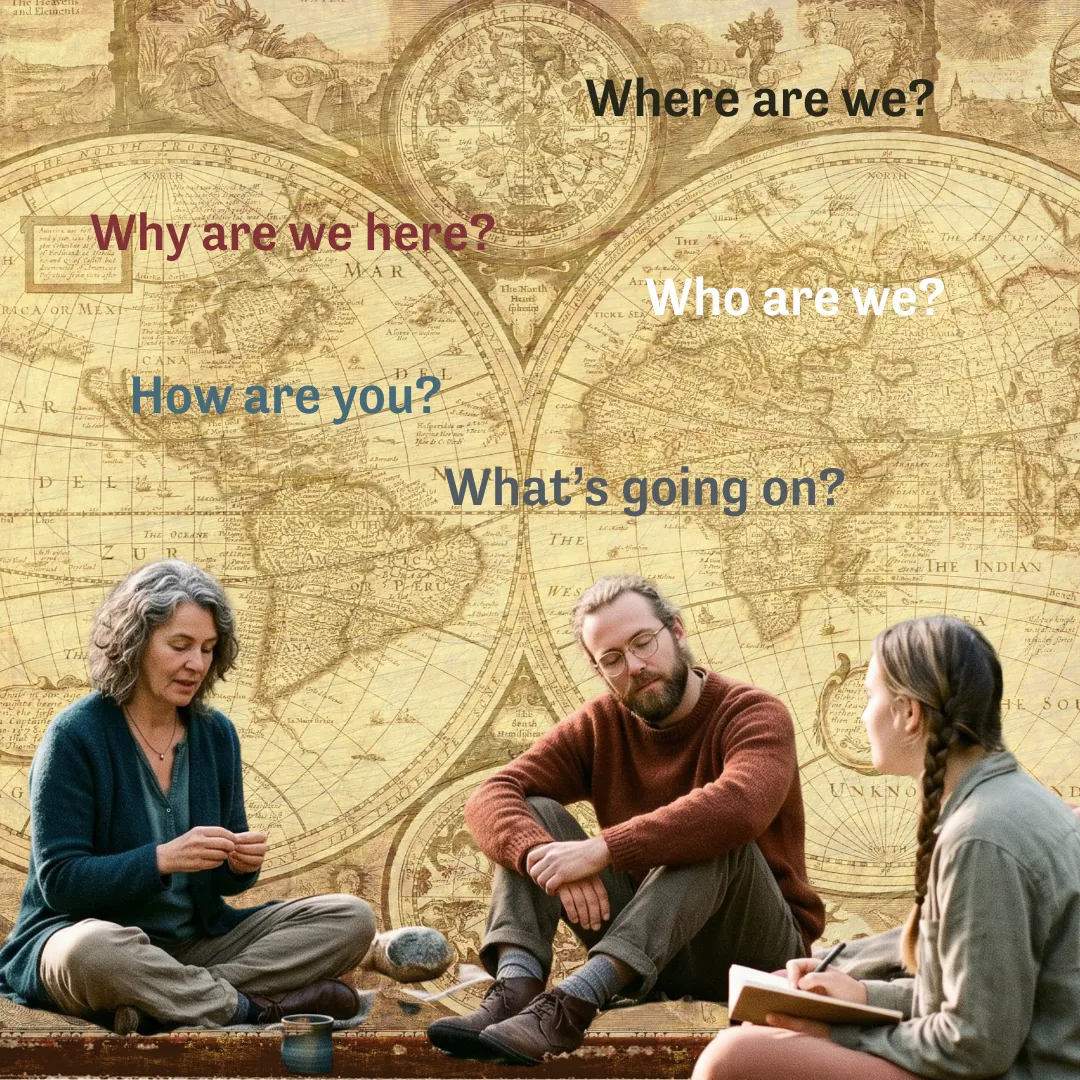
It is a radical re-orientation to religion, philosophy, science, metaphysics, and mysticism. Slow Spirituality suggests that you do not have to “blow up” your life, change your life partner, or move to a monastery to find the groundless ground. It asks only that you pause long enough to look at your worldview or map, get honest about the territory beneath your feet, and investigate with a renewed curiosity, preferably walking with friends, and a guide who knows the way.
The generation of the era of “drugs, sex, and rock and roll” that Ram Dass helped define is finding its way to the grave. A new generation of hyper-connectivity and complexity is emerging. This is the future Agnes inhabits. I will be gone before it is clear what her era will fully bring forth. But, one thing I know for sure, the One Source that all of it springs from will remain constant — like the fire from which heat and light dance, separate from the flame yet intimately one with it.
The Art of Being Human is the current refinement of everything I have learned from the monastery to the marketplace, and from that week of grilling on Maui. We explore five elements of Slow Spirituality. We re-present the Buddha’s case in secular terms. We stop tinkering and start inhabiting.
As I recently listened to a digitized version of those old cassette tapes, I felt an echo of that fire in the nineties. The technology has changed, but the itch for Truth remains.
If you feel that itch-the one that therapy and self-help books haven’t quite reached-I invite you to step into the cauldron with me.
The path to freedom begins when you decide it does. I’ll meet you there.