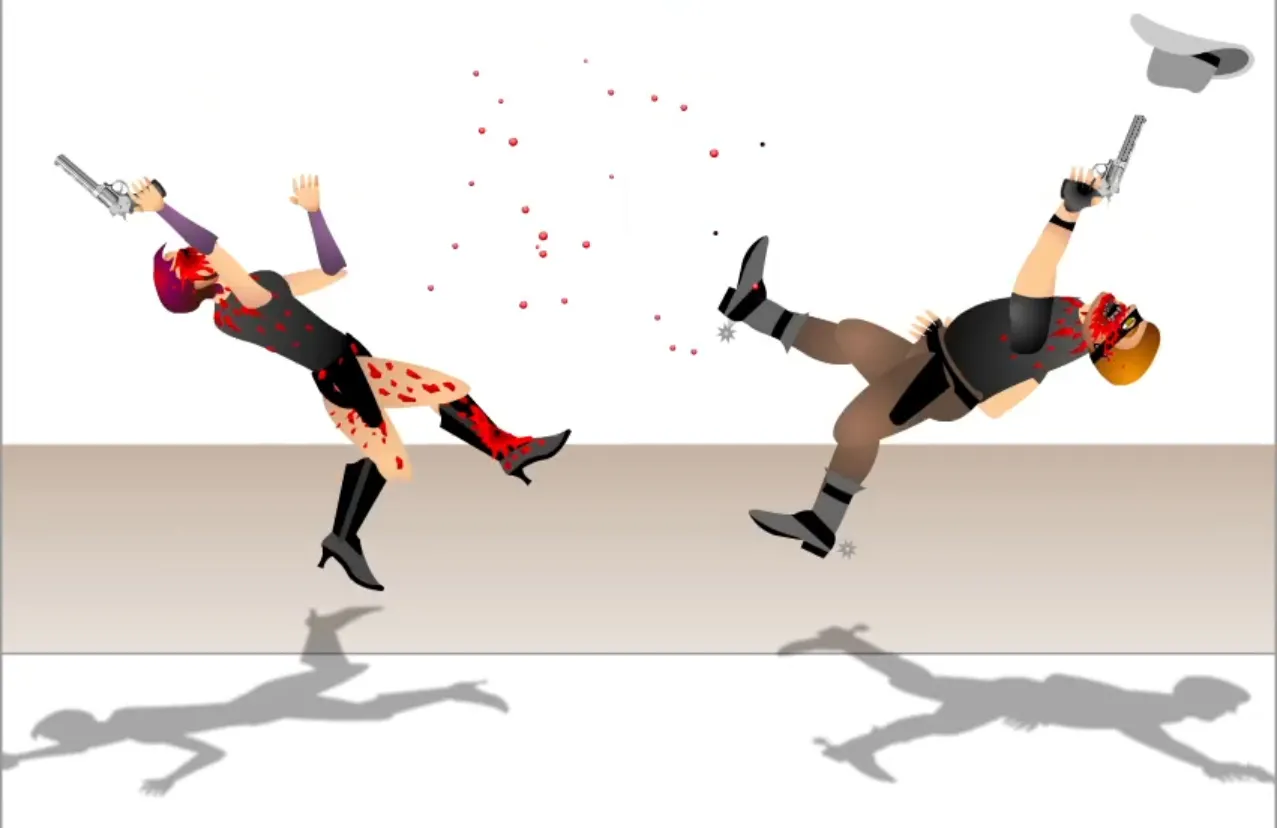
Gangsta Bean; Or, How Flash Games Kickstarted a Career

Taking a look back at Gangsta Bean and Gangsta Bean 2, how they came to be, and where their creator is hanging out now.

December 18, 2007. Newgrounds is alive and well with the sounds of compressed audio samples and popping microphones. Games like Sonny and 13 Days in Hell dominated attention spans, delivering epic RPG gameplay and tense survival horror in condensed, DSL-friendly packages. One game in particular, though, stood out.
Gangsta Bean hit the scene, bringing with it bold outlines, simplistic yet satisfying gameplay, and an inspired set of ideas that flung it directly onto the front page of Newgrounds. It was an honor reserved for the best of the best that Newgrounds had to offer, bestowed by the very same community that endorsed its creation.
But what is this bizarre game? Why is a bean affiliated with a local organized crime outfit? Why is he packing heat? And why is it so good?
In a very special installment of The Wild World of Flash Games, let’s take a look back at Gangsta Bean (and Gangsta Bean 2) with a fun twist. This time around, I got a chance to chat with the incredible artist behind these two Adobe Flash games, Kevin Okulolo (aka Leafworthy), in order to better understand what was going on behind the scenes during their creation.
Thuggin’ It Out in Gangsta Bean

Starting out, we have Gangsta Bean. Here’s the rundown.
The evil Surgeon Peppers is up to no good, and he’s causing trouble in more than just the neighborhood. His newest concoction, Partially Hydrogenated Trans-Fatty Acid, is turning the good foods of the world into corrupted monsters. To put a stop to the madness, and to put Surgeon Peppers down for good, the gun-toting VEH-G team hits the scene, led by the titular Gangsta Bean.
You’ll rumble through two fairly large levels — Don’t Playground and McDeath — while running and gunning. Snack cakes, juice boxes, pizza slices, french fries, and chicken nuggets are all on the prowl, packing heat in the form of handguns, shotguns, submachine guns, and even assault rifles. Though Gangsta Bean is heavily outnumbered, he’s not outgunned.
You’re carrying an impressive arsenal yourself. From the realm of hammerspace, you can pull the very same weapons your foes utilize and then some, with each weapon introducing its own unique quirks. The knife, for instance, is your basic melee weapon. Its range is pitiful, but it comes with the added bonus of significantly increasing your movement speed. Meanwhile, your pistol is fairly standard, but it comes with infinite ammo. Your shotgun slows you down and takes three units of ammunition per shot, but it’s incredibly powerful. You can even call upon the other members of the VEH-G team for a special attack, should you fill up an accompanying meter at the bottom of the screen.
All your guns draw from the same ammo pool, meaning you need to make some special considerations for what to use and when. If you’re lucky, you may even find a substantial upgrade for your knife, which outclasses a lot of your weaker weapons up until the final boss.

Speaking of bosses, they’re nothing short of inspired. Get a load of these:
- Big Brown Bar is a giant Hershey’s chocolate bar that slams into the ground like a wooden plank.
- ICE-E is a play on the titular frozen drink, as he’s sporting a full grill with additional bling while shooting bits of frozen stuff at you.
- Mr. Snicker is a haunting final boss that fights inside of a dark room lit only by a swinging lamp. In addition to being a Snickers bar with spindly arms and legs, he also snickers manically.
It’s all great stuff. The overall presentation is what really sells it, too. Gangsta Bean is loaded with heavy linework, fantastic color choices, dynamic movement, and an overall weightiness that really makes the action pop. It helps that the interstitial cutscenes before level transitions and boss battles look legitimately gorgeous and smooth too, especially for 2007. You can even unlock additional clothing for Gangsta Bean to wear by collecting cash throughout the two levels.
It makes you wonder what exactly inspired such a game. In Okulolo’s words, there’s a lot that went into it.
The Making of Gangsta Bean

For one thing, Gangsta Bean originally began life as a collaborative project. A September 2007 post on Newgrounds made by JoeMax, a representative for MaxGames, formally announced a Flash competition that would pay out over $40,000 worth of prizes to a select group of winners. This drew the attention of Okulolo.
I will say, the actual impetus (or making of) Gangsta Bean was the MaxGames competition. MaxGames.com had some competition where I think the top place was like, $800 or something. But I remember I had already put out a few animations on Newgrounds, and someone had hit me up to collaborate for that competition. I think without that push, I would’ve just stayed on the sidelines of the platform, doing animations.
Despite starting out as a collaborative project, however, Gangsta Bean soon fell into Okulolo’s hands alone.
But I had done enough website work with Flash that I knew the basics of ActionScript 2, and . . . I remember collaborating with the guy and then I started hearing from him less and less. And I was like, “Why am I even hitting him up when I could just do this all myself?” So I literally just took the project on myself and ran with it.
It was something that Okulolo had always wanted to do in some form or another.
I’ve always wanted to make games. Even before animation, back when I was playing Age of Empires and Starcraft, I really wanted to make a real-time strategy game. Now that I am a developer, I know that’s like, literally the hardest thing to possibly do. But that’s what actually got me into it — that, and making fan websites . . . I would gather cinematic art and put it all up on a gallery page on like, GeoCities . . . that was my first foray into this world.

As for what inspired the concept of Gangsta Bean itself, it’s a mishmash of different influences. In addition to drawing from Dragon Ball Z, which heavily influenced Okulolo’s overall art style, one of the biggest influences came from the most unconventional of places: Saturday-morning cartoons. Okulolo cited shows like Captain Planet in particular, as their focus on action with few visceral consequences sparked an itch to see the violence play out in a more realistic fashion. Counter Strike was also a huge contributor.
That’s probably what I stole the most from. Almost the entire control scheme, the way you switch to a knife to run faster, a lot of it — a lot of sound effects were straight up stolen from Counter Strike . . . they got a lot of great sound effects. Between that, Starcraft, and Warcraft, like — I’m not doing explosion foley.
Okulolo went on to describe how the medium of Flash itself had the biggest impact on the final product — a theme that would reappear not only in Gangsta Bean’s eventual follow-up, but in their subsequent game development projects.
I feel like I was largely inspired by Flash’s ability to nest animations within animations. So, like, a lot of what I was attracted to was like, I could animate everything, but then have Gangsta Bean’s face animated on its own. Or add a hat in. Or add a cool vest in. And all the animations would stay the same . . . so I was like, “That I can do.” I remember just spending two weeks thinking of every hat I could put on him and having fun with illustrations.

Okulolo would go on to win 2nd Place in the MaxGames competition, a significant event that further encouraged his artistic efforts.
Growing up as an artist, you get “encouragement” but not like, serious encouragement. People are like, “Oh yeah, that’s a great hobby, but probably you should be a dentist or something.” But this was like, the first like, “Hey, I made money with my art, that’s crazy. I could actually do this.”
Not only that, the personal involvement of Newgrounds’ founder, Tom Fulp, gave Okulolo another boost. This was after Fulp previously supported Okulolo’s The Story of Khale, a series of animations produced between 2006 and 2008.
Tom was a huge supporter for me. He sponsored, I think, both of the Gangsta Beans in the end. . . and he sponsored The Story of Khale also. He was behind me the whole way, he was great.
It was by placing so high in the MaxGames competition that Okulolo eventually drew the attention of another company — AddictingGames, a subsidiary of MTV Networks at the time. They came to Okulolo with a humble offer:
“Would you like to make a sequel?”
Staging a Comeback in Gangsta Bean 2

Gangsta Bean 2 debuted only a year later in 2008, bringing with it a substantial upgrade in. . . well, just about everything.
Mere seconds after the events of the last game, Gangsta Bean flees the burning remains of McDeath, leaving Surgeon Peppers and Mr. Snicker to die in the ensuing hellfire. Unfortunately, Mr. Snicker isn’t one to quit so easily. It’s quickly revealed that Mr. Snicker was the one that destroyed the building, riding the bloodied corpse of Surgeon Peppers to safety in the process.
Meanwhile, the VEH-G team is enjoying a night of patrolling the streets, yucking it up before a mysterious figure snatches one of the team members away. It’s quickly revealed to be — you guessed it — Mr. Snicker. Eager to get their friend back and kill Mr. Snicker once and for all, Gangsta Bean and co. strap up once more for an adventure far larger than its predecessor. But this time, he’s not doing it alone.
Gangsta Bean 2 is an evolution in every sense of the word. You now have the choice of playing as one of three characters (Gangsta Bean, newcomer Brock Lee, and the returning T-Mato), in addition to utilizing a much larger move set. The gameplay also saw a significant revamp. You can now manually aim using the mouse, you can unlock additional skills and upgrades with accumulated experience points, you can get stat upgrades from the clothing you buy, and there are now several levels that you can freely pick between:
- Milk Land: Home to the nefarious Masta Moo in addition to gun-toting snack cakes, dangerous yogurt cups, and strange underground creatures.
- Kandy Kingdom: Belonging to King Kandy Kane, this ultra-sweet landscape houses marshmallow bowmen, exploding gumdrops, and heavily-armed leprechauns.
- NRG Factory: The most industrial of the three settings, this elaborate factory features ravenous dogs and dangerous machinery, with Crimson Buck serving as its muscle-bound leader.

After you complete all three levels, you’ll then be treated to a final boss fight with one of three endings, with the game’s best ending being tied to its hardest difficulty. This means that you’ll have to beat Gangsta Bean 2 at least three times to see everything there is to do.
Get Sean Michael Shuman’s stories in your inbox
Join Medium for free to get updates from this writer.
Is it worth doing? Seeing as how it’s an Adobe Flash game, and my total playtime across all three difficulties was just over an hour, I’d certainly say so. Besides, there’s enough new stuff going on here that justifies Gangsta Bean 2’s expanded scope.
Is it more fun? Sure. The sheer variety you get in the levels, the massive ramp up in environmental details, the parallax scrolling, the new enemy designs, the verticality, and the larger arsenal all make for something that expands upon a solid base. There are even some platforming sections here and there that, albeit briefly, introduce some new challenges to juggle while fighting enemies.
The additional replayability granted by the endings also encourages you to engage with its leveling system. The skills and upgrades you accumulate are downright essential for just getting through the regular levels, let alone fighting bosses, and you’ll eventually enter a power creep so strong that you’ll melt just about anything you so much as look at. It makes the struggle in getting to that point all the more satisfying, and it makes getting the true ending a lot more enjoyable as a result.
It’s a sequel that really went wild with what it wanted to do. But how did Okulolo meet the challenge?
The Making of Gangsta Bean 2

Gangsta Bean 2 was even more of a tremendous occasion for Okulolo.
Working with AddictingGames was an entirely different experience. . . all of a sudden, I’m talking to real corporate lawyers, and like, negotiating the actual contract with milestones and s***, like, it got crazy. But they put a lot of money into it, and for the first time, I got to quit my job. I was just working on this, and making a living. I got my first car because of Gangsta Bean 2. It was huge. It changed the trajectory of my life. I probably would’ve gone [into] a completely different career if it weren’t for this popping off.
Of course, there were some technical challenges to overcome. I asked about the infamous instability of Adobe Flash as a production tool, and suffice to say, its reputation isn’t all that exaggerated.
Flash was like an abusive boyfriend. It had so much to give and was so mean so often. I remember the first time I animated episode one of The Story of Khale, I animated like, 75% of the animatic straight in a beautiful burst of inspiration. And it crashed. And I literally lost the entire thing. I had to take a few days cause like, I had poured everything into that and immediately restarting on art that you just made is such a spooky feeling. Like, “Ah, I did it better last time” — it’s never exactly the same.
Okulolo was never immune to the infamous crashes Flash would become associated with.
I’ve never had any program crash on me as much as Flash had. Flash would crash, and then would crash while reopening. There’d be days where I had to just, like, pray to the Gods, and I’d open the project ten times in a row, and only the tenth time would it work.
Even with these troubles, however, Gangsta Bean 2 ended up as a tremendously fun game. It’s a progenitor of sorts for what would come later in Okulolo’s career, as many of the same kinds of creative challenges they faced in its production would reappear in other forms throughout the coming years. This was especially true for their work outside of Flash games.
A Post-Gangsta Bean (and Flash) World

After the completion of Gangsta Bean 2, along with a handful of smaller Flash animations released in 2009, Okulolo’s public presence on Newgrounds significantly diminished. On the surface, one could imagine that they simply moved onto other things, much like many of the original Newgrounds alumni had as we entered the 2010s. However, while Okulolo hadn’t posted as much, they were still very much active professionally.
For instance, Okulolo made the best of an ordinary corporate job by taking on an unconventional challenge.
After Newgrounds, which was essentially during my college time, I got my first job at a startup. I told stories about an email organization app, which was like, possibly the most boring thing to talk about possible. But like, that was a really interesting challenge. How do you make something super boring kinda interesting?
Some time after, Okulolo took on even more unique challenges.
Then I worked at a place called Free Range. They were a creative agency that worked largely on non-profit causes and social change movements, a lot of like, really passionate people talking about actually important stories, which was an interesting change. To talk about like, real-life issues, environmental problems, trying to tell earnest stories was very interesting. Especially coming from a place where like, largely my stories were fantasy-based or comedic in some way.
For a time, Okulolo even provided content for Discord, the popular instant-messaging platform, creating a handful of spectacular animations in addition to producing a pair of games (Discord Item Shop and Discord Jr.) for the company.

Though they had spent some time away from Newgrounds, there was something about the website that kept them coming back.
There’s nothing like — especially having been a professional now for like, almost 15 years — there’s nothing like just putting something out directly to people. The amount of like, meetings I go through that have to get confirmation on each little f****** artistic detail. . . I can just make something exactly how I want it and just put it out there. That was what was amazing about Newgrounds. There was nothing to stop you. Even their content regulations, it wasn’t much. You could pretty much put anything on Newgrounds.
That said, when a particularly scary announcement came in 2017, everything changed. Adobe Flash was officially in its end of days, with support for the software looking to be completely discontinued by the end of 2020.
It was a huge event, I’m not gonna lie. I remember even, I was at work, and somebody was like, “Dude, have you seen the letter?” What do you mean? Flash can’t be dead, what do you mean? And it was that day, we were like, “Oh s***, we need to move over to After Effects. This isn’t gonna work out anymore.” Because we had been using Flash with After Effects for a long time.
For many artists, Adobe Flash made up a significant portion of their overall workflow. This included Okulolo, who had to find a way to not only pivot to a brand-new tool, but find a workflow that can utilize it as well.
Flash, for a bit, could render video, and then it kinda sucked at it. So pulling an .swf file into After Effects, you could work with it like it was a regular video. But when all this happened, they stopped supporting that for a little bit. And I remember that was our whole workflow: bang it out in Flash, and put cool touches on it in After Effects. I remember having whole meetings about it: “What are we gonna do?”

Instead of lamenting the death of Flash, however, Okulolo viewed it as an opportunity to further their own professional development. Their own prior experience with After Effects effectively prepared them for a workflow that was not only more powerful than Flash, but much more efficient as well.
For me, professionally, it was a great challenge. Suddenly, I had all of these new options. . . you’re no longer bound to that vector style. And so, in some ways, it was a great “freeing” event where, having been constrained and found every possible exploit for the vector world I could, being thrust into the raster world really did wonderful things for my skill set. It was rough at first, because it really has never been any easier to use than Flash, probably still. . . but After Effects, the level of programming you can do to save time, it’s powerful in an entirely new way. So if that hadn’t been there, I literally don’t know what I would’ve done to pivot.
The death of Flash meant that Okulolo could now freely explore other creative avenues, not only growing their own skill set further, but allowing for the exploration of brand-new art styles, storytelling concepts, and other fruitful endeavors. This included their work with Unity, a popular game development engine — and the current engine powering their most ambitious project yet.
Gangsta Bean 3?

Fortunately, those who still remember Gangsta Bean have plenty to look forward to. Okulolo hasn’t abandoned the idea of a potential sequel. In fact, they’ve happily been working on one in seclusion.
I’m still working on Gangsta Bean, I’m not gonna lie. I have Gangsta Bean 3 — I’ve been working on it for years now, it’s playable, but it’s not something, like, releasable. But that’s still my world. My art is still in the Newgrounds type of, “Let’s make something really cool and weird.”
It promises to be the most ambitious game in the series yet, being a culmination of many years of off-and-on development, experiments in Unity, and more.
I’ve spent probably 4–5 years tinkering — it sort of reminds me of like, you know when old dads have like a Ford Chevy that they’ve been working on? And like, you know it’s never really gonna drive, but the working is the fun part? That’s how I feel about it at this point. I’ve used it to learn everything I can about Unity, I’ve pushed the engine in a million ways.
One of these ways was their pivot to pixel art — a common art style found in both indie darlings and retro throwbacks alike. But the switch up was more than just an aesthetic decision. Much like how Flash shaped the creation of Gangsta Bean and Gangsta Bean 2, Unity and the efficiency of modern production tools gave Okulolo a welcomed reprieve.
The pixel art craze right now in the indie dev world is, I think, largely a necessity. I think what pixel art does is what Flash was doing, as far as limiting you and forcing you to make clear decisions. Like, a pixel either is there or isn’t. And so like, you have to dedicate to something, versus like, a sketchy pencil line could be kinda there, you know? A pixel either isn’t there or is. . . it’s a way to have something look finished very quickly. There are palettes out there already made, so you can make it look good no matter what. And it’s just faster. I made the animations for Gangsta Bean in this new game probably in like a week or so? For every animation he could possibly need. I can’t imagine producing it in any other way that quickly.

Due to their current circumstances, Okulolo has also been able to more freely explore the current landscape of indie games in their free time.
Playing games again has been huge, for maybe 10 years I did not really play games. I, at a certain point, hit a wall with games because I got repetitive strain injuries in my arms from working all day on a computer, and then going home and playing games on a computer all night. It turns out adult bodies aren’t meant to do that. So like, for a long time, I just didn’t play games. But getting back into it, there’s so much cool s*** now, especially in the indie world where it’s still allowed to be pretty weird.
Games like Project Zomboid in particular really stood out to them, as the isometric camera angles, the lighting system, and other mechanics present there partially inspired similar mechanics currently in development for Gangsta Bean 3. Seeing how other developers managed to tackle alike problems and challenges was incredibly educational. Okulolo went on to describe how the ease of accessibility for modern development tools, as well as the community resources that formed around them, really allowed for a level of creativity that feels unmatched compared to what came before.
A lot has changed in the almost two decades since Gangsta Bean originally debuted. Adobe Flash has largely been supplanted by mobile games and browser games powered by Unity. The indie scene is more popular than ever, with more and more developers and players alike turning towards it for brand-new games. Even in the animation space, open source tools and more specialized products have been able to accomplish what Flash was jerry-rigged into doing.
Though Gangsta Bean may just come off as a crude Flash game to most, it was the start of something much bigger. What was just a fun time killer for the end user was the catalyst for a career in animation, motion design, and even game development. If you have the drive and the skill to put yourself out there, there’s almost no downside to doing so. If you find the right environment to succeed, you’ll be able to do tremendous things.
Even just working on [Gangsta Bean 3] in seclusion, it’s so fun. I love making games. I’m so glad Newgrounds gave me a reason, it’s so nice to just have like, one more reason other than, “I really want to.”

Both Gangsta Bean and Gangsta Bean 2 can be downloaded from Kevin Okulolo’s official website. In addition to finding the rest of Kevin’s published work there, you can also follow their Instagram and Cara pages for some fantastic art and potential updates for Gangsta Bean 3. Be sure to keep an eye out for the next installment of The Story of Khale as well.