On the USWNT’s 2–2 draw with Spain

Well, that was fun! Kind of!? Right guys!? Maybe? Yeah, fun, but in a sort of profoundly scary way? Good. Excellent.
I am, of course, talking about the US women’s national team’s two friendlies with Spain, producing a defeat in game one and a glorious come-from-behind 2–2 draw in game two.
Here I’ll focus on game two, my analysis of the match but also some of the themes and storylines around it, as well as questions from Bluesky. Thank you for those, by the way.
Where the US defence worked, sort of
Since taking charge two years ago, Emma Hayes has preferred a 4–4–2 zonal block, with some player-to-player focus in there.
In this game the line-up was:
- Goalkeeper: Phallon Tullis-Joyce
- Defence: Emily Fox, Kennedy Wesley, Tierna Davidson, Gisele Thompson
- Midfield: Trinity Rodman, Claire Hutton, Lindsey Heaps, Ashley Sanchez
- Attack: Rose Lavelle, Sophia Wilson
Let’s separate the defending in open play from the defending at goal kicks and restarts from Spain’s goalkeeper.
When Spain restarted play from the goalkeeper, the US stepped up and tried to match up, with the central midfielders joining in to mark their direct opponents. Generally, I thought this worked quite well in disrupting Spain’s rhythm, forcing them into long balls and duels.

However, while the initial results of that press were positive, I don’t think the US capitalised enough on those moments.
Whether it was failing to win the first ball, or the midfielders failing to get back to collect the second ball, these situations surprisingly didn’t always work in the USWNT’s favour.
Where the US defence struggled
Now for the defending in open play, when Spain had established possession. I thought this was a real struggle, as it was in game one.
Spain’s basic attacking approach is to outnumber in midfield, to get one or two extra players around the ball. They are extremely comfortable receiving ball to feet, even under pressure, and playing one- and two-touch with one another.
There is the basic style of play, but also the synergies between players who have spent years together at club and international level, plus the fact that Spain have a deep-rooted footballing identity, meaning it’s easier for players of different clubs to strike up a working relationship.
I often find this forces the opposition into extreme defensive measures — either you:
1) Sit off and completely renounce possession, get 9 or 10 outfielders back to defensively outnumber them, and look to counter-attack from deep. Sort of like England at Euro 2025. Or,
2) Do what Brazil did at the 2024 Olympics and go player-to-player, matching up formations to stop Spain outnumbering you, creating lots of one-on-ones and disrupting their rhythm.
The way Hayes sets up the US here is a sort of halfway approach between the extremes, zonal but trying to trap Spain or press them early, before they are camped in your half.
- To explain my concerns about this approach, I’ll use a boxing metaphor.
- You can beat Spain by running around the outside of the ring, evading and picking your attacks wisely (England), or by getting inside on them and not letting them dictate the tempo (Brazil).
- Hayes’ halfway approach, however, feels a bit like the football equivalent of standing at mid-range and trading punches with Mike Tyson.
The US got opened up consistently by Spain’s ability to outnumber the central areas, with the first two lines of defence broken or outmanoeuvred too easily, too often.

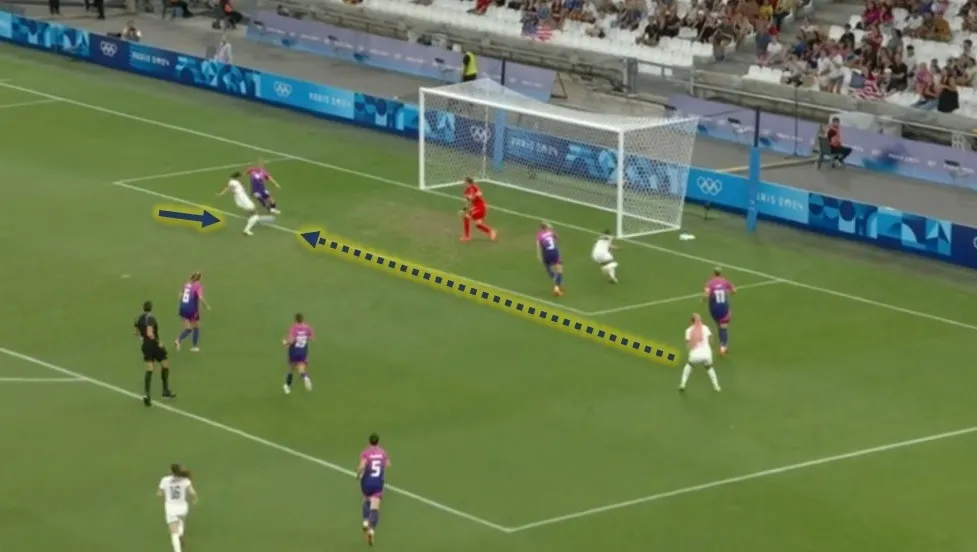
At times this was just a momentary lapse in concentration. Spain’s opening goal is a good example.
The US front two go to press, but the midfield aren’t there to back them up. Spain play into midfield, then through the midfield.


Salma Paraluello drops off the front line, drawing Gisele Thompson out, and lays the ball off. Clara Serrajordi rotates into Paralluelo’s position unmarked and receives.
Tierna Davidson has to close down Serrajordi, meaning two of the US back four are out of position.

When the cross comes in, the US back line is overloaded 3-v-4, and one of Spain’s runners from midfield, Alexia Putellas, puts the ball in the net.
Notes on Kennedy Wesley
I thought Kennedy Wesley’s performance in this game was outstanding.
With the first two lines of US defence so often bypassed, there was a lot of responsibility placed on the centre-backs to close down threats between lines. Wesley did that well, putting out a few fires and winning plenty of duels.
Wesley is a front-footed, aggressive defender. She plays this way for San Diego and here, in just her ninth cap, she brought the bravery, commitment and decisiveness we so often see at club level.
When I think of a USWNT defender, this is the sort of profile that comes to mind. Diligent, focused, unapologetically physical. Who knows, maybe some of Spain’s forwards will think twice when receiving back to goal when they next play the US?
What about the attack?
One thing I noticed about the US in game two that looked different to game one was Emily Fox’s position in build-up. She seemed to play much closer to Wesley, to my eyes.
Spain press in a 4–1–3–2 that is quite unique to Spanish football. Juan Carlos Amoros brought it to the NWSL with Gotham, and I’ve seen Barcelona have great success with it.
Basically, this involves one midfielder joining the striker in pressing, and another midfielder joining the wingers as a unit of 3, shifting side to side to mark the deepest opposing midfielders and close down the full-back in possession.

Fox playing a bit deeper, almost as a third back in a line with Wesley and Davidson, meant Spain couldn’t simply press the centre-backs 2-v-2. And Fox’s closer position to Wesley meant she could receive at shorter distance, giving Spain’s winger less time to press forward on her.
Get Second Ball’s stories in your inbox
Join Medium for free to get updates from this writer.
The implication on the other side was that the US left-back, Gisele Thompson, was enabled to push forward more. And that in turn meant that Ashley Sanchez could play inside, in a similar role to Rose Lavelle.

Thompson got forward on the overlap brilliantly in the 43rd minute, showing great timing and acceleration. However, as a natural right-footer, she turned back onto her right foot before crossing.
Instead of an early cross into the danger area with Spain’s defenders running back towards their own goal, there was a high in-swinger against a set Spanish defence now ready to attack that ball and clear their lines.
Can Thompson work on her left foot? Can Avery Patterson? If not, this will affect the dynamic of the US attack on the left side a little bit. One wonders if Evelyn Shores will get a look-in at some point, given her left-footedness, not to mention the quality of her distribution in NWSL play this year.
In general, I thought the US final ball was a big factor in this game, in a bad way. There were four or five occasions where players got open running against the Spanish last line, only to fumble the pass. A potentially dangerous attacking play then became Spanish possession.
These are big moments in these particular games and that last pass needs to be sharper. It could be the difference between victory and defeat.

Notes on Ashley Sanchez
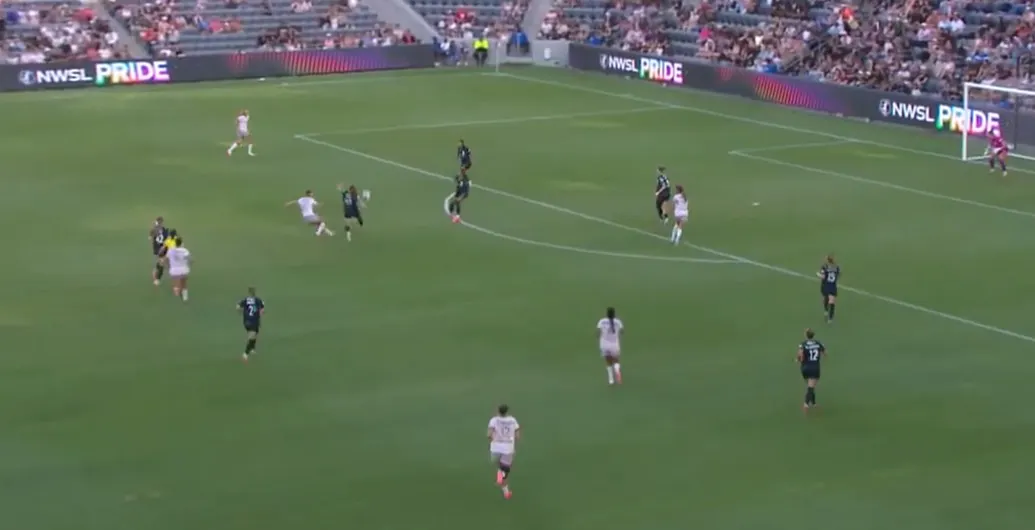
Sanchez has been sensational for North Carolina in the NWSL, scoring goals for fun having incorporated more runs behind into her game. She got the start in game two against Spain and scored her team’s first goal, feinting brilliantly to throw off Ona Batlle and open some room to find the far corner of the net.
My question is: Should she bet on herself more?
There were a couple of times in the first half where Sanchez moved the ball on to a teammate quickly, when she had space to drive into.
She’s a wonderful dribbler with top close control and trickery, and I believe she could perhaps have taken the attack on herself a bit more in these situations. Get the defence backpedaling, take space and look to shoot or play in a teammate closer to goal.
This was Sanchez’s first start for the US in two years, so I understand if she would want to ingratiate herself within the team, if there were some nerves or if there was some lack of synergy with teammates. But she should watch her goal over and over again. She doesn’t need to service the attack, she can drive it too.
Trinity Rodman: A rebuttal to Attacking Third
I listen to the Attacking Third podcast regularly and am a fan of the show. However, I must take issue with one of the segments in their post-match show, regarding Trinity Rodman. I won’t repeat word for word what was said, but I found it to be exaggerated to the point of being distasteful.
The basic premise is that Rodman showed bad body language in this game. McCall Zerboni called this “disrespectful to the badge”. I respect Zerboni like the rest of the panel, as they are all former players with a great deal of experience, but this was poor form in my opinion.
Rodman was tasked with an extremely demanding role as Spain like to push their left-back forward. Rodman did a fantastic job — FANTASTIC — of controlling those overlapping runs from Medina. And when Spain built their attack on the opposite side, Rodman was on hand to fill in at the far post too.


This was a vital defensive role, as it allowed Fox to narrow in, offer extra cover to the centre-backs and pick up central runners.
Without Rodman’s defensive application, I genuinely think Spain could just about have picked their score in this game.
What did her role involve? Well, defensively, Rodman had to basically run back three-quarters of the length of the field. And then she had to make that run again to support the attack.
These are long runs, big distances, sprints back and forth. Not to mention putting your foot in defensively. And then there is an expectation to provide those fast-twitch, explosive moments in attack: change of pace, change of direction, powerful shot.
Physically, Rodman’s role was arguably the most demanding on the team, not just for the volume and distance of runs but the different types of movements she had to perform. But she did a great defensive job for the team.
Towards the end of the first half, I noticed her attacking actions weren’t as sharp. She bent over at one point and tiredness may have affected her decision-making on the ball. Ultimately, she was subbed off around the hour mark for Michelle Cooper.
There is an obvious reason why Rodman’s body language changed and I won’t be subtle about this: She was f**king knackered!
Rodman’s playing a different role than for her club, and it’s tough work. But she put team before self. To even remotely question her attitude suggests the panel, particularly Zerboni, did not pay attention to Rodman’s performance. Thankfully, Darian Jenkins added some balance, correctly mentioning “mental exhaustion” as a possible factor.
Fatigue can be physical but also mental and tactical. Rodman probably had a bit of all three given the shift she put in.
Change of formation: Food for thought?
A brief note on the change of formation midway through the second half. Or at least, what looked to me like more commitment to the three-back.
As the second half went on and subs were made, the US increasingly looked shaped in a 3–4–1–2, with three back, three in midfield, two wide players and two strikers. This got extra numbers through the centre of the field and seemed to make it easier for the US to apply pressure in there and to pick up second balls.
Will Hayes consider this if the US meets Spain at next year’s World Cup, or will she stand by the 4–4–2 / 4–2–3–1? Plenty of food for thought for the head coach here.
Stress exposure and psychological warfare
With Chelsea, Hayes had a habit of managing her squad brilliantly, to keep them fresh season-round and allow them to power through at the end when others had injury crises or other issues.
Why is Hayes rotating players so much and trying out different selections? If I had to guess, this would be a sort of stress exposure, to give players difficult experiences now, to learn and steel themselves in advance of the World Cup.
This 2–2 draw should help develop the idea in players’ heads that Spain are not invincible. They can be gotten at, and that memory could prove useful next summer.
Hayes has, however, firmly positioned her side as underdogs in relation to the Spanish, ignoring the fact Spain have failed to win either of the last two major competitions they entered: the 2025 Euros and the 2024 Olympics.
While Hayes has always admired and respected Spanish football, this could also be interpreted as some sort of psychological warfare, to put pressure on Spain and take it off particularly her newer caps and younger players. If so it needs to be carefully managed both internally, to not create inferiority complex, and externally, where a demanding fanbase might baulk at the notion of being second-best.
(Who knows, though, maybe I’m wrong and this stuff won’t matter at all!)
Questions!
Thank you to Southern Sylvs (@southernsylvs.bsky.social) who asks:
Is there any world where the US, based on the talent pool, can play well without a 6? If not, why does Hayes insist on doing so for at least one match?
I think this is referring to game one, where Hayes lined up a midfield of Heaps, Yohannes and Lavelle. No natural, out-and-out defensive midfielder there.
My take is yes, I do think the USWNT can play without this profile, but only in specific situations. As an example, if they build up with a three-back, with Emily Fox alongside two centre-backs, I think that provides a nice safety blanket for a more creative, risk-taking midfield setup.
As for Hayes’ intentions in game one against Spain, my best guess is that she wanted to stress test a short passing game against one of the world’s best pressing teams. Spain get credit for their pass-and-move play but their pressing is elite too. So maybe Hayes wanted to see what happened when the US set up to play out against that press, with a natural attacking midfielder/goal threat in Heaps and a velvet-touch playmaker in Yohannes.
And thank you also to Ninjahipypirate (@ninjahipypirate.bsky.social), who asks:
Im sure im not alone, but what is with the backline letting that first goal? What changed in the 2nd half?
I do cover the first goal in my second defensive section if you want a detailed breakdown, but basically it’s the first two lines (frontline and midfield) not stopping Spain from playing through. Spain then rotated some players in attack, dragged two US defenders out of position, and overloaded the back line 4-v3 on the cross-in to score.
As for the second half changes, it looked to me as if Hayes simply leaned into the three-back, bringing on Alyssa Thompson on the left. It looked to me like a 3–4–1–2 and meant more numbers through the centre of the field. I thought it worked quite well, but Spain perhaps tired as well and by that point didn’t have their best team on the field.
Thank you for reading! If you’d like to get in touch, I’m on Bluesky @secondball.bsky.social