When Beauty Brands Share Manufacturers, What do they Actually Own?

For a few days, three enormous beauty brands appeared to have arrived at almost the same product idea at almost the same time. Fenty Skin, Glow Recipe and Huda Beauty all revealed under-eye patches with remarkably similar twist-and-dispense concepts, and before the internet had finished deciding who had copied whom, people had already found an earlier version from Korean brand Wonder Bath.Naturally, social media had fun with it. The brands joined in, memes followed, and what could have become an awkward conversation about originality turned into several days of very good marketing. But I was less interested in who had used the packaging first than I was in what the moment revealed about how beauty products are actually made.

The beauty industry often encourages consumers to imagine that every new launch begins inside the walls of the brand whose name appears on the box. Sometimes it does. Often, however, the reality is much more interconnected. Brands may use the same contract manufacturers, work with the same formulation houses, buy from the same packaging catalogues, attend the same trade shows, speak to the same ingredient suppliers and receive presentations on many of the same emerging formats.
Once you understand that infrastructure, it becomes much easier to understand why entire categories sometimes seem to move together.
There have been periods when every brand appeared to be launching a gloss at once. Then came similar lip oils, cream blushes, complexion drops, jelly textures and other formats that seemed to emerge within remarkably compressed timelines. Trends obviously play a role, because brands watch consumer behaviour closely, but there is another part of the story that receives much less attention: many brands are developing products within overlapping manufacturing ecosystems.
A contract manufacturer may spend months developing a base formula, texture or product concept before presenting it to several clients. One brand might change the colour, another the fragrance, another the active ingredients, another the packaging, and by the time all of them reach the market they can appear to consumers as separate innovations even though parts of their technical origin may be closely related.
There is nothing inherently wrong with this model. Contract manufacturing allows brands to launch products without investing millions into laboratories, equipment, technical teams, quality systems and manufacturing facilities. It lowers the barrier to entry enormously, and there are exceptional contract manufacturers producing technically sophisticated products.
The problem begins when a brand mistakes access to a manufacturer for ownership of product development.

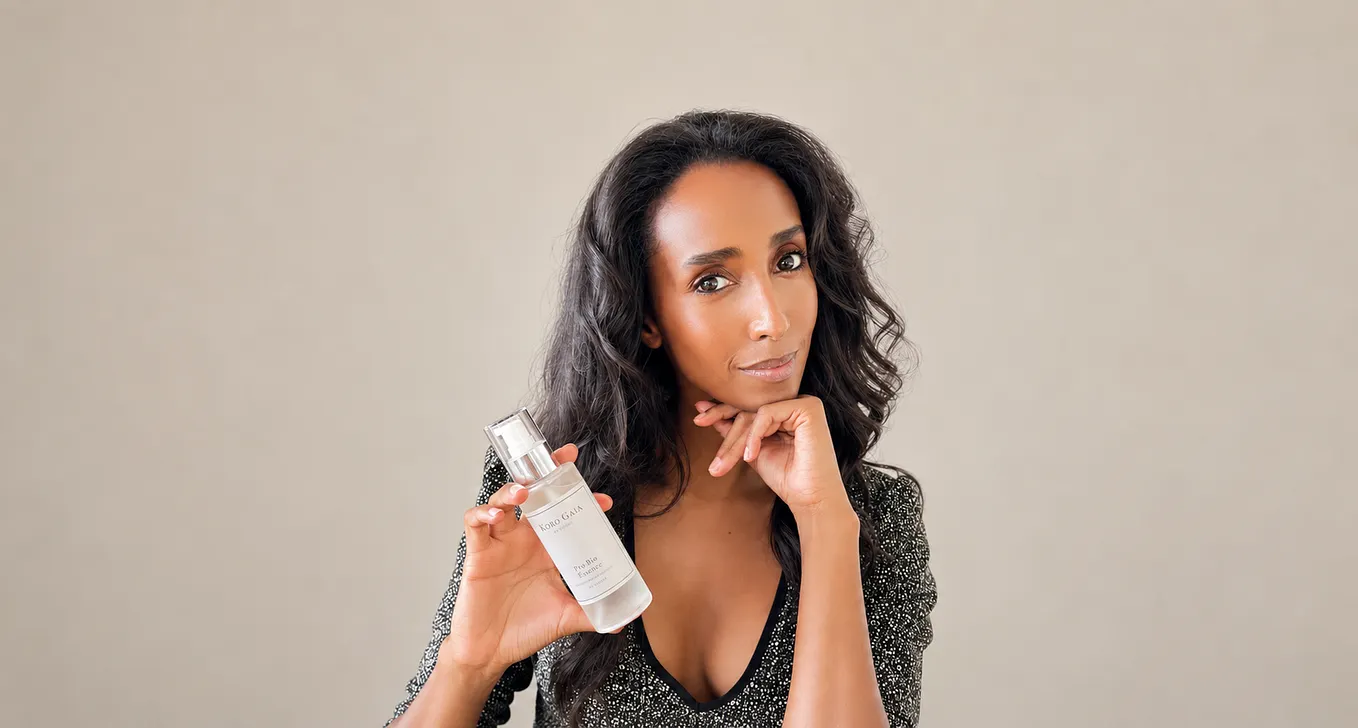
For me, this distinction has become increasingly important while building Koro Gaia. I am much less interested in chasing whichever format happens to be receiving attention that year than I am in understanding whether the formula itself is doing what we need it to do, particularly for melanated skin.
My starting point is rarely, “What are people launching right now?” I am much more interested in what problem we are trying to solve, how irritation may influence that problem, what delivery system makes sense, which ingredients can support each other, what concentrations are appropriate, what pH the formula needs to operate within where relevant, how stable the system is, how the ingredients interact and whether the finished formulation remains elegant enough that someone will actually want to use it consistently.
That difference matters because consumers are frequently taught to judge skincare through headline ingredients. Niacinamide. Vitamin C. Retinol. Tranexamic acid. Kojic acid. Azelaic acid. But the presence of an ingredient tells you remarkably little about how good the finished product is. Concentration matters, but even concentration is only one part of the formulation. Stability matters. Solubility matters. Delivery matters. Compatibility matters. Supporting ingredients matter. Preservative systems matter. The environment surrounding the active matters.
For melanated skin, I think that level of formulation attention becomes especially important. Darker skin is still inadequately represented in a great deal of cosmetic research, while concerns such as post-inflammatory hyperpigmentation mean that irritation can have consequences that extend well beyond temporary redness. That has influenced how I think about product development from the beginning. The goal is not simply to place an ingredient associated with pigmentation into a bottle. The goal is to build a complete formulation around tolerability, efficacy, stability and repeated real-world use. This emphasis on formulation architecture rather than hero-ingredient marketing is also central to the way I want to talk about cosmetic science publicly.
It is also why I increasingly believe that one of the most important things a beauty company can eventually own is its R&D capability.
If your manufacturer owns the formula, the technical expertise and the manufacturing process, then your competitors may be able to walk into that same ecosystem and access something very similar. They may not receive your exact product, particularly where exclusivity agreements exist, but they can often access comparable technologies, textures, delivery systems and formulation approaches.

When you develop technical capability internally, the relationship changes. Your manufacturer stops being the source of your product intelligence and becomes one part of a larger system you control. Your team can brief differently, test differently, reject differently and iterate differently because the knowledge is sitting inside the company rather than entirely outside it.
Get Shamim’s stories in your inbox
Join Medium for free to get updates from this writer.
Owning manufacturing takes that even further. It gives a company greater control over formulation development, scale-up, process parameters, quality, experimentation, production timelines and ultimately the speed at which technical knowledge compounds.
That does not mean every beauty startup should immediately build a factory. Manufacturing facilities are expensive, operationally difficult and heavily dependent on quality systems, regulatory discipline, equipment, technical staff and consistent production volume. For many companies, contract manufacturing is not only practical but commercially intelligent.
But there is a difference between using external manufacturing strategically and outsourcing the entire technical brain of the company.
For Koro Gaia, building formulation and manufacturing capability has always been part of the larger ambition. We want to understand the products we make at the level of the formula itself, not simply at the level of the claim appearing on the carton. That becomes even more important when the consumer we are designing for has historically been underrepresented in the research used to make formulation decisions in the first place. My work has increasingly centred on cosmetic formulation for melanated skin, product development, manufacturing and the relationship between all three.

The same principle applies far beyond one company. It is also part of how I think about the future of African beauty.
We already talk extensively about the extraordinary raw materials found across the continent: shea, marula, baobab, frankincense, myrrh, gums, oils and hundreds of botanicals with long histories of traditional use. I am deeply interested in those materials, particularly East African botanicals, but supplying the ingredient is only the beginning of the value chain.
Someone still has to extract it. Someone has to standardise it. Someone has to understand its chemistry, establish specifications, test stability, study compatibility, formulate with it, manufacture the finished product and build the consumer experience around it.
The greatest commercial value does not necessarily sit with whoever grows the plant. It often sits further downstream with whoever owns the technology, the formulation knowledge, the manufacturing infrastructure, the intellectual property and eventually the brand.
South Korea understood this extraordinarily well. The strength of K-beauty is not simply that Korean companies are good at spotting trends. Behind the brands sits an enormous technical ecosystem of ingredient developers, formulators, original design manufacturers, contract manufacturers, packaging suppliers, testing laboratories, machinery companies and manufacturing specialists. That infrastructure means the country does not only participate in beauty trends. It helps determine what products the rest of the world is able to launch.
That is the part of the conversation around African beauty that interests me most.
I do not want Africa to simply become a more fashionable source of ingredients while the extraction technology, formulation knowledge, manufacturing value and intellectual property continue to sit somewhere else. I want more of the laboratories here. More cosmetic chemists. More ingredient processing. More formulation research. More testing capability. More manufacturing facilities. More people who understand how to move from a botanical growing in the ground to a reproducible ingredient specification, then to a stable formulation, then to a product that can be manufactured at scale.

And I want more African beauty companies to reach the point where their technical capability becomes part of their competitive advantage.
Packaging can be copied. Trends travel quickly. A popular texture can appear across several brands within a year, and a component that looks completely new to a consumer may already have been sitting inside a supplier catalogue for months.
Technical knowledge compounds much more slowly.
That is why I am less interested in whether Koro Gaia is the first brand to use a particular package, texture or fashionable format than I am in whether we are becoming better formulators, better manufacturers and better students of the skin we are developing for.
For me, the most defensible beauty company is not necessarily the one that launches the most visibly original product. It is the one that keeps getting better at making things other people do not fully understand how to make.