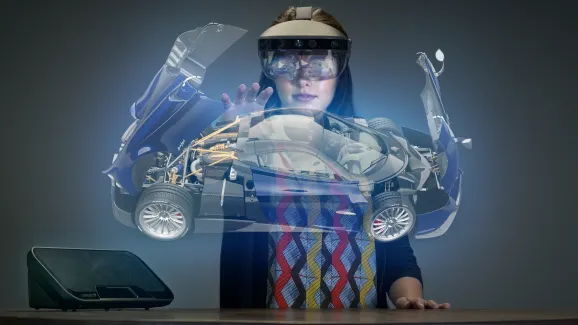
Viewing Excel in Augented Reality

[[NOTE: This is an extract from issue #4 of my AR Business World, newsletter. You can subscribe here if you like it.]
In 1979, Dan Bricklin and Bob Frankston invented the first electronic spreadsheet, the first killer app. In the next 37 years, not a whole lot else really happened to it. Sure the graphics got better, and the power of hardware enabled the sheer size of a spread sheet to go for thousands of columns and rows and number crunching is a bit faster . But the truth today — as it was in 1979 — is that a spreadsheet is just a spreadsheet.
That is enough to designate it among the great killer apps of computer productivity. Microsoft says there are 1.2 billion MS Office active users. I think it is safe to assume that nearly every Office user, be it a CEO overseeing a global corporation, or someone like me keeping lists in a home office, depends on spreadsheets to run the business.
But now, comes AR and its incredible abilities to visualize data and a small startup you probably have never heard of has succeeded in modernizing the spreadsheet for all data-dependent organizations
CEO Vision, LLC, based in Triangle Park, NC, was founded in May 2017. It has landed its first corporate customer who is benefiting from an entirely new way to visualize, understand and communicate spreadsheet data. The new AR app lets users graphically explore the most massive spreadsheet, reducing the time required to find answers to “what if” queries.
A Call for Useful
Last week, I put out a call for interesting or useful AR-related business stories: CEO Vision co-founder David A. Smith, was the first to respond. He’s an interesting tech industry veteran of about 35 years. Perhaps his most notable past hit was Rainbow Six, produced in collaboration with uber-spy novelist Tom Clancy. It was the first realistic 3D adventure shooter game. Co-founder Derek Tishler also comes out of the VR game industry. He developed VR Roller Coaster, which has sold six million copies as of this writing.
These are two accomplished geeks coming out of the world of action-adventure games, a category that I believe has more great talent than the market requires. There are just so many ways to zap an alien. In a previous ARBW issue, I predicted that this abundance of talent would spill over into business apps as the imminent arrival of Apple AR builds demand for them in such categories as healthcare, training, retail, real estate, travel, logistics, non-game entertainment and more.
Get shel israel’s stories in your inbox
Join Medium for free to get updates from this writer.
Spreadsheets, of course, serve every one of these huge categories, putting CEO Vision in a very nice position in a nascent industry about to explode. Not only that, but the startup supports any AR platform adhering to WebVR, an open standard which makes it possible to see AR and VR in almost every browser. Microsoft, Google, Samsung, HTC, and Oculus AR and VR all run on WebVR. Anything built on Apple ARKit will run run on WebVR. I assume that Magic Leap will support it as well when it launches in December as it is rumored to do.
I was impressed that CEO Vision, a company founded so recently and without fanfare, was already taking in revenue and was so magnificently positioned. I was a little hesitant to run with this story without getting a credible third-party who had actually worked with the software to confirm that it was as good as Smith and the demo implied. As a journalist, I pride my myself on skepticism. My first editor taught me that if my mother said she loved me, I needed a second source before I could trust her.
Smith was quick to provide an extremely credible resource, a personal friend of his who had no financial interest in the company, one with enough cred in the tech industry to fill a Super Bowl stadium.
Inventing the Future
Alan Kay is one of the most respected pioneers in the personal digital revolution. Starting in the late 1960s, he played fundamental roles in the development of object-oriented programming, GUI, the tablet, touch screen and the laptop. He contributed significantly during tenures at Apple, HP, Disney Imagineering, and most notably at the old Xerox PARC. In 2003, he received the Turing Award, technology’s equivalent of the Nobel Prize. Back in the formative days of the PC, he was friends and collaborated with Ivan Sutherland, father of computer graphics and Doug Engelbart, inventor of the digital mouse and a digital interface thought leader.
Kay, who has no commercial connection with CEO Vision, is Smith’s friend and colleague. Late last year, Kay was asked to solve the spreadsheet problem by the CEO of a global enterprise with 200,000 employees. He connected the CEO with Smith, the result being the formation of CEO Vision. Describing Smith as a spiritual and intellectual heir to Engelbart, he said they both have the sorts of minds that “invent the future.”
“People cannot see until they realize they are blind. But once we understand what we are missing, we invent tools to fix problems. Most people remain oblivious through life, content to do what they have always done,” Kay said. “But others go on to invent the future. Those are the people who have changed the world for everyone in almost every practical domain,” Kay said.
Two of those inventors of the future are Engelbart, one who stands out from an earlier era, and Smith, one who is doing precisely the same today, in an era when the tools of technology — such as AR — can solve nagging problems of yore in new ad exciting ways.
That plays into what Scoble and I see in AR and related technologies. We would not presume to have the incredible prescient visions of Alan Kay or Doug Engelbart, or for that matter even David A. Smith, but we have spent the past 15 years trying to predict what’s coming next in technology and how it will change work and life.
The spreadsheet was a killer app indeed, but it only automated the past (by making accounting a bit easier and doing a tiny amount of analysis) and only pokes into the future a little (because the future really needs comprehensive simulators). Part of its acceptance is that it was enough like what people were already doing to be seen as a convenience and worthwhile learning. In any case, all worlds seem to lead to AR dramatically transforming life and work as we know it.