What Is a Stock Keeping Unit (SKU)?

Read this Article with shoppro
A Stock Keeping Unit (SKU) is a unique identifier or code used to track and manage inventory in a retail or e-commerce environment. It is a distinct combination of letters, numbers, or both that represents a particular
product or item. SKUs are primarily used by businesses to differentiate and classify their inventory items for efficient inventory management.
Each product variant or distinct item within a product line is assigned a unique SKU. The SKU helps businesses identify and track individual products, making it easier to manage stock levels, monitor sales, reorder products, and analyze inventory data.
SKUs typically include information such as product attributes, such as size, color, style, or any other relevant characteristics. This information allows businesses to differentiate between similar products and avoid confusion in inventory management.
By using SKUs, businesses can streamline their inventory operations and gain insights into product performance, sales trends, and overall inventory health. Additionally, SKUs can be integrated into point-of-sale systems, e-commerce platforms, and inventory management software to facilitate accurate tracking and reporting.
Overall, SKUs play a crucial role in inventory management, helping businesses maintain accurate records of their products and efficiently manage their supply chains.

Certainly! Here are some additional details about Stock Keeping Units (SKUs):
1. Structure and Format: SKUs can vary in their structure and format depending on the needs and preferences of the business. They are often alphanumeric codes, combining letters and numbers, but they can also be purely numeric or even barcodes. The specific structure of an SKU is determined by the business’s inventory management system.
2. Uniqueness: SKUs are designed to be unique identifiers for each product variant or individual item. This uniqueness helps businesses accurately track and differentiate their inventory. By assigning a distinct SKU to each product, businesses can avoid confusion and maintain accurate records.
3. Product Attributes: SKUs often include information about specific product attributes. These attributes can include size, color, style, material, version, or any other relevant characteristic that distinguishes one product variant from another. By incorporating such information into the SKU, businesses can quickly identify and locate specific products within their inventory.
4. Inventory Management: SKUs play a crucial role in inventory management. Businesses use SKUs to monitor stock levels, track sales, and reorder products when needed. By analyzing SKU-specific data, businesses can identify which products are selling well and which ones require replenishment. This information enables them to optimize their inventory levels, reduce stockouts, and ensure timely restocking.
5. Integration: SKUs can be integrated into various systems and software to streamline inventory management processes. They can be utilized in point-of-sale (POS) systems, e-commerce platforms, and inventory management software. This integration allows for real-time tracking of inventory, efficient order processing, and accurate reporting.
Get Shopppro’s stories in your inbox
Join Medium for free to get updates from this writer.
6. Data Analysis: SKUs enable businesses to analyze their inventory data more effectively. By aggregating and analyzing SKU-specific information, such as sales volume, profitability, and demand patterns, businesses can make informed decisions regarding pricing, promotions, and product assortment. This data-driven approach helps optimize inventory management and improve overall business performance.
7. Scalability: SKUs are particularly useful for businesses with a wide range of products or those that deal with large inventories. They provide a scalable way to organize and manage diverse product lines and numerous variants. With a well-structured SKU system, businesses can efficiently handle inventory expansion and ensure smooth operations as they grow.
In summary, SKUs are unique identifiers that help businesses track and manage inventory efficiently. They provide crucial information about product variants, enable accurate inventory tracking, and support data-driven decision-making in inventory management.
SKU number examples
Let’s unpack an example of how one retailer — say, a wine shop — may generate its SKU numbers.

SKU vs. UPC
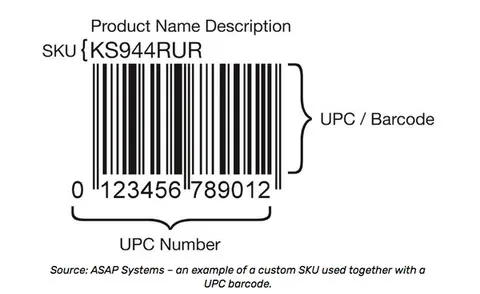
While SKUs and UPCs look similar — both are seemingly identical alphanumeric codes — they are used in two different ways. Here’s a helpful breakdown.
SKU (Stock Keeping Unit)UPC (Universal Product Code)InternalUniversalBetween eight and 12 charactersAlways 12 charactersIdentifies product traitsIdentifies manufacturer and itemAlphanumericNumericRetailers determine SKU architectureIssued by the Global Standards Organization
If you’re a new business that still needs barcodes for your merchandise, visit GS1’s starter guide to creating barcodes and UPCs.
As you create your SKUs, ensure those and your UPCs are not the same.
As a rule of thumb, let your SKUs identify product traits, while the UPCs identify the manufacturer (first six numbers), item (next five characters), and check digit (last number). (The check digit is formulated by adding and/or multiplying multiple digits in the code to show that the UPC code is valid.)
SKU vs. barcode
A barcode is the batch of black lines that retailers scan when completing a customer’s purchase. The term barcode is often used in place of UPC, meaning that the two are interchangeable.
Unlike SKU numbers, which are unique to a business or seller, barcodes are assigned to all like products regardless of where they are sold. SKUs also accompany barcodes.
You can read about what is shopppro.