From Zero to ML: Your First Machine Learning Model in Python
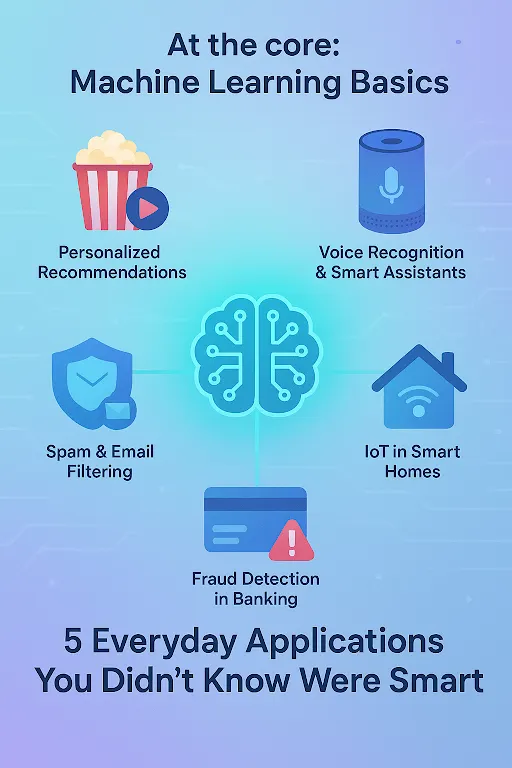
Machine Learning (ML) is no longer just a futuristic idea — it’s already part of our daily lives. When Spotify curates playlists for your mood, when Google Maps predicts traffic, or when your email filters spam, ML is silently working in the background.
The exciting part? You don’t need to be a mathematician or a computer scientist to get started. With Python and its beginner-friendly libraries, anyone with curiosity and a laptop can build their first ML model.

🧠 What Is Machine Learning?
At its core, Machine Learning is about teaching computers to learn patterns from data and make decisions.
Think about it this way:
- In traditional programming, you give the computer explicit instructions. Example: If it rains, take an umbrella.
- In machine learning, you give the computer examples, and it figures out the rule. Example: Show it many days with “rain” labeled and many days with “no rain,” and it learns when to predict rain on its own.
It’s like teaching a child: you don’t give them every possible rule of language, you just talk to them, and they learn patterns by example.
🛠️ Tools You’ll Need
Before we dive into building your first ML model, here’s what you’ll need:
- Python → The programming language most ML beginners start with.
- Libraries like Pandas, NumPy, scikit-learn, and Matplotlib → These are pre-built tools that make working with data, training models, and visualizing results much easier.
- A dataset → The raw material your model learns from.
Don’t worry — Python has many beginner-friendly datasets built-in, so you don’t need to search for one to start.
📂 Step 1: Understanding the Dataset
Every ML journey begins with data. Imagine you’re trying to train a model to identify different types of flowers. Your dataset might include measurements like:
- Petal length
- Petal width
- Sepal length
- Sepal width
Alongside these measurements, you also have labels that tell you the type of flower: Setosa, Versicolor, or Virginica.
This combination of inputs (measurements) and outputs (labels) is the foundation of supervised machine learning.
📊 Step 2: Preparing Data
Once you have a dataset, the next step is to split it into two parts:
- Training data → Used to teach the model.
- Testing data → Used to check if the model actually learned something useful.
Why do we split the data? Imagine you studied only past exam questions and scored well, but when faced with new questions, you struggled. That’s what happens if we don’t test on unseen data. A good ML model should generalize, not just memorize.
⚡ Step 3: Choosing the Right Algorithm
An algorithm is the engine of your ML model — it’s the method that finds patterns in data.
Get Skillzverse Marketing’s stories in your inbox
Join Medium for free to get updates from this writer.
Some beginner-friendly algorithms include:
- Logistic Regression → Despite its name, it’s often used for classification (like determining flower species).
- Decision Trees → Like flowcharts that split decisions based on feature values.
- K-Nearest Neighbors (KNN) → A simple method that classifies something based on its “neighbors” in the dataset.
For beginners, logistic regression or decision trees are great starting points because they are easy to understand and interpret.
🤖 Step 4: Training the Model
Training means feeding your model the training dataset so it can learn patterns.
Think of it like teaching a friend how to cook: you show them enough examples of recipes, and eventually, they’ll be able to cook a dish on their own without following instructions.
✅ Step 5: Testing the Model
After training, you test the model using the test dataset. This shows you how well it performs on new, unseen data.
The performance is often measured using accuracy — the percentage of correct predictions. For example, if your flower prediction model gets 95 out of 100 flowers correct, that’s 95% accuracy.
📈 Step 6: Making Predictions
Once your model is trained and tested, you can use it to make predictions.
Imagine you measure a flower’s petals and sepals, feed these values to your model, and it predicts:
👉 “This flower is likely a Setosa.”
That’s the magic moment when you see your first ML model in action.
🎨 Step 7: Visualizing the Results
Numbers are useful, but visuals make ML more intuitive. For example, if you plot flower measurements on a graph, you’d see clusters of dots, each representing a species.
The boundaries your model draws between these clusters are what allow it to make predictions. Visualization helps you see why the model made its decisions.
🚀 Beyond the First Model: Expanding Your Skills
Congratulations — you’ve just conceptually built your first ML model! But ML is a vast field, and this is just the beginning. Here are some exciting directions you can explore next:
- Experiment with other algorithms → Try decision trees, random forests, or support vector machines.
- Work on real-world datasets → Predict house prices, classify emails as spam or not spam, or analyze customer behavior.
- Improve data preprocessing → Learn how to clean, normalize, and transform messy real-world data.
- Dive into deep learning → Explore neural networks with libraries like TensorFlow or PyTorch.
- Deploy your model → Turn your project into a simple web app and share it with others.
⚡ Key Takeaways
- Machine Learning is about finding patterns in data and using them to make predictions.
- A dataset with inputs and outputs is the foundation of supervised learning.
- Training and testing ensure that your model learns properly and performs well on new data.
- Even with simple algorithms, you can achieve high accuracy and useful predictions.
Final Thoughts
Building your first machine learning model in Python doesn’t have to be overwhelming. You don’t need advanced math or years of study to get started — all you need is curiosity, patience, and a willingness to experiment.
The journey from zero to ML is not about rushing into complex models; it’s about building a solid foundation. Start small, play with simple datasets, and gradually take on bigger challenges.
One day, you’ll look back and realize that your first flower classification project was the spark that lit your journey into one of the most exciting fields of technology today.