Spring is usually described in terms of what arrives. Blossoms, warmth, color returning after a long absence. The imagery is almost always about fullness, the branch heavy with flowers, the garden finally doing something again. But every spring branch I’ve ever worked with has told me something different, and this one more clearly than most.
The branch in this arrangement is bare along most of its length. There are a few clusters of pink buds near the top, some open and some still considering it, and then below them a long stretch of dark, unadorned wood. When I cut it and held it up, my first instinct was to angle it so the flowering portion was more visible, to lead with what was happening rather than all the quiet wood beneath. Instead I let it rise nearly vertical, the way it wanted to, and left the bareness where it was.
What I found when I actually looked at it was that the bare section wasn’t absence. It had weight and texture and a particular quality of stillness. The few buds at the top meant something different against all that empty wood than they would have in a fuller piece. They felt harder won.
This is something ikebana has been formally articulating for centuries. Rather than piling up materials, ikebana prioritizes creating bold ma, negative space, so that the vitality of the plant is highlighted. But there’s a deeper principle underneath the compositional one. Buddhist teachings on mujo, or impermanence, ask practitioners to find beauty not only in full blooms but also in buds and withering branches, the attitude of accepting the cycles of nature as they are. The bare wood isn’t a problem to be solved. It’s the whole point.
Get Saanvii Senthilkumar’s stories in your inbox
Join Medium for free to get updates from this writer.
This idea has deep roots in the practice. Ikenobō Sen’ō, one of the earliest developers of the art, insisted that arrangements should include symbolic elements like withered stems or twisted branches that represent the grandeur of nature. That was in the 15th century, and the principle has held. The essayist Kenkō, writing in the 14th century, asked: “Are we to look at cherry blossoms only in full bloom?” He argued that branches about to blossom are worthier of admiration, that privileging only the moment of peak fullness is actually a refusal to accept the basic condition of impermanence.
I think about this alongside wabi-sabi, the aesthetic philosophy that underpins so much of how Japanese art approaches incompleteness. Wabi-sabi centers on the acceptance of transience and imperfection, often described as the appreciation of beauty that is imperfect, impermanent, and incomplete. In practice, this means the bare section of a spring branch is as much a subject as any flower on it. The wood is doing something. It has its own presence, its own way of holding light and casting shadow. Stripping your attention down to what’s actually there rather than what you expect to find, that’s where the practice lives.
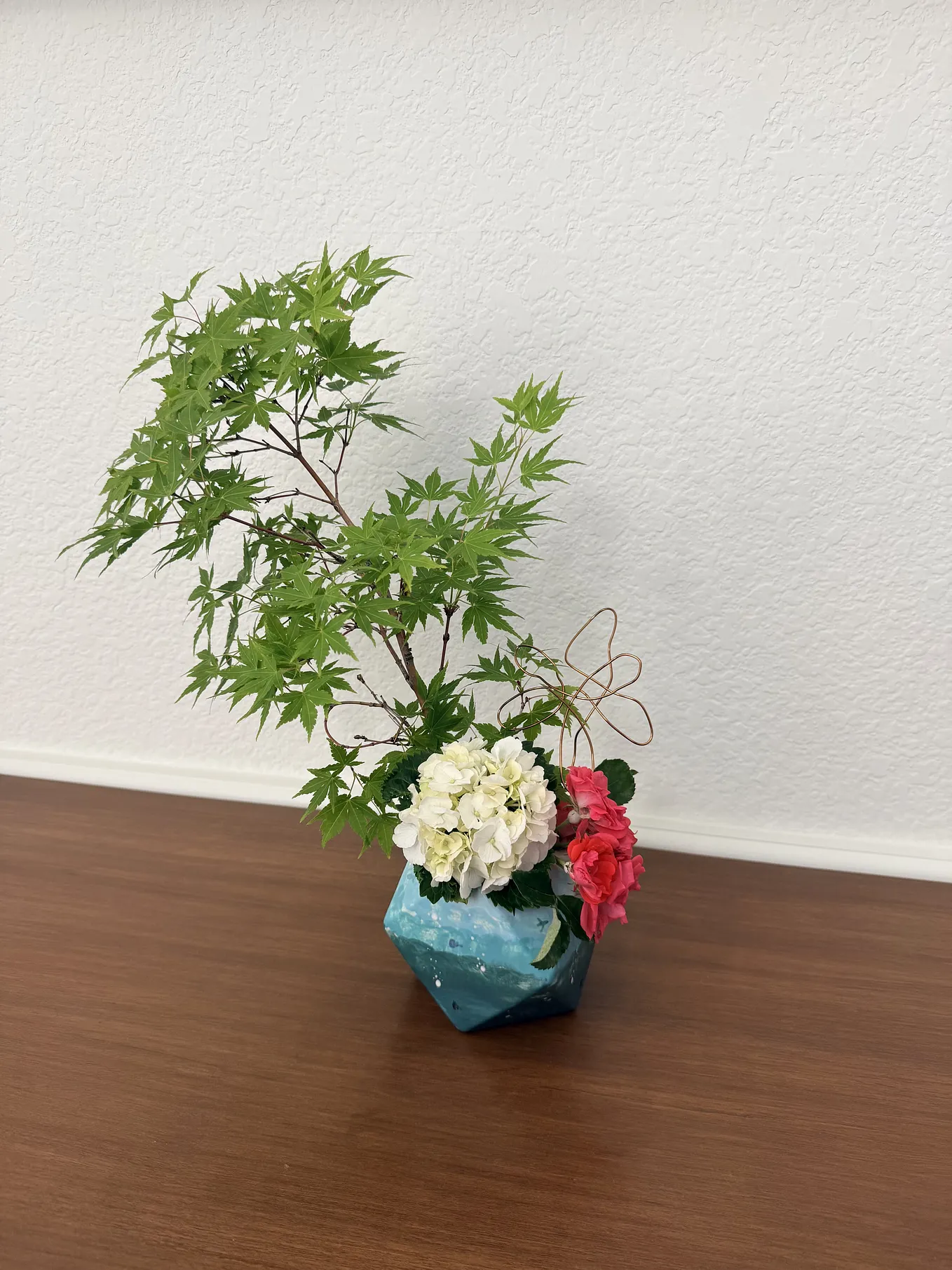
The coral rose at the base of this arrangement complicates the reading in a way I find more interesting than if I’d paired the branch with something softer. It’s fully open, warm, completely arrived. The contrast I expected to create tension, two elements at entirely different stages of becoming , instead resolved into something coherent. The rose doesn’t make the branch look unfinished. It confirms that the branch is exactly where it is, and that’s sufficient. There’s a version of this arrangement where both elements are in the same register of spring softness and blush pink, and I think it would have been a much less honest piece. This one has some friction to it. The friction is the arrangement.
Sogetsu, the school I practice, has always been less interested in dictating the correct expression of a season than in asking what each material actually is and what it’s actually doing. Sogetsu was founded in 1927 by Teshigahara Sōfū and is characterized by respect for individual expression over adherence to established styles. That philosophy gives you permission to let a bare branch be a bare branch rather than an apology for a branch that hasn’t bloomed yet.
What I keep returning to, making arrangements in early spring especially, is how much the season asks you to be patient with things that are still in process. The branch isn’t on its way to becoming something worth looking at. It already is. The buds near the top are a detail, not the destination. Most of what’s happening is the wood itself, its color, the way it moves, the quality of its stillness. Ikebana taught me to see that, or is still teaching me, and I’m not sure I would have noticed otherwise.