My Journey into Cloud-Native, DevOps, and NoSQL: Key Takeaways from the IBM Program

The digital landscape demands more than just great user interfaces. As a Meta-certified Front-End Developer based in Karachi, Pakistan, I felt that firsthand. While I love bringing designs to life, a growing curiosity pushed me to look ‘under the hood’ — to understand how modern applications are built, deployed, and scaled efficiently in the cloud.
Driven by this desire for deeper knowledge, and a public commitment I’d made on LinkedIn to expand my skillset, I embarked on the IBM Professional Certificate course covering Cloud Native, DevOps, and NoSQL.
This article isn’t just a summary of modules; it’s my personal reflection on that learning journey — the key concepts that reshaped my perspective and the practical skills I gained along the way.
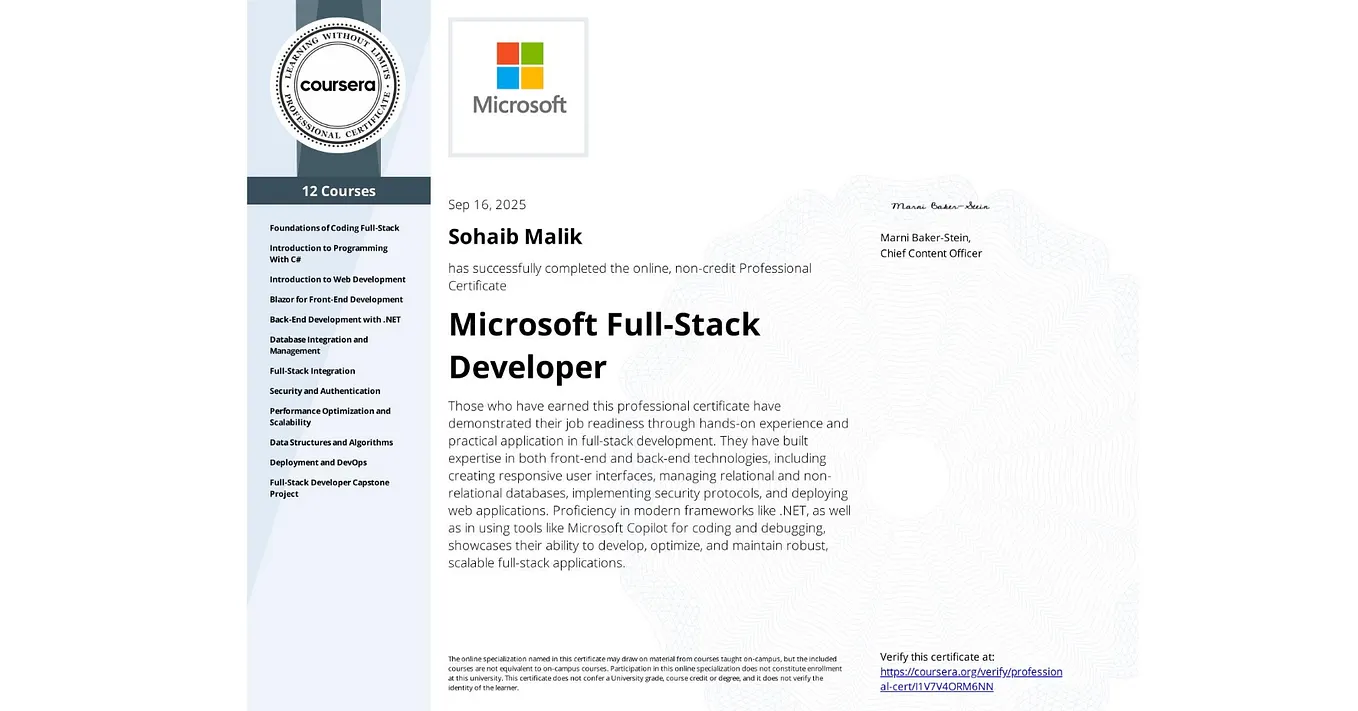
You can verify my completion of this certificate here: Credly | Coursera
Module 1: Introduction to Cloud Native — Thinking Beyond the Lift-and-Shift
This first module fundamentally shifted my perspective on cloud computing. It introduced Cloud Native — not just running apps in the cloud, but architecting them for the cloud. The key takeaway for me was the emphasis on designing for resilience and scalability from the start, often using microservices. This contrasts sharply with simply migrating legacy applications.
Key concepts that stood out:
- Containers (like Docker): Understanding how containers package everything needed to run an application consistently across environments was a lightbulb moment for deployment ease.
- CNCF (Cloud Native Computing Foundation): Realizing the importance of this foundation and its projects (like Kubernetes) highlighted the community-driven nature of cloud-native evolution.
- Hybrid Cloud Infrastructure: Learning about blending private and public clouds showed the flexibility required in real-world enterprise scenarios.
- Application Modernization: Seeing this as a practical pathway towards Cloud Native made the overall concept feel more achievable for existing systems.
Module 2: DevOps & CI/CD — Automating Collaboration
This module on DevOps was truly insightful, revealing a powerful approach to breaking down traditional barriers in software development.
What’s DevOps? More Than Just Tools
My understanding evolved beyond just tools; DevOps is fundamentally about culture and collaboration. It bridges the gap between Development (Dev) and Operations (Ops), fostering a shared responsibility throughout the software lifecycle. The goal? Faster delivery, higher quality, and less friction.
Building with Intention: TDD & BDD
The introduction to these methodologies was particularly valuable:
- Test-Driven Development (TDD): The concept of writing tests before code seemed counter-intuitive initially, but I quickly saw how it forces clarity on requirements and builds confidence in the code’s reliability from square one.
- Behavior-Driven Development (BDD): Focusing on software behavior from the user’s perspective resonated strongly with my front-end background, ensuring development efforts align directly with user needs.
The Power of Automation: CI/CD
Continuous Integration (CI) and Continuous Delivery (CD) were perhaps the most impactful concepts for me:
- Continuous Integration (CI): The practice of frequently merging and automatically testing code changes made so much sense. It’s about catching issues early and often.
- Continuous Delivery (CD): Extending CI to ensure every validated change is ready for release transforms the deployment process from a stressful event into a routine capability.
The true significance of CI/CD, as I learned, lies in reducing risk and increasing velocity. It fosters confidence that your codebase is always in a deployable state through relentless automation and testing.
Essential DevOps Tooling
While principles are key, the tools enable the practice. The overview of tools like Jenkins and Tekton for building pipelines, Docker for containerization, and Kubernetes for orchestration provided a practical glimpse into the DevOps ecosystem.
“This module solidified my understanding of how DevOps principles create more efficient, collaborative, and reliable software development workflows.”
Module 3: Agile & Scrum — Embracing Change and Delivering Value
This module demystified Agile methodologies and the popular Scrum framework, showing their indispensable role in navigating the complexities of modern projects.
So, What’s Agile Really About?
Get Sohaib Malik’s stories in your inbox
Join Medium for free to get updates from this writer.
Beyond the buzzword, Agile is an iterative mindset. It’s about breaking large problems into smaller, manageable pieces, working collaboratively, gathering constant feedback, and crucially, adapting to change. The Agile Manifesto’s values really underscore this philosophy.
Scrum Explained: Structure for Agility
Scrum provides a concrete framework to implement Agile. Learning the structure was key:
- Sprints: Fixed-length iterations providing rhythm and focus.
- Key Events: Understanding the purpose of Sprint Planning, Daily Scrums, Sprint Reviews, and Sprint Retrospectives clarified how the team stays aligned and continuously improves.
Why Agile Matters (My Takeaway)
The module highlighted that merely adopting Agile ceremonies or tools without embracing the underlying adaptive mindset is ineffective. It’s not just about working sequentially faster; it’s about being responsive and delivering value incrementally. Effective training and a genuine cultural shift are essential.
Making Agile Concepts Practical:
This module didn’t just define terms; it showed how they translate into practical tools for managing complex projects:
- Kanban Boards: Became clear as powerful tools for visualizing workflow, identifying bottlenecks, and managing tasks currently in progress.
- User Stories: Understanding the “As a [user], I want [action], so that [benefit]” format emphasized keeping user value at the forefront of every development task.
- INVEST Criteria: Learning this checklist (Independent, Negotiable, Valuable, Estimable, Small, Testable) provided a concrete way to ensure user stories are well-defined, actionable, and ready for work.
- Story Points: Grasped these not as measures of time, but as relative units for estimating effort which directly aids in more realistic sprint planning.
- Sprint Reviews vs. Retrospectives: Clearly distinguishing these meetings highlighted their distinct purposes: the Review for demonstrating the completed work and gathering product feedback, the Retrospective for reflecting on and improving the team’s process. Collectively, these concepts provide a robust toolkit for breaking down complexity and fostering continuous improvement.
Module 4: NoSQL Databases in the Cloud — Flexibility Meets Scalability
Shifting gears, this module introduced the world beyond traditional SQL databases, focusing on NoSQL — specifically MongoDB.
What is NoSQL? Beyond Rigid Schemas
NoSQL (“Not only SQL”) represents database types designed for scenarios where the rigid structure of relational databases might be limiting. My key takeaway was their emphasis on flexibility and horizontal scalability.
MongoDB in Focus:
Learning about MongoDB highlighted its specific advantages:
- Flexible Schema: The ability to evolve the data model without complex migrations felt like a significant advantage for rapidly developing applications.
- Scalability: Its design for distributed environments makes it suitable for global applications.
- Ease of Use: Features like easy indexing and support for diverse data types were presented as key benefits.
Practically, learning the basic CRUD (Create, Read, Update, Delete) operations using the Mongo shell provided a hands-on feel for interacting with this type of database. It was interesting to see how different querying felt compared to SQL.
Module 5: Final Project and Exam — Putting It All Together
This module tested our understanding through a final project and exam, requiring the practical integration of Cloud Native, DevOps, Agile, and NoSQL skills learned throughout the course.
Conclusion: A Stepping Stone in My Learning Journey
Pursuing this IBM program certificate was a deliberate step towards fulfilling my LinkedIn commitment and expanding beyond my front-end roots. While my Meta certification provided an excellent foundation, particularly in user-facing development, the IBM course added critical layers covering the infrastructure, deployment, and process side of modern software development — especially the DevOps component that initially sparked my interest.
For anyone considering these paths: both the Meta and IBM programs offer valuable, high-quality training. The “best” choice depends entirely on your background, learning preferences, and specific career goals. From my perspective, the Meta program was exceptionally beginner-friendly and engaging for front-end skills. The IBM program felt broader, diving into cloud, and operational concepts that complement front-end development well.
This journey has reinforced a key lesson, perhaps best captured by the sentiment: “planning is everything.” Embarking on intensive learning like a professional certificate program requires structure. I strongly advise anyone considering this path to create a dedicated learning plan to stay on track.
Pro Tip for Learners: If you’re looking for deeper insights into effective study habits, I found prompting conversational AI with concepts from experts like Andrew Huberman on “optimal protocols for studying and learning” surprisingly helpful.
Originally published at https://www.linkedin.com.