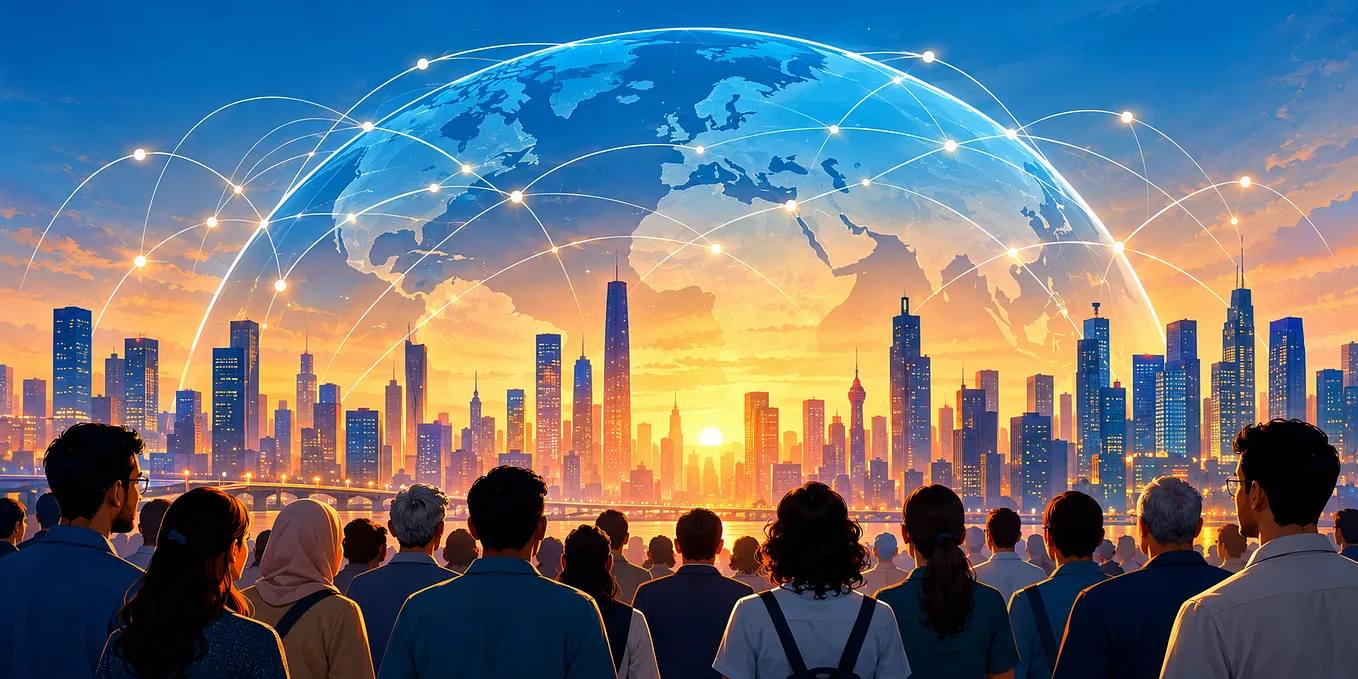
So, Is Democracy Ending?
What we are witnessing is not collapse but a historical transition.


Most people today sense that something is off about politics. Elections still happen, constitutions still exist, and leaders still speak the language of democracy yet trust keeps falling, institutions feel weaker, and societies grow more divided each year.
So the question quietly enters public conversation: is democracy failing?
Perhaps the better question is whether we are mistaking an ending for a breakdown when in reality we may be living through a transition between two different political eras.
For much of the last century, democracy appeared stable, inevitable, even permanent. But that period may not have been the culmination of history. It may have been an unusually calm interval between older forms of power and whatever comes next.
The Myth of the Long Democratic Age
We often imagine democracy as the culmination of moral progress, a slow expansion of human rights across centuries.
History tells a very different story.
For most of human civilization, power followed a simple chain: the divine, the monarch, the aristocracy, and then everyone else. Ordinary people were not meant to govern; they were meant to produce, food, labor, taxes, and soldiers.
Even the countries we now consider the birthplaces of modern democracy granted full voting rights astonishingly late. Women voted in Switzerland only in 1971. Large parts of the population in the United States could not effectively vote until the 1960s. Much of the world lived under colonial rule until after World War II.
Democracy, as we know it universal franchise combined with civil rights is barely 70–80 years old.
It did not emerge purely from enlightenment or moral awakening. It emerged from necessity.
After World War II, elites faced two existential threats: fascism had nearly destroyed the world, and communism promised to overthrow capitalist societies from within. To stabilize societies, governments needed citizens not just as workers but as stakeholders.
So a bargain was struck.
Citizens would receive welfare, education, rising incomes, and dignity. In return, they would accept institutions and social order.
Democracy wasn’t simply an ethical triumph. It was a political technology for stability.
The Golden Window (1945–2008)
For roughly sixty years, the arrangement worked remarkably well.
Economic growth was rapid. The middle class expanded. Media was centralized enough to create shared realities. Political disagreements existed but rarely shattered the system.
This period which we now call normal may actually have been the exception in human history. Then something changed.
The Cold War ended. The ideological competitor vanished. For the first time, liberal democracy no longer had to prove itself superior to an alternative system. And slowly, almost invisibly, the bargain shifted.
Earlier, prosperity created legitimacy. Now, markets were liberated first, legitimacy would be managed later.
Globalization accelerated. Capital became mobile. Production spread across continents. The citizen stopped being economically central to the state in the same way industrial workers once were.
Democracy remained. But its foundations quietly moved.
The New Empires Without Territories
In earlier centuries, empires-controlled land. Today, power increasingly controls attention.
Modern corporations do something historically unprecedented: they mediate how humans perceive reality itself. They do not merely sell products; they shape information, relationships, and even social belonging.
This changes politics fundamentally.
Democracy depends on a shared public conversation citizens arguing over the same facts. But when information ecosystems fragment, people no longer disagree about opinions. They inhabit different realities.
Elections still happen. Consensus disappears.
Get Dr SP Mishra’s stories in your inbox
Join Medium for free to get updates from this writer.
And when consensus disappears, institutions begin to look illegitimate regardless of whether they function.
Why Politics Feels Smaller
Many people sense that political leadership has weakened that the quality of political class has declined. But this may not be primarily about individual competence.
Governments have lost three historic powers: control over capital, control over information, and control over identity formation. Markets cross borders, communication platforms operate globally, and communities form digitally rather than geographically.
States can no longer guarantee prosperity the way they once did.
So politics shifts toward the only tools still available: identity, memory, religion, and nationalism. These are not accidents of leadership; they are fallback mechanisms when material legitimacy becomes harder to sustain.
When growth slows, belonging becomes the new currency.
The Return of Faith and Tribe
Throughout history societies have relied on three sources of legitimacy: the sacred, the institutional, and the economic.
When economies deliver, institutions are trusted. When economies stall, societies search for meaning.
This is why across continents we see renewed emphasis on religion, civilizational narratives, linguistic identity, and cultural memory. The nation-state alone struggles to command emotional loyalty in a globalized economic world.
People anchor themselves where certainty still exists community and identity.
Not because humanity is regressing, but because stability requires belief.
The Age of Elite Networks
One growing public frustration is the sense that accountability weakens at the highest levels that powerful networks rarely fully expose themselves.
This does not necessarily require grand conspiracies.
Modern elites operate across overlapping spheres: finance, politics, media, and law. Mutual vulnerability produces mutual restraint. Institutions designed for national accountability struggle to investigate transnational influence networks.
The result feels like impunity, even when systems technically remain democratic.
Citizens still possess rights. But power diffuses into spaces those rights struggle to reach.
So, Is Democracy Ending?
Probably not.
Elections will continue. Constitutions will remain. Courts will function. Citizens will still vote and protest and debate.
What may be ending is the brief historical phase where democracy automatically produced trust, shared reality, and upward mobility.
The post-war democratic era relied on conditions that no longer exist: national economies, centralized media, and industrial growth that lifted most people together.
We are entering something different, a world where political systems persist but legitimacy must constantly be narrated, negotiated, and defended in fragmented public spheres.
Democracy is not collapsing. It is losing its old operating system.
The Real Question
The 20th century asked whether people should have the right to choose their leaders.
The 21st century asks a harder question:
Can democratic self-government survive when power is no longer territorial when influence flows through networks, narratives, and platforms rather than borders?
We do not yet know the answer.
We are living inside the transition itself.
And future generations may look back at our time not as the fall of democracy but as the moment it stopped being simple.
About the Author:
Dr SP Mishra is the Founder of India Career Centre, a Hyderabad-based career guidance, study-abroad consulting and educational research organisation. He writes and speaks on career decision-making, higher education, skills, employability and the future of work in India. Also hosts the India Career Centre Podcast. Connect on LinkedIn.