QSFP vs SFP+: Differences and Popular Types

Both QSFP and SFP+ transceivers are widely applied in today’s network applications. In today’s blog post, we will take an extensive comparison between QSFP transceivers and SFP+ transceivers from the aspect of their working principle, popular product types, specs, and applications.
What is QSFP?
QSFP stands for Quad Small Form-factor Pluggable, which has four independent transmit and receive channels, each lane supports up to 10 Gbps data rates, resulting in a total of 40Gbps. QSFP 40G transceiver compliant to the IEEE 802.3ba standard, SFF 8436, and QSFP Multi-Source Agreement (MSA). 40G QSFP+ transceivers are usually applied in 40G Ethernet connectivity options for data center, enterprise core, distribution layers, and service provider applications.
What is SFP+?
SFP+ stands for enhanced small form-factor pluggable, which is an enhanced version of the SFP. SFP and SFP+ have the same form factor size and appearance that are the industry’s smallest form factor. SFP+ 10G transceivers compliant to IEEE 802.3ae, SFF-8472, SFF-8431, SFF-8432, SFP+ MSA. With the Significant advantages of small form factor size, lower power consumption rate, and low cost, SFP+ modules are widely applied in diverse networking environments of 10G Ethernet deployments for data center, enterprise wiring closet, and service provider transport applications.
Working Principle: QSFP+ vs SFP+
Next, we will choose QSFP-40G-SR4 and SFP-10G-SR as the research objects to analyze the differences in their working principle.
Get Steven’s stories in your inbox
Join Medium for free to get updates from this writer.
At the QSFP-40G-SR transmitter, four-lane parallel 10 Gbp/s electrical signals are converted into optical signals through the laser driver chip. Once this process has been performed, the optical signals can then be transmitted over optical fiber to the receiver. At the receiver, the optical signals are then recovered as electrical signals via photodetector, as shown in the figure. 1. As for SFP-10G-SR, it has a similar photoelectric conversion system of electrical signal-optical signal-electrical signal to QSFP-40G-SR4, the major difference is that the SFP-10G-SR has only one single channel at 10Gbps, so QSFP-40G-SR4 supports 4 times data transmission as SFP-10G-SR.


Form Factor Size: QSFP+ vs SFP+
Figure 3 shows the outline dimensions of QSFP+ and SFP+ transceivers. It’s not hard to find out that QSFP+ transceivers are slightly larger than SFP+. Then what you could do if you want to insert a 10G SFP+ transceiver into a 40G QSFP switch port? A 40G QSFP+ to 10G SFP+ Adapter Converter Module could help with that. Inserting your 10G SFP+ module into the QSFP+ to SFP+ converter module, the 10G SFP+ module enables work at 10G data rate on the QSFP switch port.

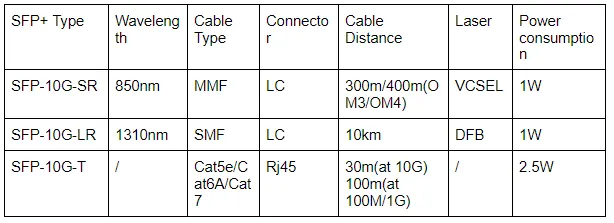
The Most Popular QSFP and SFP+ Types & Specs


Conclusion
As mentioned above, we have an extensive understanding of QSFP+ and SFP+ modules from the aspects of working principle, form factor, typical product types, and specs. If you have purchase demand on QSFP 40G transceivers and SFP+ 10G transceivers, QSFPTEK will be a great choice. QSFPTEK SFP+ and QSFP+ transceivers are certified and tested on Cisco/Juniper/Arista/Brocade/Intel QSFP 40G ports for superior performance, quality, and reliability. Welcome to inquire at sales@qsfptek.com.