Contextual Case Study #10: When Too Much Freedom Becomes the Problem

When nobody tells you what to do, when to do it, or when it must be finished
Freedom sounds like the perfect solution to a demanding schedule.
No fixed working hours. No supervisor checking your progress. No externally imposed deadlines. No one deciding which task deserves your attention first.
You can work whenever you want.
You can choose what to work on.
You can organise the process in whatever way suits you.
And yet, the work keeps getting postponed.
You spend time deciding what to do. You reconsider your priorities. You move tasks around. You promise yourself that you will begin when you feel more prepared, have more time, or find the right moment.
Because nothing requires you to act now, almost everything can wait.
Eventually, the freedom you wanted begins to feel like a problem.
But why?
When external boundaries disappear, the responsibility for creating those boundaries moves to the individual. And that responsibility can become another obstacle between intention and action.
The Case: A Person Who Can Work Whenever They Want
Consider Arun, who leaves a structured job to work independently.
He has several projects he wants to complete. He has the necessary skills, a suitable workspace, and enough flexibility to organise his days.
At first, the freedom feels liberating.
He can start late if he wants. He can spend the morning researching and write in the afternoon. He can change priorities whenever a more interesting opportunity appears.
There is no manager waiting for an update. No meeting determines when a particular task must be finished. No one questions how he spends his working hours.
But gradually, his days become less predictable.
He begins the morning by deciding what deserves attention.
One project seems urgent. Another seems more interesting. A third might offer a better long-term opportunity.
He starts one task, remembers another, and changes direction.
When something becomes difficult, he tells himself he can return to it later.
Later, he finds another reason to postpone it.
By evening, Arun has spent considerable time thinking about his projects, reorganising his plans, and working on several small tasks.
Yet the most important project has barely progressed.
He responds by creating a detailed schedule for the following week.
For a few days, he follows it.
Then something changes. He misses a session, rearranges the timetable, and gradually returns to his previous habits.
Arun begins to wonder whether he is capable of managing his own time.
But the more useful question is this:
Has freedom made it easier for Arun to act, or has it increased the number of decisions he must make before he can act?
The Hidden Cost of Having No Boundaries
Freedom does not automatically produce procrastination.
The problem emerges when the freedom available exceeds the person’s ability or willingness to organise the behaviour required to achieve their goals.
Consider four things that external structure often supplies.
1. A starting point
A scheduled meeting tells you when to be present.
An assigned task tells you what needs attention.
A deadline establishes a point by which something must happen.
Without these cues, you may have to decide when to begin, what to begin, and whether now is the right time.
Each decision creates another opportunity to postpone action.
For someone who already struggles with initiation, unlimited flexibility can make beginning less predictable.
2. A priority order
When several tasks compete for attention, an external system may establish which one comes first.
Without that system, every task competes for consideration.
You may spend so much time deciding what matters most that the decision itself displaces the work.
The difficulty is no longer simply completing the task.
It is repeatedly choosing which task deserves to be completed.
3. A boundary around completion
External deadlines limit how long a task can remain open.
Without them, a project can continue indefinitely.
You can research more, reconsider the approach, change the plan, or move the finish date.
This may be useful when the work genuinely requires flexibility.
But when postponement is already a pattern, the absence of a finish boundary can make it easier for the pattern to continue.
4. A consequence for postponement
When another person depends on your work, delay may become visible quickly.
When the goal belongs entirely to you, the consequences may remain distant.
You can miss today’s session without anyone noticing.
You can move the deadline without explaining yourself.
You can postpone the project while continuing to believe that you will eventually complete it.
The absence of immediate consequences does not mean the goal is unimportant.
It means that its importance may not translate into immediate action.
The Behavioural Loop
For Arun, the loop may look like this:
Freedom → no predefined starting point → repeated decisions → competing priorities → task switching or postponement → little visible progress → renewed planning → temporary commitment → return to unrestricted behaviour.
Notice that Arun is not necessarily avoiding work altogether.
He may spend his entire day working.
The problem is that his behaviour is not consistently organised around the outcomes he intends to achieve.
He has freedom over his time, but that freedom does not automatically provide direction.
And because he can change his plan whenever he wants, he may repeatedly replace action with another decision about action.
Planning becomes a substitute for committing.
Flexibility becomes an opportunity to renegotiate.
And the day ends without a clear connection between what mattered and what actually happened.
Is Freedom the Problem or the Decisions It Creates?
Not everyone struggles in an unstructured environment.
Some people work effectively without fixed schedules. They can identify priorities, begin independently, recover after interruptions, and finish without external pressure.
Others perform well when expectations are clear but struggle when they must create those expectations themselves.
The distinction matters.
A person may need a starting time but not a strict timetable.
Another may need clear priorities but prefer choosing their own working hours.
Someone else may need a defined finish line because open-ended projects repeatedly expand.
And another person may have no difficulty organising the work but may struggle to maintain attention once they begin.
The same absence of structure can expose different behavioural failure points.
Therefore, the answer is not necessarily to eliminate freedom.
It is to identify which decisions, boundaries, or expectations the person needs to make their intended behaviour more reliable.
The Freedom-Behaviour Audit
Choose one project you repeatedly postpone because you have complete freedom over when and how to work on it.
Answer the following questions.

Look carefully at the answers.
If you repeatedly reconsider priorities, you may need a more stable decision rule.
If you know what matters but cannot begin, the problem may be initiation rather than planning.
If you begin but drift into other activities, the absence of structure may be exposing a recognition problem.
Get Suman Pradhan’s stories in your inbox
Join Medium for free to get updates from this writer.
If you repeatedly return to planning instead of completing, you may need a clearer boundary around action and completion.
The audit should reveal what freedom has made difficult — not simply how much freedom you have.
The Experiment: Keep the Freedom, Add Three Boundaries
For the next seven days, choose one important project.
Do not impose a rigid timetable on your entire day.
Instead, introduce three small boundaries around the project.
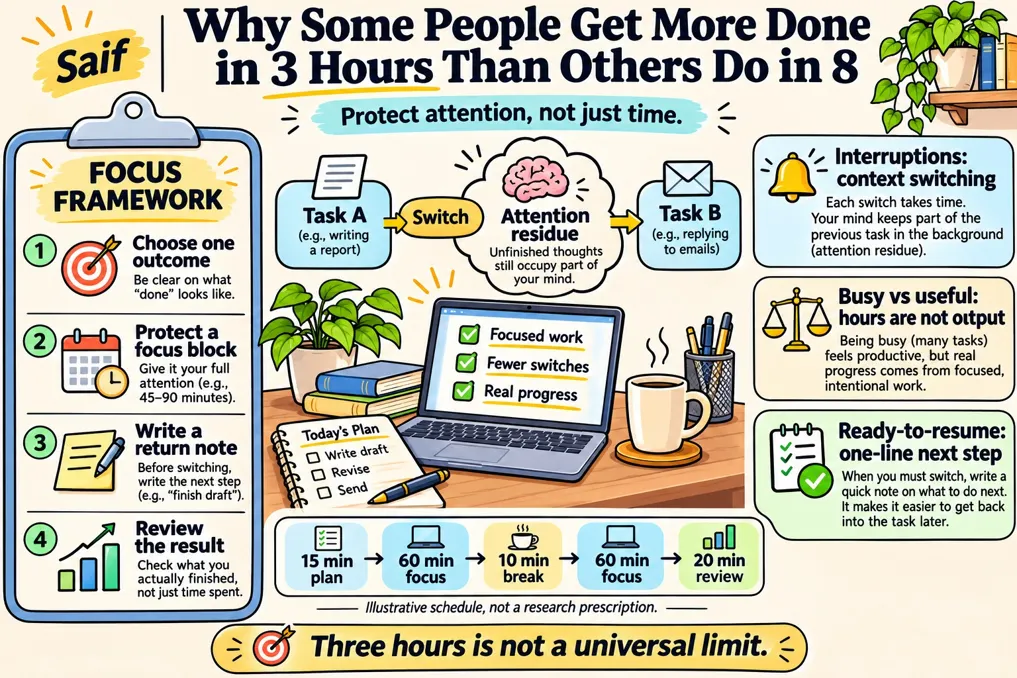
Boundary 1: Decide the next action in advance
At the end of each working session, write down the first concrete action for the next session.
Not:
Work on the project.
Instead:
Open the draft and write the first two paragraphs of the section on customer feedback.
This reduces the need to decide what to do when you begin.
You retain freedom over much of your day without making every session begin with another planning exercise.
Boundary 2: Establish a realistic starting window
Choose a period during which you will begin the task.
For example:
I will begin the project between 9 a.m. and 10 a.m.
A window provides flexibility without leaving the starting point entirely undefined.
Record whether the window helps you begin or simply becomes another deadline you repeatedly move.
Boundary 3: Define the day’s finish condition
Decide what would count as meaningful progress before beginning.
For example:
Today, I will complete the outline and draft the first section.
When that action is complete, you can decide what comes next.
If it is not complete, record what happened rather than automatically rewriting the plan.
At the end of seven days, examine the evidence.
Did fewer decisions make it easier to begin?
Did a starting window reduce postponement?
Did a concrete finish condition help you distinguish meaningful progress from activity?
Or did the problem persist even after the boundaries were introduced?
The experiment is not designed to prove that more structure is always better.
It is designed to discover whether a small amount of structure improves the behaviour that is currently breaking down.
The Gaming Sheet: Measure What Freedom Does to Behaviour
A simple productivity tracker might record hours worked.
But Arun’s problem is not necessarily a lack of working hours.
It is the relationship between his freedom, his decisions, and the work he actually completes.
The Gaming Sheet should therefore track:

After several sessions, look for patterns.
You may discover that the absence of a starting time is your main difficulty.
You may find that you start reliably but keep changing priorities.
You may discover that you work consistently until a task becomes difficult, then use your freedom to move to something easier.
Or you may find that your environment is genuinely unpredictable, making a fixed schedule impractical.
Each result calls for a different response.
The purpose of measurement is to discover which freedom is helping you and which freedom is repeatedly allowing your intended behaviour to disappear.
Which Archetype Does Unstructured Freedom Reveal?
The absence of boundaries does not create a fourth archetype. It can expose or intensify an existing behavioural pattern.
The Drifter
Without clear priorities or checkpoints, attention moves from one activity to another.
The person may remain busy but lose contact with the original intention.
Diagnostic question: Am I consciously choosing to change direction, or am I drifting away from what I intended to do?
The Restarter
The person begins, but the lack of a reliable return point makes interruptions more costly.
Without an established sequence or next action, returning may require another round of planning and decision-making.
Diagnostic question: After I stop, do I know exactly where and how to resume?
The Hidden Perfectionist
An open-ended project provides endless opportunities to improve, reconsider, or prepare.
Without a clear finish condition, the person can continue working without allowing the work to become complete.
Diagnostic question: What would make this work finished, rather than merely better?
The environment matters because it changes the conditions under which each pattern operates.
A Drifter may need more visible priorities.
A Restarter may need a reliable re-entry point.
A Hidden Perfectionist may need a defined stopping condition.
Giving all three people a stricter timetable may leave the underlying problem untouched.
When More Structure Is Not the Answer
There is a danger in assuming that anyone who struggles with freedom simply needs more rules.
Some people have unpredictable responsibilities, changing workloads, or limited control over their time.
A rigid timetable may be unrealistic.
Others need room for experimentation, creative thinking, or changing priorities as new information emerges.
Excessive structure can create unnecessary pressure, encourage unhelpful compensation after missed sessions, or make a plan too fragile to survive ordinary disruptions.
The objective is not to replace freedom with control.
It is to distinguish useful flexibility from the absence of boundaries needed to make progress possible.
A person may need a clear outcome but flexible working hours.
They may need a fixed next action but freedom over the method.
They may need an agreed deadline but room to change the route.
The appropriate structure depends on the task, the environment, and the point at which behaviour breaks down.
The Real Intervention: Give Freedom a Working Boundary
Freedom allows you to choose.
But meaningful choice does not require you to reconsider everything, every time.
You can choose your working hours without deciding from scratch when to begin each day.
You can choose your method without continually changing your priorities.
You can revise a project without making completion indefinitely negotiable.
You can adapt to circumstances without abandoning the original intention whenever action becomes uncomfortable.
The intervention is not to remove autonomy.
It is to create enough boundaries that autonomy can produce consistent action.
Start with three questions:
What must remain fixed?
Perhaps the intended outcome, the next action, or the final deadline.
What can remain flexible?
Perhaps the working hours, the sequence of secondary tasks, or the method you use.
What happens when I do not follow the plan?
Do you return, adjust the plan for a genuine reason, or repeatedly postpone without examining the pattern?
These questions help distinguish freedom that supports effective action from freedom that makes postponement easier.
Pattern in One Line
When there are no clear boundaries, schedules, or expectations, freedom can become another source of procrastination …not because autonomy is inherently harmful, but because the individual must repeatedly create the decisions and constraints that turn intention into action.