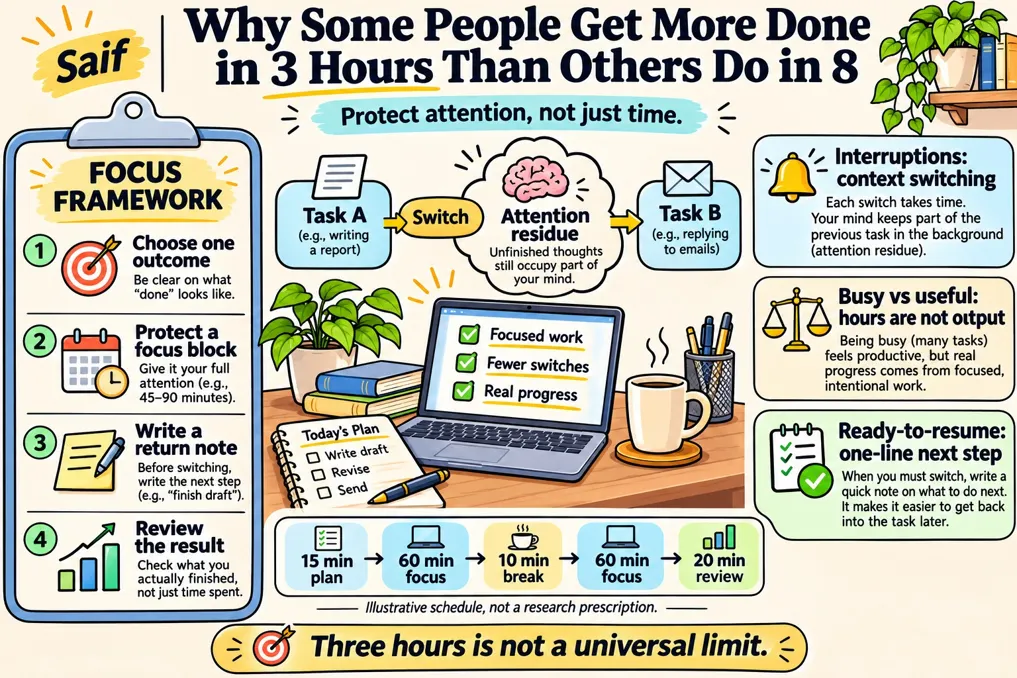
Contextual Case Study #12:When the Environment Makes Returning Difficult

Why the real problem may begin after an interruption?
Some people can begin a task without much difficulty.
They know what they need to do. They understand the next step. They may even make reasonable progress before something interrupts them.
Then they leave.
A phone call arrives. Someone needs their help. A meeting begins. A family responsibility demands attention. A colleague asks an unexpected question.
The interruption itself may be unavoidable.
The difficulty appears when they try to return.
The desk is now occupied. The document is buried beneath other windows. The notes they need are somewhere in a pile of papers. The next step is no longer obvious. The quiet space they were using has disappeared.
They intend to resume, but returning requires more effort than it did before they left.
They need to reconstruct their thinking, locate their materials, recreate the conditions in which they were working, and decide where to begin again.
They postpone the return until the environment feels suitable.
Sometimes that opportunity never arrives.
By the end of the day, a temporary interruption has become an abandoned work session.
This is a contextual case of the Restarter.
But the important question is not simply why the person struggles to resume.
It is:
What happens to the conditions for action after the person leaves — and how does the changed environment turn a temporary interruption into a prolonged absence?
To investigate the psychological mechanism, this case will examine Self-Sabotage: a possible pattern in which the person’s subsequent actions make returning to an intended goal harder than it needs to be.
That mechanism should not be assumed merely because the environment creates difficulty. The case must establish whether the person is contributing to the difficulty, or whether the environment is genuinely preventing a return.
The Case: Meera’s Interrupted Workday
Meera is preparing a detailed report for an upcoming review.
She works best when she has her reference documents open, her notes arranged in a particular order, and a clear view of the section she is writing.
During the first hour, she makes good progress.
Then a colleague approaches her with a problem that requires her attention.
Meera leaves her desk to help.
When she returns, another colleague is using the desk beside hers for a discussion. Her notes have been moved to make space. Several documents are closed, and a message notification appears on her screen.
She tries to resume.
But she cannot immediately remember how she intended to connect the last two sections. She searches for her notes, reopens the relevant files, and rereads what she has already written.
After several minutes, she becomes frustrated.
She tells herself she will return to the report once the discussion has ended and the workspace is quiet again.
In the meantime, she answers a few messages.
Then another request arrives.
By the time the environment becomes quieter, she has lost the time she intended to use for the report.
Meera concludes that interruptions are destroying her productivity.
That explanation is partly correct.
But it leaves an important question unanswered.
What could she have done before leaving, or immediately after returning, to make resumption possible despite the changed conditions?
Perhaps she could have recorded her exact stopping point. Perhaps she could have saved the relevant materials together. Perhaps she could have identified a smaller next action that did not require recreating the entire working environment.
Some conditions are outside her control.
Others may be modifiable.
Until she distinguishes between them, every interruption risks becoming a fresh starting problem.
Why the Environment Matters After an Interruption?
An interruption does not merely take time away from a task.
It can change the conditions under which the task was originally possible.
Before leaving, Meera had a working arrangement:
- Her materials were accessible.
- Her attention was organised around a particular problem.
- She knew what she was trying to accomplish.
- Her next action was reasonably clear.
- The environment supported continued work.
After returning, some or all of these conditions had changed.
The task itself may be exactly the same, but the cost of resuming it is different.
This is why telling someone to just get back to work can be inadequate.
The instruction assumes that the conditions required for returning still exist.
Sometimes they do not.
The person must rebuild them.
And when rebuilding takes effort, the task can begin to feel more difficult than it did before the interruption.
That creates an important distinction:
The interruption explains why the person left. The conditions after the interruption help explain whether the person returns.
For the Restarter, the return process deserves its own investigation.
The Primary Mechanism: Self-Sabotage
Self-Sabotage describes a pattern in which a person repeatedly does things that make achieving their own intended goal harder.
In this case, the environment may create the initial obstacle. Self-Sabotage becomes relevant only if the person’s subsequent behaviour contributes to maintaining or increasing that obstacle.
Consider two possibilities.
Possibility A: The environment genuinely prevents a return
Meera returns to find that her workspace is unavailable, her materials have been moved, and the information she needs is inaccessible.
She tries reasonable alternatives, but none is workable.
Her failure to resume is not sufficient evidence of Self-Sabotage.
The primary problem may be an environmental constraint.
The appropriate response is to investigate what access, workspace, information, or alternative arrangement she needs.
Possibility B: The environment makes returning harder, and Meera adds to the difficulty
Meera returns to a usable workspace, but her notes are scattered.
She could spend two minutes identifying the next action and opening the relevant document. Instead, she starts answering messages, opens unrelated files, and postpones the report until she feels organised.
Later, she finds that the return is even harder because the time has disappeared and her working context is still unreconstructed.
Here, her behaviour may be contributing to the conditions that maintain the problem.
The mechanism is worth investigating because the difficulty is no longer entirely external.
Meera may not be deliberately trying to undermine herself. Self-Sabotage does not require conscious intent.
The relevant question is whether her repeated responses make the intended task harder to resume.
Do not diagnose Self-Sabotage from the outcome alone. Identify the behaviour that increases the difficulty and examine whether that behaviour is part of a recurring pattern.
The Behavioural Loop
The case can be mapped in two connected stages.
Stage 1: The environmental disruption
Work begins → interruption occurs → person leaves → workspace or task conditions change → person returns → previous working conditions are no longer available.
This stage explains why returning has become more difficult.
It does not, by itself, establish a psychological mechanism.
Stage 2: The return becomes increasingly difficult
Return opportunity appears → reconstruction is required → next action feels unclear or effortful → person postpones resumption → time passes → additional demands accumulate → the original task becomes harder to restart.
If the person repeatedly adds avoidable delays, abandons workable return options, or engages in behaviours that further complicate resumption, Self-Sabotage may help maintain this second stage.
The Restarter describes the observable difficulty: returning after leaving.
Self-Sabotage is a possible explanation for some of the behaviour that makes returning harder.
The environment provides the context in which the pattern develops.
Get Suman Pradhan’s stories in your inbox
Join Medium for free to get updates from this writer.
These are related, but they are not interchangeable.
The Post-Interruption Environment Audit
For the next five working days, record what happens when you leave a task and attempt to return.
Choose one recurring task rather than tracking every interruption in your life.

At the end of the day, look for recurring patterns.
Do you repeatedly return to an environment that no longer supports the task?
Do you lose time reconstructing what you were doing?
Do you have workable opportunities to resume but use them for competing activities instead?
Do you postpone returning because you expect the original conditions to be restored first?
These questions help distinguish a genuine environmental barrier from a return process that has become unnecessarily difficult.
The Experiment: Design the Environment for Return
For seven days, choose one task that is frequently interrupted.
Do not begin by trying to eliminate every interruption. Instead, design a way to resume even when the original conditions have changed.
Step 1: Create a return point
Before leaving the task, record three things:
Where I stopped: The exact location in the work.
What I was doing: The immediate action or question in progress.
What I will do next: One specific action that can be performed when I return.
For example:
I stopped halfway through the second section of the report. I was comparing the quarterly figures. When I return, I will verify the March figures and finish the comparison paragraph.
This reduces the amount of thinking required to reconstruct the task.
Step 2: Make essential materials recoverable
Keep the materials needed for the next action together, digitally or physically.
For digital work, this might mean saving the relevant files in one location and leaving a note that identifies which document matters next.
For physical work, it might mean keeping the active notes and reference materials in a designated folder or tray.
The goal is not perfect organisation.
It is to reduce the number of decisions required to resume.
Step 3: Identify an alternative working condition
Ask what you can do if the original environment is unavailable.
If your desk is occupied, can you use another space?
If you cannot access all the materials, can you complete a smaller part of the task?
If you cannot concentrate because the environment is noisy, can you perform a related action that requires less uninterrupted attention?
Do not invent alternatives where none are realistically available. Record genuine constraints honestly.
Step 4: Use a minimum return action
When you return, do not demand that you immediately regain your previous level of concentration.
Start with the smallest meaningful action that reconnects you to the task.
Open the document. Read the last paragraph. Check the next figure. Write one sentence.
The purpose is to re-establish contact with the task before deciding whether you are ready for a longer work session.
Step 5: Review what actually helped
After seven days, examine which changes reduced the cost of returning.
Did a clear stopping note help?
Did keeping materials together save time?
Did an alternative workspace make a difference?
Did you have workable opportunities to resume but continue postponing them?
The answers should determine the next intervention.
Do not assume that every unsuccessful return requires more discipline. Sometimes the environment needs redesigning. Sometimes the return action needs simplifying. Sometimes another behavioural mechanism needs investigation.
The Gaming Sheet: Measure the Cost of Returning
A simple interruption tracker records how often someone is interrupted.
For this case, that is insufficient.
The central question is what happens after the interruption.

Track three measures particularly carefully:
1. Return delay: How long passed between the end of the interruption and meaningful work resuming?
2. Reconstruction cost: How much work was required to recreate the conditions needed to continue?
3. Successful return rate: Of the occasions when a realistic opportunity to resume existed, how many resulted in a return to the intended task?
These measures reveal more than the number of interruptions.
For example, interruptions might remain unchanged across two weeks while average return delay falls substantially. That would suggest that the return system has improved even though the environment remains unpredictable.
Conversely, a clear return note might make little difference if the person still lacks access to the workspace or information required to continue.
The Gaming Sheet should help you identify which part of the process is changing ,not merely whether you had a productive day.

Diagnosing the Restarter Without Blaming the Environment or the Person
A difficult return can have several explanations.
Environmental obstruction: The person cannot reasonably resume because necessary resources, access, time, or working conditions are unavailable.
Reconstruction difficulty: The person can return, but has to rebuild the context they lost while away.
Unclear re-entry: The person has access to the task but does not know precisely what to do next.
Behavioural postponement: A workable return opportunity exists, but the person repeatedly moves towards other activities instead.
A mixed pattern: The environment creates a genuine barrier, and the person’s subsequent responses add further delay.
These possibilities can coexist.
The point is not to decide in advance that the person is responsible for every failed return. Nor is it to assume that the environment explains everything.
The diagnostic task is to identify what happens at the moment returning becomes possible.
If the person cannot access the work, address access.
If they repeatedly lose the thread of the task, preserve the return point.
If they have the necessary conditions but avoid the first action, investigate what happens at that decision point.
If they resume but repeatedly leave again when the work becomes difficult, examine the process that triggers the next departure.
The intervention should target the actual breakdown.
The Real Intervention: Stop Requiring a Perfect Return
Many people imagine that returning to a task means recovering the state they were in before the interruption.
They want the same quiet, the same concentration, the same arrangement of materials, and the same sense of momentum.
But an interrupted environment may never return to its original state.
Waiting for it can turn a temporary disruption into prolonged postponement.
The alternative is to design a return process that tolerates some change.
For the Restarter, this means creating a reliable route back into the work, even when the original conditions have disappeared.
That route may include a recorded stopping point, accessible materials, a smaller next action, or a realistic alternative workspace.
However, these tools are not substitutes for solving genuine environmental problems.
A return note cannot compensate for missing information. A smaller action cannot create time that does not exist. A different workspace may not be available to someone who has no control over where they work.
The intervention must respect those constraints.
Where conditions can be improved, improve them.
Where they cannot, identify what remains possible.
Where the person has a workable opportunity to resume but repeatedly postpones it, investigate the behaviour maintaining that delay.
The goal is not to prevent every interruption. It is to prevent an interruption from automatically becoming an extended absence from the task.
Pattern in One Line
When the environment changes after an interruption, the Restarter’s difficulty may lie not in leaving the task but in the increased cost of returning; the intervention must distinguish genuine environmental barriers from the behaviours that make an otherwise workable return harder.