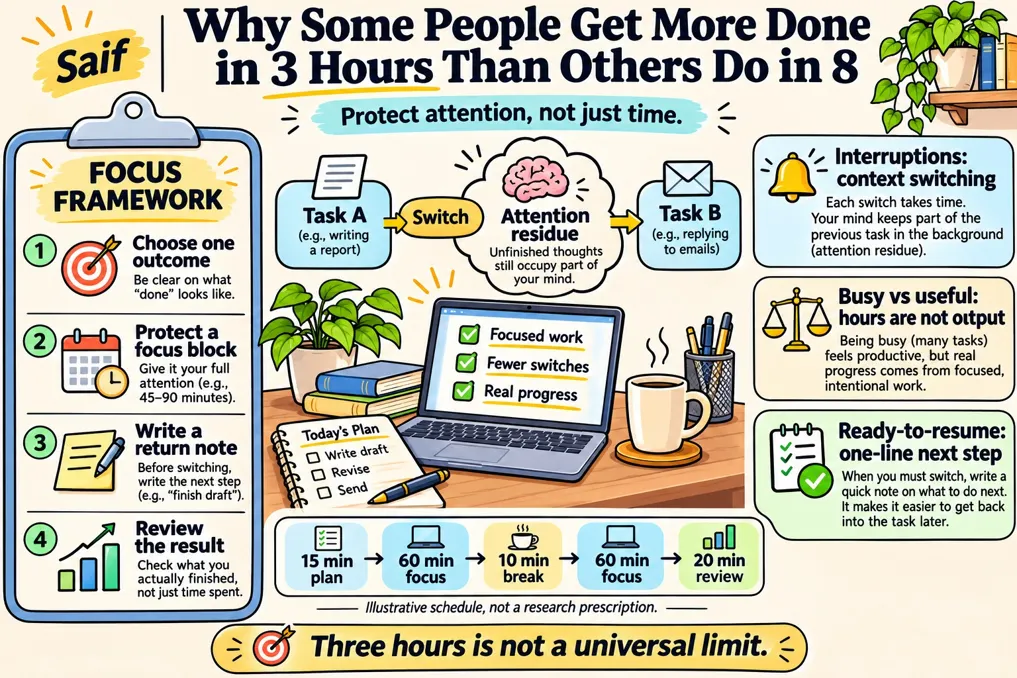
Contextual Case Study #13:When Distraction Is Built Into the Environment

How environments repeatedly make competing behaviour easier than the work we intend to do…
We often describe distraction as an individual problem.
Someone cannot concentrate.
They keep checking their phone.
They move between browser tabs.
They respond to notifications, conversations, messages, and small requests instead of continuing the task they intended to complete.
The usual advice follows naturally:
Remove distractions.
Improve your concentration.
Practise discipline.
Put your phone away.
But what happens when distraction is not an occasional interruption?
What happens when the environment repeatedly places competing behaviour within easy reach, while the intended task requires effort, concentration, and deliberate action?
Consider someone working at a desk where messages keep appearing, colleagues frequently approach, several unrelated tasks remain visible, and the phone is always within reach.
They are not encountering one distraction.
They are working inside an environment that repeatedly offers alternatives to the task.
And those alternatives often have an advantage: they are easier to access, provide immediate feedback, and require less effort to begin.
The problem is not simply that the person gets distracted. It is that the environment repeatedly makes distraction easier to perform than the intended behaviour.
This case examines that pattern through Self-Sabotage as the primary psychological mechanism and The Drifter as the primary behavioural archetype.
The Case: Rohan’s Distracting Workspace
Rohan works remotely and is responsible for preparing a detailed project proposal.
He has allocated two hours every morning for concentrated work.
His intention is clear.
But his working environment is full of competing opportunities.
His phone is beside his laptop. Notifications appear throughout the morning. His email remains open. Several browser tabs contain unfinished tasks. His messaging application is always accessible.
He begins writing.
A notification appears.
He checks it because it might be important.
While responding, he notices an unanswered email. He opens it, replies, and remembers another task that needs attention.
He returns to the proposal, but now he cannot immediately remember the argument he was developing.
He rereads the previous section.
Another notification appears.
This time, he checks it almost automatically.
The pattern continues.
At lunchtime, Rohan has responded to several messages, completed minor tasks, and moved between different activities.
He has spent two hours at his desk.
But the proposal has barely progressed.
He concludes that he lacks concentration.
He decides to try harder tomorrow.
The next morning, the same environment is waiting for him.
Nothing about the conditions that produced yesterday’s behaviour has changed.
And so the pattern repeats.
The Primary Mechanism: Self-Sabotage
Self-Sabotage describes a pattern in which a person repeatedly engages in behaviour that makes achieving their own goals harder.
In Rohan’s case, the environment provides frequent opportunities for competing behaviour.
But the mechanism becomes relevant when we examine how he responds to those opportunities.
He knows the proposal is important.
He has allocated time for it.
Yet he repeatedly engages with activities that interrupt his progress, increase the effort required to return, and reduce the time available for the intended work.
He may tell himself:
- “I’ll just check this message.”
- “This will only take a minute.”
- “I should clear my inbox before continuing.”
- “I can return to the proposal once everything else is sorted.”
- “I need to stay available in case something important comes up.”
Each decision may seem harmless.
The difficulty lies in their repetition and cumulative effect.
Rohan is not necessarily choosing to sabotage his project consciously.
But his repeated responses to the environment may be making the project increasingly difficult to complete.
There is an important qualification here.
An environment that encourages distraction is not itself evidence of Self-Sabotage.
If Rohan is required to monitor messages continuously as part of his job, the problem may be an organisational expectation rather than an individual mechanism.
If he has no control over interruptions, the environment may be the primary constraint.
Self-Sabotage becomes a useful explanation when he has some workable opportunity to protect his task but repeatedly engages in behaviours that undermine that opportunity.
The diagnosis must follow the behaviour, not the label.
How the Environment Maintains the Pattern
Rohan’s environment repeatedly presents competing activities with several advantages.
1. Immediate accessibility
The phone, messages, email, and unrelated tasks are already available. He does not have to make much effort to begin them.
2. Immediate feedback
A new message gives him something to respond to. An email gives him a clear action. A notification creates a sense that something has happened.
The proposal, by comparison, may require several minutes of concentrated thinking before visible progress appears.
3. Low entry cost
Checking a message is easy.
Returning to a complex argument requires him to reconstruct his thinking and continue from where he stopped.
4. Repeated exposure
Even when Rohan decides to concentrate, the same competing activities remain visible and accessible.
He must repeatedly resist them.
The environment therefore makes the unwanted behaviour easy to initiate and the intended behaviour harder to sustain.
This is not simply a concentration problem.
It is a repeated competition between two kinds of behaviour, occurring under conditions that favour one of them.
The Behavioural Loop
Rohan’s pattern can be mapped as follows:
Important task → competing activity becomes visible → competing activity is easily accessible → attention shifts → immediate response or relief → original task loses continuity → return requires additional effort → progress becomes slower → competing activity remains attractive → another departure.
Over time, the pattern may become self-reinforcing.
The more often Rohan leaves the proposal, the harder it becomes to maintain his working context.
The more difficult returning becomes, the more attractive an easier alternative may appear.
And because the environment continues to offer those alternatives, the same sequence can repeat throughout the day.
The important point is that the environment does not merely interrupt the task once.
It repeatedly creates opportunities for the behaviour that displaces it.
The Environment–Distraction Audit
For the next five working days, examine one environment in which you repeatedly lose contact with an intended task.
Do not begin by judging your concentration.
Study the conditions that make competing behaviour possible.

At the end of each day, examine the repeated conditions.
Are the same applications, objects, people, or environmental arrangements involved?
Get Suman Pradhan’s stories in your inbox
Join Medium for free to get updates from this writer.
Does distraction occur even when the task is clear?
Does the environment repeatedly make the alternative easier to access?
Most importantly, does changing access to the competing activity change your behaviour?
That final question helps distinguish an environmental problem from a pattern that continues even after the environment becomes more supportive.
The Seven-Day Experiment: Make the Intended Behaviour Easier to Choose
The purpose of this experiment is not to eliminate every distraction.
It is to change one environmental condition that repeatedly makes competing behaviour easier than the intended task.
Step 1: Identify the strongest competing activity
For example:
- Repeatedly checking messages.
- Opening unrelated browser tabs.
- Responding to non-urgent requests.
- Moving between several unfinished tasks.
- Checking notifications whenever they appear.
Choose one.
Do not try to redesign your entire environment at once.
Step 2: Identify what makes it easy
Ask:
- Is it always visible?
- Is it within immediate reach?
- Does it produce frequent notifications?
- Does it require less effort than the intended task?
- Does it provide immediate feedback?
You are looking for the environmental condition that gives the competing activity an advantage.
Step 3: Change that condition
Examples:
- Keep the phone outside the immediate workspace.
- Close unrelated browser tabs.
- Turn off non-essential notifications.
- Use a separate browser profile for concentrated work.
- Keep only the materials required for the current task visible.
- Establish a designated time for checking messages.
Choose a change that is realistic within your responsibilities.
If your role requires immediate availability, do not simply disable essential communication. Instead, identify which notifications genuinely require immediate attention and which can be handled at scheduled intervals.
Step 4: Make the intended action easier
Before beginning, open the relevant document, arrange the necessary materials, and identify the next physical action.
For example:
Instead of writing:
Work on proposal.
Write:
Complete the section explaining the project’s expected outcomes.
The objective is to reduce the effort required to continue the intended task.
Step 5: Observe the difference
For seven days, compare your behaviour before and after the environmental change.
Did you leave the task less frequently?
Did you notice fewer competing activities?
Did you return more quickly?
Did the task progress further?
Or did you simply find another way to avoid it?
That last possibility matters.
If distraction decreases but postponement continues, the environment may not have been the only mechanism maintaining the behaviour.
The Gaming Sheet: Measure Environmental Advantage
A conventional distraction tracker might record how often someone checks their phone.
But this case requires a broader view.
The objective is to understand how the environment influences the competition between intended and competing behaviour.

Track three measures particularly carefully.
1. Departure frequency: How often did you leave the intended task for a competing activity?
2. Return delay: How much time passed before meaningful work resumed?
3. Environmental response: Did reducing the accessibility or visibility of competing activities change your behaviour?
You may discover that the number of departures decreases but the return delay remains high.
Or you may discover that one distraction disappears while another replaces it.
These differences matter because an intervention should not be judged only by whether one unwanted behaviour decreases.
It should be judged by whether the intended behaviour becomes easier to perform.
Diagnosing the Behavioural Archetype
The Drifter is the most obvious archetype to investigate in this case.
The person repeatedly moves away from the intended task as competing activities capture attention.
However, the same environment can produce different behavioural breakdowns.
The Drifter — Recognition Axis
The person does not notice how far they have moved from the original intention.
They may spend considerable time on unrelated activities before recognising that the important task has disappeared from their attention.
The Restarter — Breaking Axis
The person notices the departure but struggles to return.
The competing activity may be brief, but the cost of reconstructing the original task becomes substantial.
The Hidden Perfectionist — Finishing Axis
The person may avoid the actual completion point by repeatedly checking, adjusting, researching, or improving the work.
The environment supplies the opportunities, but the difficulty lies in finishing.
These archetypes describe different places where the behavioural process breaks down.
They should not be confused with the primary mechanism.
Self-Sabotage remains the mechanism to investigate when the person’s repeated responses make their own goal harder to achieve.
The Real Intervention: Change the Competition, Not Just Your Concentration
People often try to solve environmental distraction by demanding more concentration from themselves.
But concentration is not the only variable involved.
If an environment repeatedly places competing behaviour within immediate reach, the person must repeatedly make a decision not to engage with it.
That is an expensive way to organise work.
A better intervention changes the conditions of the competition.
Make the intended task easier to enter.
Reduce unnecessary exposure to competing activities.
Create boundaries around communication.
Keep the next action visible.
Reduce the amount of reconstruction required after a departure.
And, where possible, change the environmental arrangements that repeatedly produce the same behaviour.
However, do not assume that every distraction can be removed.
Some environments are genuinely unpredictable. Some jobs require responsiveness. Some people have limited control over their workspace.
In those circumstances, the intervention may need to focus on protecting smaller periods of work, creating reliable return points, or negotiating more workable conditions.
The objective is not to create a perfectly distraction-free environment.
It is to stop making the intended behaviour unnecessarily difficult.
When competing behaviour is consistently easier to access than meaningful work, asking the individual to concentrate harder may leave the actual problem untouched.
Pattern in One Line
When distraction is built into the environment, the intended task repeatedly loses the competition for attention; Self-Sabotage becomes relevant when the person’s recurring responses further undermine their own goals, while the intervention must first address the environmental conditions that make competing behaviour easier.