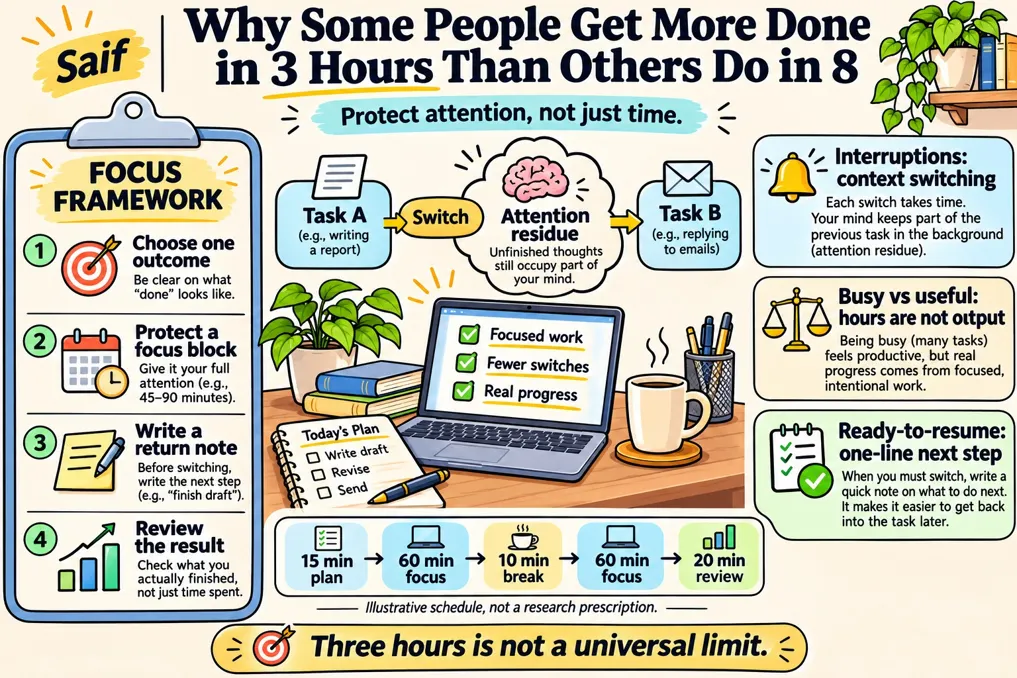
Contextual Case Study #3— The Restarter Under Repeated Interruptions

When starting isn’t difficult, but every interruption creates another return
At 8:30 a.m., someone begins working on a report.
They know what needs to be done.
The document is open. They find their rhythm. Twenty minutes later, the phone rings.
They deal with it.
They come back.
Before they can fully reconnect with the report, someone needs them for something else.
Another interruption.
They return again, but now they have to remember:
Where was I?
What was I trying to say?
Which document was I using?
They reread the previous section.
Just as the work begins making sense again, another demand appears.
By afternoon, something strange has happened.
They haven’t abandoned the report.
They haven’t decided not to do it.
They have simply had to restart their relationship with it over and over again.
Eventually, another interruption comes.
This time they think:
“I’ll get back to it when I have a proper block of time.”
They don’t.
The next morning, the report feels strangely distant.
Now returning requires more than opening the document.
They have to reconstruct yesterday’s thinking.
And what began as an interruption has become absence.
Some People Don’t Have a Starting Problem
This distinction matters.
A person can start reasonably well.
Give them a clear task and enough space, and they begin.
The difficulty appears after continuity has been broken.
That makes generic advice such as:
“Just start.”
poorly matched to the behavioural problem.
They already started.
Perhaps several times.
Their environment repeatedly creates a different demand:
Can you return?
For the Restarter, that question can matter more than initiation.
But What If Interruptions Aren’t Exceptional?
Many interventions quietly assume that uninterrupted work is normal and interruptions are occasional deviations.
For some people, that simply isn’t their environment.
A parent working from home may be interrupted repeatedly.
A teacher may move constantly between classes, students, administrative requests and preparation.
Someone caring for another person may have very little control over when their attention is required.
A workplace may be organised around messages, calls and rapidly changing priorities.
In these situations, designing a system that works only when nothing interrupts it may be designing a system for a day that rarely exists.
So the intervention needs to change.
The goal cannot always be:
Prevent interruption.
Sometimes it has to become:
Build a reliable way back after interruption.
The Behavioural Loop
For this person, the loop may look like:
Start → build momentum → interruption → leave → attempt to return → reconstruct context → regain momentum → interruption → leave again → return becomes increasingly expensive → postpone return
Notice what is happening.
The interruption itself isn’t necessarily the behavioural failure.
Some interruptions are unavoidable.
The important variable is what happens after them.
A five-minute interruption can become a five-minute absence.
Or it can become:
5 minutes → 20 minutes → afternoon → tomorrow → “I’ll restart properly on Monday.”
That expansion is what I would want to observe.
The Return Point Worksheet
For this contextual case, I wouldn’t begin by recording everything that interrupts the person.
I would begin by recording what the interruption leaves behind.
Before leaving an unfinished task, answer three questions:

That creates a Return Point.
Compare:
“Continue report.”
with:
“Open Section 3 and insert the April–June figures into the second paragraph.”
The second instruction requires far less reconstruction.
That matters when someone has already been mentally pulled into another context.
After the Interruption, Track the Return
Now the Gaming Sheet can capture something different:

The interruption duration and the return delay are not the same thing.
That distinction is important.
Get Suman Pradhan’s stories in your inbox
Join Medium for free to get updates from this writer.
If an interruption lasts fifteen minutes but the person remains away for another ninety, simply eliminating the original interruption doesn’t explain the whole pattern.
Now we have something measurable.
The First Experiment: Don’t Restart the Task
For the next few days, the intervention is not:
“Protect yourself from every interruption.”
It is:
After an interruption, return before deciding whether you are ready to continue.
That sounds strange, but the distinction matters.
The Restarter may unconsciously make returning conditional on having:
enough time,
enough concentration,
the right mood,
a quiet environment,
or the ability to work properly again.
So returning becomes expensive.
Instead, define a Minimum Return Action beforehand.
For example:
Open the document and read the last two sentences.
Or:
Put the next figure into the spreadsheet.
Or:
Write one sentence beneath the return marker.
That action doesn’t mean:
“Finish the task now.”
It means:
“Re-establish contact with the task.”
Returning and continuing are separate decisions.
Why “I’ll Come Back When I Have Time” Can Become Dangerous
Sometimes waiting genuinely is sensible.
Ten minutes may not be enough for work requiring sustained concentration.
But there is a difference between deliberately rescheduling something and leaving it without a return structure.
Compare:
“I’ll do this later.”
with:
“I can’t continue now. At 3:00, I’ll reopen Section 3 and start with the April–June figures.”
The second preserves a bridge.
The first leaves returning to a future version of yourself who will have to reconstruct both the task and the intention.
Repeated often enough, unfinished work accumulates.
And each unfinished task becomes another thing that requires restarting.
What the Gaming Sheet Should Measure
For the Student Drifter, recognition was central.
For the Workplace Drifter, we tracked displacement of priorities.
Here, I would make return behaviour the primary measurement.
Track:
Interruptions → opportunities to return → successful returns → average return delay → returns requiring reconstruction
Suppose the first week looks like:
12 interruptions → 7 same-day returns → average return delay: 74 minutes
After practising Return Points:
14 interruptions → 12 same-day returns → average return delay: 21 minutes
Interestingly, the person’s environment actually became more interrupted.
Yet their behavioural system may have improved.
That’s precisely why measuring only interruptions would have given us the wrong picture.
The intervention isn’t necessarily succeeding because life became easier.
It may be succeeding because recovery became more reliable.
If the Worksheet Doesn’t Work
Again, failure is information.
Suppose the person leaves excellent Return Points but still avoids reopening the task.
Ask what happens immediately before return.
If they think:
“I’ve lost momentum. I’ll need to start the whole thing again.”
we may need to reduce the psychological cost of re-entry further.
If they return but immediately begin correcting everything they completed earlier, a Hidden Perfectionist pattern may be interacting with the Restarter.
If they repeatedly forget that the task exists at all, recognition and Drifter behaviour may need examination.
And if the sheet shows that another person or system is interrupting them every few minutes, with virtually no usable recovery window, then we need to be careful.
The problem may not primarily be an individual’s ability to restart.
The environment may be incompatible with the kind of continuity the task requires.
No worksheet should turn a structural problem into a character flaw.
The Context Changes the Intervention
If interruptions are rare, preventing them may be enough.
If interruptions are inevitable, prevention alone becomes a fragile strategy.
The person needs something else:
a recovery system.
That changes the intervention question from:
“How do I stop getting interrupted?”
to:
“How cheaply and reliably can I return after I am interrupted?”
The aim isn’t to create a perfectly uninterrupted life.
For many people, that isn’t realistic.
The aim is to stop every interruption from becoming a new abandonment.
Because for the Restarter, resilience may not look like never losing momentum.
Sometimes it looks much simpler:
Knowing exactly how to come back.
Pattern in One Line
The Restarter under repeated interruptions doesn’t necessarily struggle to begin; the behavioural cost accumulates because every interruption creates another return, and without a reliable re-entry system, temporary departures can gradually become prolonged absences.
Write for Infinite Library: Submission Guidelines