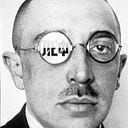
Speculation about the literature of tomorrow

Helmut Heissenbuttel (orig.1963/4)
//Reading high literary theory from the 1960s, from an experimental writer midway through his writing career is a rare pleasure. Not that Helmut Heissenbuttel is an experimental write in the sense of modern or avant-garde. Rather as you will see in the text that follows, he is a writer whose work is a con tinuopus experiment with words, phrases, sentences. It is you might say as nearly scientific, as a philosopher like Michel Serres is as nearly artistic, in this text from the mid-1960s. The question is what is missing from this 60 year old text? What has become of the form and contents Heissenbuttel writes of, and crucially what is missing? A partial inventory list is sufficient: science fiction and fantasy, fuzzy literature (in the sense of fuzzy logic), auto-fiction, the explosion of non-european literatures and of course the ease of translation in the 21st century…\\
<<anti-grammatical, anti-syntactical transformation and reproduction of language and effective principles in twentieth century literatire…>> (Heissenbuttel in Frankfurt) Just as they are now.
Speculation about the literature of tomorrow:It used to be easier to say what writers were writing about. Because there were tragedies (bourgeois and others) and comedies, social plays and historical dramas, Renaissance dramas and Hohenzollern dramas, love poems and ballads and nature poems and idylls and romances and patriotic songs, love stories and coming-of-age novels, historical novels and women’s novels, regional novels and war novellas, psychological novels and adventure novels, South Sea stories and colonial novellas, etc. It was understood that a colonial novella dealt with the problems of the colonies (English, French, German, etc.), a coming-of-age novel dealt with the development of a (usually young) man (not a woman, because there were novels for young girls, which, strangely enough, had little to do with development), an adventure novel was full of adventures, a regional novel was full of regional sentiment, etc.
Of all these, only the crime novel has survived to the present day. We know for sure that it deals with the story and (if possible) the solving of a murder. Have we grown tired of knowing in advance what we will find when we open a book? I’ll leave theater out of it, because, first of all, it’s so intertwined with classical literature that contemporary theater is hardly noticeable, and secondly, today’s plays mainly deal with the problems of theater itself, which leads us down a different track (besides, I haven’t been to the theater in a long time, so I can’t really judge). So I’ll stick with books, especially those that are meant to be read continuously over a longer period of time, whether they contain a novel, stories, or texts (although it’s not entirely clear whether the novel is already a text in itself or whether it must be assumed that it has a tendency to become more and more of a text). The text does not say this in a way that can be generalized. The blurb also does not say it in a way that could be generalized. For example, there are prisoner-of-war reports (and novels). But this theme as a type is rather hidden. What is openly proclaimed are statements such as that these are attempts by young authors, that they are a nouveau roman, an inner monologue, an experiment, or something similar. In other words, group designations or slogans that make use of pseudo-formal labels. Yet the new French novel has several clearly recognizable themes, such as captivity, as Gerda Zeltner has shown. A completely different classification should not be overlooked, namely that which is common in the field of post-Marxist ideology. There, a distinction is made solely between critical and social realism. The subject matter of literature is reduced to the depiction of the relationship that one or more individuals have to the general public, which means either bourgeois capitalist society or the communist state. There, all possible individual themes actually converge into one general theme.
So what do writers write about? What can those write about who only feel a dark urge without being clear about the nature of the commitment with which they would bind this urge? What are the topics that may have been in the air or on the streets in 1962/63 (as was often claimed immediately after the end of the war, when the mysteriously apostrophized drawers proved to be empty)? Where are the unborn, undiscovered heroes of emerging books and stories to be found? Is it once again the little man? The much-cited man on the street who doesn’t want to be one because he has the ambition to become more? Could it still be the farmer fighting for his land? (The question itself seems embarrassing.) Is it the functionary, that inevitable stylistic flourish of neo-democratic rhetoric? Is it the powerful, whose activity, once stripped of its representativeness, so easily falls back into powerlessness? Is it the victims of politics, of industrial development, of social change? Which victims, those of the past or those of today? Is it the lovers, who, to all appearances, remain in equal numbers? Is it married couples, who perhaps have a harder time than before in an age of dual careers and relaxed morals? Is it the believers, those who have survived, or those who would like to be believers without knowing which church to turn to? Is it the private self, seeking a few points of reference in a confused and confusing world? Is it still that unknown entity that the last fifty years have made increasingly plausible to us? Is it humanity itself, which, as is so often asserted, must be rediscovered, redefined, or whatever?
I have expanded this list of questions to illustrate what is not actually at stake. The difficulty, as all these seemingly misguided questions show, lies in the fact that the material of literature no longer presents itself as material in the way it did in the days when we learned to read. The familiar division of themes and subjects, which, it should be emphasized, made perfect sense, has become as meaningful as it is meaningless. Nothing answers it anymore.
A few examples: Jean Genet’s The Thief’s Journal is an autobiographical narrative; the author tells his own story. He does so because he is an outsider, because his experiences contradict those of society. The individual approach (the traditional theme) is reversed, for example, into a perspectival limitation. The immediate precursor to this can be found in the autobiographical narratives of Strindberg, in which the suffering of individuality is not yet able to break down the boundaries. Günter Grass’s The Tin Drum is very different from Genet’s work. It is also an autobiographical narrative, but allegorically alienated. The origin of the autobiographical in contrast to the environment, in ironic-opportunistic opposition to society. Where the narrative falls back into the merely personally interesting, it is empty. Thomas Mann’s The Confessor would be a historical-mythological novel according to conventional classifications; its precursors in this respect would be found in Anatole France, for example. Nevertheless, it is something completely different, a parable that finds its meaning in a special kind of Spracwitz and at the same time in a rhe- remaining half of the 19th century. But here, too, the quotation appears to live, an exemplary world of quotations that is suspended from all content. Jean Giono’s The Hussar on the Roof deals with a historical theme that can be defined even more precisely; it is set in the early 19th century. The factual content is suspended in a self-sufficient, self-aggrandizing linguistic space that is entirely drawn from the literature that is contemporary with the historical theme. Something similar can be observed in Sun and Moon by Paris Gütersloh. The first part of Samuel Beckett’s Molloy deals with the fate of an old vagrant. But that is not the subject of the novel. Molloy is a kind of Everyman, but stripped of all the pathos that Everyman had in Hofmannsthal’s attempts, for example, and saturated with the extreme experiences of Momo Artauds. In a different way, the Everyman is the unknown man whose portrait Nathalie Sarraute leaves out more than she draws in her story. Here we can see how, in the wake of the psychological novel, psychological differentiations automatically transform into an apparatus of sociological metaphor and allegory. Carlo Emilio Gadda deals with a criminal case in The Horrible Mess in Via Mernlana, Muriel Spark in The Bachelors, the story of an epileptic richly interspersed with criminal elements; Camilo Cela in The Beehive, the events that take place in a labyrinth of Madrid streets, apartments, and bars; Wright Morris in Love Among Cannibals, the love story of two musical writers; Arno Schmidt in The Stone Heart, the theft of historical documents. But all these different themes do not make these books distinguishable; their actual theme uses the various materials, occasions, and facts only as a means to an end. Their actual theme consists of something more general, which makes these books appear similar to each other despite all their differences in language, setting, characters, and milieu. The spectrum of different themes, which still had a specific meaning fifty years ago, has, as it were, melted together in II6 A LITERATURE OF THE DAY AFTER TOMORROW; the individual thematic colorings now have only coloristic value, so to speak; the essence is something general, almost the same.
Get sz_duras - text’s stories in your inbox
Join Medium for free to get updates from this writer.
All this must be indicated if one wants to take a step beyond the present day, if one wants to venture a speculation about what tomorrow will bring. For the question of what writers of the near future will write about is speculative. Speculation (meaning thinking that attempts to transcend the realm of experience through reflection) can only make sense if one extends lines from the realm of experience. Only the extension of what already exists can be discussed.
The keyword-like overview of a dozen novels from the last twenty-five years suggests that the various individual themes tend to merge into one another. This tendency runs parallel to the one that manifests itself in the blurring of genre characteristics. However, this merging does not apparently unify the thematic area; it merely creates a broad common basis on which the most diverse details can be settled. The material theme loses its constitutive and exemplary character, which it undoubtedly had in the past. What is more general, which takes its place, has, one might say at first glance, something to do with a more general, new, and fundamental desire for orientation. The inner and outer landscape, which seemed divided into its diverse districts, had become almost imperceptibly boundless and limitless. This was and is not recognizable in the conditions that can be gleaned from the public sphere and everyday life. It can only be recognized in the attempts of a few sharp-sighted individuals who realize that where the path is still presumed to exist, in reality it has long since disappeared; that where the fixed contours of a district still serve as an argument, in reality other, difficult-to-recognize conditions have long since taken hold.
Without resorting to metaphor, this means that the standardization of the thematic basis is a symptom of a temporary general uncertainty. This uncertainty will find expression in literature, and this will continue to be the case. It is then possible that the recent or distant past will be recapitulated once again, that an everyday event, a tram accident, a murder, a gossip story will be chosen as the starting point; it is also possible that the realm of imagination and the repertoire of ideas of some historical past will be used as a mirror; it is possible, perhaps with even more justification, that the patterns and schemata of “uneventful” everyday life will form the grid into which the empirical propositions will be hung, etc. For a while longer, the effort to understand what is going on will remain in the foreground. Engagement will increase, but not in the sense of forming more appropriate opinions, but rather in the search for and presentation of areas and grounds that will then, later, enable the formation of more appropriate opinions.
I do not assume that more specific themes will emerge. I suspect a renewal of some older narrative types and the clarification of some new types. Already, we can see a revival of allegory filled with contemporary details and insights from progressive experience, for example in the short novels of Simenon (The Accomplices, Three Rooms in Manhattan, The Negro, etc.) and in the last novels of Faulkner. The hallmark of this allegory will increasingly be realistic detail, precise observation, and a psychology typified by conventional morality. A revival of the similarly renewed dialogue seems possible (Thomas Mann, Die Betrogene; Claude Mauriac, Ein Abendessen in der Stadt, individual parts in various novels of recent years). The type of an open treatise, i.e., one not bound to any doctrine, seems to be emerging. In smaller form, even crime and science fiction stories have taken on a parable-like character (Stanley Ellin, Dashiell Hammett, Ray Bradbury). All these new takes or reworkings of an older literary typology are characterized by a certain paradox. The basic features that have been adopted are comparatively rigid and archaic. The historical development of these types took place in the realm of religious teachings; they express experiences of a pre-individual state. However, the material with which they are filled comes from the latest branches of individual experience and serves the experiences of a disoriented post-individual state. Superficially, one might suspect a restorative tendency here. The opposite is the case. In place of doctrine comes the utterly unteachable, formulations that express the utmost openness, the utmost independence from any pre-formulated theology. It is obvious that this, if you will, negative theology contains features that have been registered philosophically in so-called existentialism. The buzzword of existentialism, whether in Heidegger’s or the French variant, is nevertheless misleading insofar as these philosophical attempts at orientation are not the basis for contemporary literature, but a parallel phenomenon that remains as open as the literary forms.
If, in order to find a provisional label, one wanted to describe the subject matter as existential (which might make sense), one would always have to bear in mind that this label refers to the experience common to both philosophy and literature, not to specific philosophical questions. On the other hand, new literary types are emerging. narrative, a strategic narrative, and a topographical narrative. What all these types have in common is that the element of inventory narrative, cataloging, a statistical or topological novel, plays a greater role in them than the special, “interesting” features that characterize the 19th-century novel, for example. Pronounced factuality, to the point of denying one’s own processing of the material, registration methods, quasi-collage elements, the use of various scientific and semi-scientific disciplines, from information theory to depth psychology, from the schematics of the latest mathematical and physical findings to the experimental results of empirical sociology — all of this could be used to characterize this type of literature rather than the question of its “poetic” content or poetic quality. — II9 THEORY All of this could be used to characterize this type of literature rather than the question of its “poetic” content or poetic quality. Aesthetics can only be oriented here toward its cognitive value. L’art pour l’art would only make sense if it were understood as the ultimate consequence of a desire for knowledge bound to literature (i.e., not conceptually or philosophically explained). As a position of distancing oneself from society, it has lost its meaning. The examples that can be cited are still isolated. Gertrude Stein provided the magnificent first draft of a statistical novel with The Making of Americans. A number of more recent American novels (Bellow, Salinger, Hutchins) have inventory-like features.
A more recent German example of inventory narratives is provided by the Lebenslänfe (Lifetimes) by Alexander Kluge. Statistical and inventory-like features merge into one another. Topologically, one could describe the narrative style, which, in analogy to the mathematical use of this term, deals with neighborhood relationships, with the changing relationships of persons within a group, whereby the method could range from detailed description to reduced elementary narration. The type of strategic narrative could be recognized in the narrative conquest of a linguistic-material domain undertaken according to a specific plan. A pattern for this would be Raymond Queneau’s Sally Mara stories, in which the “content” is formed by the linguistically explored realm of experience. Jean Tardieu’s narrative of the research of “Professor Froeppel” would be along the same lines. Another variant of this type can be found in Henri Michaux’s mescaline report Turbulence in Infinity. Even a novel as conventional in appearance as Brecht’s The Business of Mr. Julius Caesar shows distinctly strategic features. I would describe as topographical a narrative style whose method aims at the depiction of a linguistically comprehensible space, the description of a repertoire landscape that can be delimited by vocabulary. A number of Mihaux’s short pieces are topographical in nature. Beckett’s Nameless and Schmidt’s Kaff bear topographical features in very different ways. In the German sphere, Jürgen Becker’s Felder (Fields) also belongs to this category. A large part of recent poetry is also topographical. There are already attempts to provide initial summaries in mixed types, summaries that differ from the old epoch-making works of Proust, Joyce, and Musil precisely in the characteristics of such a new typology. In the last phase of Mann’s work, the transition is perhaps most evident. Two very different works that could be mentioned as attempts with an explicitly collecting, summarizing character (regardless of how successful they may be considered) are Der Heilige Bimbam by Queneau and Fa: m Abniesgwow by Hans G. Helms. All these examples uniformly show that there is no longer any interest in the pattern of exposition, catastrophe, and resolution; that there is no longer any interest in empathetic sympathy with intimate matters of the heart; that there is no longer any interest in the invention of illusionistic worlds of play and mirrors; that there is a growing realization that the writer can know no more than what can be grasped in the immediate, unmediated unity of linguistic formulation and directed experience.
The traditional artificial scaffolding (whose artificiality constitutes the historical experience of those living today) stands empty and collapses one after the other. There is hope that the new constructions will have a higher degree of objectivity, that they will be more appropriate to the material they are intended to serve, the most general linguistic orientation, than the old ones that are being left behind. One does not know. Every step is a draft. The past returns transformed. The so-called inner monologue, once the last position of self-aggrandizing narrative, becomes an open network, a multifaceted but dense conglomerate of immediate linguistic reproductions. The fable, stripped of its defining role, penetrates the network in anecdotal knots. Psychology and sociology are constructive auxiliary disciplines. And so on.
I break off the sketch. It could be continued. The further the boundary of experience recedes in “deconstructive” progress, the more hypothetical its features would become. But what matters is not the increasingly detailed elaboration of this hypothesis, but the inspiration. In truth, only one thing helps, only one thing can lead further, and that is the attempt that the individual writer makes through writing. I think that in doing so, he has a large, perhaps even confusing selection of material to choose from. He can write about anything possible. However, the material will increasingly be guided by the types that are newly emerging. The types push for two basic themes, the existential and the sociological. Individual topics such as imprisonment come to the fore because they can be used to develop something like a model. In this respect, the choice of material is ultimately smaller than it initially appears. But in what the activity of writing is directed toward, in the commitment to knowledge, there is no choice. Anyone who still believes they have a choice has already lost.
(machine translation, 2025)