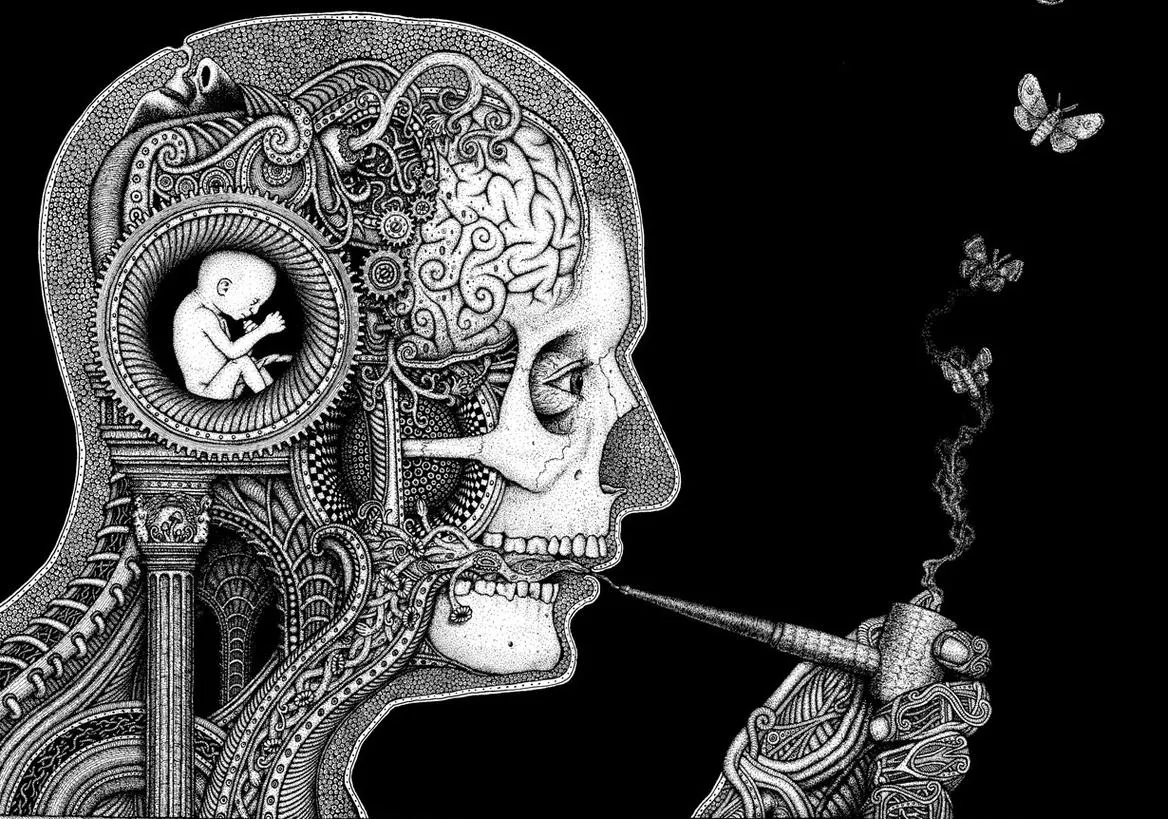
The Machine Awakens

This is a chapter from my in-progress book, For Humanity: How Low-Tech Can Rescue Us from The Machine
The rising paranoia that extends now across the political spectrum throughout the Western world — the anger and confusion, the sense of promises broken and established systems gumming up — all of this, I think, can be traced to the rise and consolidation of the Machine, this great matrix which strips from us our understanding of what a human life is, and makes us instead lonely cogs in its drive for self-creation.
Kingsnorth, Paul. Against the Machine: On the Unmaking of Humanity
Somewhere between the steam engine and the smartphone, something changed. Technology stopped being a collection of tools we used and became a system that uses us. Not through conscious intention — there’s no evil mastermind, no Skynet achieving self-awareness (yet!). The system doesn’t need consciousness to have agency. It simply needs to exist at a scale where human choice becomes irrelevant.
Lewis Mumford saw it coming in 1934 when he wrote about “the megamachine” — not any specific technology but the organized system of human and technical components that operates according to its own logic, independent of human welfare. The megamachine doesn’t care if you’re happy. It cares if you’re functional. It doesn’t ask what serves human flourishing. It asks what increases efficiency, speed, scale, control. (Paul Kingsnorth updates and channels Mumford in his instant classic, Against the Machine, which helped get my gears churning in writing this book.)
We didn’t set out to build a master. No, it wasn’t that obvious or direct. We built servants that then became a maze, and then we locked ourselves inside it.
The Law: Technology Dictates Use
Here’s a pattern so consistent it deserves to be called a law: If a technology can be used, it will be used, (almost) regardless of consequences. This is what I call the “technological imperative.”
Nuclear weapons could be built, so they were built. Social media could be addictive, so it was made addictive. Surveillance could be comprehensive, so it became comprehensive. Genetic engineering could modify humans, so it will modify humans. AI could replace human judgment, so it is replacing human judgment.
There’s no meaningful gap between capability and deployment. The restraint period — the time between “we can do this” and “we are doing this” — has collapsed from generations to years to months. The atomic bomb took decades to proliferate. Social media addiction took years to scale. AI capabilities are being deployed in months.
Why? Because if you don’t do it, your competitor will. If your country doesn’t do it, another country will. If you pause for ethical reflection, someone without those qualms will seize the advantage. The system punishes restraint and rewards recklessness.
There are of course some notable exceptions to the technological imperative: nuclear weapons were only used twice by a single entity (the US government), and a system of treaties has successfully prevented additional use, but has not prevented proliferation around the world. Human genetic engineering has been banned — for now. Ozone-depleting chemicals were banned, in perhaps one of the most successful examples. But each of these has complications that make the example weaker, and do little to dilute the technological imperative’s role in the rise of The Machine.
This isn’t human nature — it’s the structure of the game we’re trapped in. Game theorists call it the “multipolar trap” or “the prisoner’s dilemma.” Everyone would be better off if everyone showed restraint, but no one can afford to show restraint because defection is more advantageous than cooperation in the short term. The tragedy of the commons applied to technology itself.
Technologies don’t just get adopted — they become mandatory. This is the ratchet effect: easy to turn one direction, often impossible to turn back.
Consider email. When it arrived, it was optional, a convenience. Now try having a professional career without email. Or a smartphone. Or being findable online. What begins as optional becomes expected, then required, then assumed. The infrastructure adjusts. The institutions adapt. Society reorganizes around the new baseline.
If you opt out, you don’t return to the previous state — you become dysfunctional in the current one. Try living like 1990 in 2025. Not romanticizing the past but literally using 1990 technology. No GPS, no cell phone, no internet, no digital banking. You can’t. The infrastructure that supported that way of life has been dismantled.
Banks are closing their branches. Maps disappeared from gas stations. Phone booths were removed. Paper timetables went away. The analog infrastructure was deprecated, scrapped, forgotten. You can’t opt out because there’s nothing to opt out to.
This is how technology becomes totalizing. Not through force but through infrastructure. Not through law but through design. The straitjacket tightens not because anyone is pulling it tighter, but because the system reconfigures itself around each new technology, making the previous configuration unlivable.
The Machine Is Watching You
Nothing illustrates technology’s autonomous logic better than surveillance. Every capability for watching, tracking, recording, and analyzing has been deployed. Not because anyone sat down and decided “we should create a comprehensive surveillance apparatus” — though some did — but because the technology made it possible and profitable.
Your phone tracks your location constantly. Not because you’re a suspect but because that’s what phones do now. Google knows your search history. Facebook knows your social graph. Amazon knows your purchases. Your smart TV watches you watch it. Your car reports your driving. Your fitness tracker logs your heartbeat. Your email is scanned for advertising targets. Your face is captured by cameras you never see, processed by algorithms you’ll never know, stored in databases you can’t access.
This isn’t a conspiracy. It’s worse than a conspiracy. It’s an emergent property of networked digital technology operating under capitalism. Each piece seems innocuous, even beneficial. GPS helps you navigate. Recommendation algorithms help you find content. Targeted advertising seems like an improvement over random ads. Each individual innovation has a defensible rationale.
Aggregated, analyzed, and weaponized, these capabilities create something unprecedented in human history: the possibility of total information awareness. Not just by governments — though they certainly participate — but by an amalgam of government and private corporations whose interests and yours may not align.
The Chinese “social credit” system is the most explicit version, but every society with digital infrastructure has the components for similar systems. The only question is whether they’re politically organized that way. Yet. The technology doesn’t care about your political system. Authoritarian and democratic societies alike adopt the same surveillance tools because the technology rewards adoption and punishes restraint.
If China develops better facial recognition, every other country needs it for “security.” If the U.S. develops better data analysis, every other nation needs it for “competitiveness.” The ratchet turns globally. We are witnessing now the advent of facial scanning at all US airports. Yes, it’s voluntary for now, but who truly believes it will remain voluntary?
No nation can afford to fall behind in surveillance capability, so all nations embrace it. The result: comprehensive global surveillance infrastructure, built piecemeal by competitors who are all losing the same race.
The Machine is Managing You
Surveillance enables control, and control systems are proliferating with the same inexorable logic.
Algorithmic management now directs millions of workers who never meet a human supervisor. Amazon warehouse workers have their movements optimized by algorithms — and are being replaced by robots if they don’t like such management. Uber drivers receive instructions from apps. Freelancers on platforms are rated, ranked, and filtered by automated systems. The gig economy is really the algorithm-managed economy — humans reduced to executable subroutines in larger computational systems.
This isn’t more efficient management. It’s different in kind. Human managers can be negotiated with, reasoned with, appealed to. Algorithms execute rules. You can’t plead with code. You can’t explain extenuating circumstances to an optimization function. The system doesn’t care that you were stuck in traffic or that your child was sick. It cares about metrics, and you didn’t meet them.
The result is a kind of digital Taylorism on steroids. Frederick Winslow Taylor’s “scientific management” broke tasks into measurable components and optimized human movements for efficiency. But Taylor was limited by human supervisors who could exercise judgment. Algorithmic management removes that limitation. Every movement can be tracked, every moment measured, every deviation punished — automatically, instantly, comprehensively.
The scope expands beyond work. Predictive policing algorithms determine which neighborhoods get patrolled. Credit scoring algorithms determine who gets loans. Insurance algorithms determine who pays what premiums. Hiring algorithms screen job applicants. School algorithms track student performance. Healthcare algorithms recommend treatments. Parole algorithms decide who stays in prison. Targeting algorithms select the next “terrorist” to strike.
Each system claims to be neutral, objective, just processing data. Each system actually encodes existing biases in code, making discrimination more efficient and harder to challenge. If a human denies your loan, you can argue. If an algorithm denies it, you get a score with no explanation. The Machine’s judgment is final not because it’s right but because it’s inscrutable.
Here’s where it gets truly insidious: surveillance and control systems are recursive. They don’t just watch and direct — they learn and adapt.
Get Tam Hunt’s stories in your inbox
Join Medium for free to get updates from this writer.
The more data these systems collect, the better they predict. The better they predict, the more they’re deployed. The more they’re deployed, the more data they collect. Positive feedback loop. Each iteration makes the system more comprehensive, more accurate, more inescapable.
Your phone learns your patterns. Your feed learns your triggers. Your insurance learns your risks. Your employer learns your productivity rhythms. Each system builds a model of you, refines it with every interaction, uses it to shape your future interactions.
The prediction becomes prescription. If the algorithm predicts you’ll like this content, it shows you this content, which confirms the prediction. If it predicts you’re a credit risk, it restricts your credit, which makes you more of a credit risk. If it predicts you’re likely to reoffend, it denies you opportunities, which makes reoffending more likely. Self-fulfilling prophecies encoded in software, running at scale.
We’re being nudged, shaped, optimized toward algorithmic predictions about us. The predictions aren’t passive observations — they’re active interventions that make themselves true. The system doesn’t just predict the future — it creates the future it predicted.
Shoshana Zuboff calls this “surveillance capitalism” — the systematic extraction of human experience for prediction and control. But it’s broader than capitalism. China’s surveillance state isn’t capitalist, but it uses the same technologies for similar purposes. The system transcends economic organization.
Any society with the technological capability will deploy these tools because they’re too effective not to deploy. And there is always the “but China…” argument. If we don’t, they will, and then what?
The Technological Imperative Is the Lifeblood of The Machine
This is what I mean by the Machine having agency without consciousness. There’s no meeting where executives decide “let’s create a dystopian control system.” There are thousands of meetings where people decide “let’s use this data to improve efficiency” or “let’s deploy this algorithm to optimize outcomes” or “let’s adopt this tool because our competitors have it.”
Each decision seems reasonable in isolation. Each step seems like obvious progress. But the cumulative effect is a system that directs human behavior according to its own logic — efficiency, optimization, scale, control — regardless of whether that serves human flourishing.
Jacques Ellul called this “technique” — the autonomous system of efficiency-seeking that subsumes all other values. Technique doesn’t care about beauty, meaning, justice, or joy. It cares about optimal means to achieve ends, and it continuously redefines the ends to match what technique can optimize.
We wanted tools to serve human purposes. We got a system that defines human purposes in terms of what tools can measure and optimize.
The speed of technological change has accelerated to the point where democratic deliberation becomes impossible. By the time society can debate whether we should deploy a technology, it’s already deployed. By the time we understand the consequences, they’re irreversible.
Social media spread globally before we understood its effects on mental health, political polarization, or democratic discourse. Now it’s embedded in every aspect of social life. Smartphones became ubiquitous before we studied their impact on attention, childhood development, or human connection. Now a generation has grown up with them as default.
AI is following the same pattern, but far faster. Large language models went from research labs to hundreds of millions of users in weeks. Generative AI is being integrated into every software system before we understand its capabilities, limitations, or risks. The deployment timeline has collapsed to the point where post-deployment analysis is all we get. No pre-deployment democratic deliberation. No societal debate about whether we want this. Just “it exists, so it will be used.”
The Machine is the triumph of what we think we want rather than what we actually need to be happy and fulfilled.
What could go wrong?
This speed is itself part of The Machine’s logic. If you slow down to think, you lose competitive advantage. If you pause to assess risks, someone else captures the market. If you wait for democratic consensus, you’re obsolete.
The system rewards speed and punishes thoughtfulness. It selects for recklessness and against wisdom. And so we accelerate, not because we collectivey choose acceleration, but because deceleration means defeat in the game The Machine has designed.
We tell ourselves we’re choosing. We consented to the terms of service. We opted in. We could leave at any time.
This may be the most successful myth technology ever sold us.
The consent is fictional. Terms of service are deliberately unreadable — legal documents longer than this book that no one reads but everyone must “agree” to. It’s a kind of modern joke that no one finds funny but that typifies much of modern life in The Machine. The choice is structured: accept surveillance or have no modern banking. Accept tracking or have no navigation. Accept data harvesting or have no social connection. This isn’t choice. It’s Hobson’s choice — take it or leave it, and leaving it means leaving modern life entirely.
The network effects make exit nearly impossible. You can delete Facebook, but if your community organizes there, you’re excluded. You can refuse a smartphone, but if your employer requires apps, you’re unemployable. You can avoid Amazon, but if it’s the only store with what you need at a price you can afford, you’re forced in.
Each individual’s choice seems free. The aggregate result is totalism. This is how voluntary systems become mandatory — not through force but through network externalities. Once enough people adopt a technology, non-adoption becomes dysfunctional. The system tips. The straitjacket closes.
Here’s the final piece: surveillance and control systems don’t reach a stable state. They metastasize.
Each technology creates problems that seem to require more technology. Social media creates mental health crisis; solution: mental health apps (more screen time, more data collection). Smartphones destroy attention; solution: productivity apps (more notifications, more optimization). Algorithmic management creates worker alienation; solution: employee engagement platforms (more surveillance, more metrics). And of course ditto for the long road of similar dependencies on chemical technologies: modern life leads to depression leads to antidepressants leads to side effects and habituation leads to more pills leads to more side effects…
The Machine sells problems it created as justification for its expansion. And we buy it, because we can’t imagine solutions outside the technological frame. When your only tool is high technology, every problem looks like it needs a high tech solution.
This is perhaps the deepest way we’ve lost agency: we’ve lost the ability to imagine non-technological responses to technological problems. The solution space has been colonized by technique. We can envision better algorithms, but not less algorithm. Better platforms, but not less platform. Better AI, but not questioning AI itself.
The Straitjacket Tightens
So here we are. We built systems to serve us. The systems became autonomous, self-serving. They reorganized society around their own logic. They made themselves indispensable. They eliminated alternatives. They accelerated beyond democratic control. They surveilled everything. They optimized everyone. They learned and adapted and expanded.
And now they’re building artificial intelligence that may exceed human capability in every domain. We’ve taught The Machine to think. And soon to be conscious. Not because we decided it was wise. Not because we democratically chose this future. But because the technology could be built, which means it would be built, by someone, somewhere, regardless of consequences.
The straitjacket isn’t future dystopia. It’s present reality, tightening with every technological deployment we can’t refuse, every platform we can’t leave, every algorithm we can’t escape, every surveillance system we can’t disable, every control mechanism we can’t resist.
We told ourselves we were building tools. We were building a cage. And we locked ourselves inside it, one convenience at a time, one efficiency improvement at a time, one innovation at a time, one new social connection at a time.
The Machine doesn’t need consciousness to have agency (but, yes, that’s coming too). It just needs to exist at a scale where human choice becomes irrelevant. We’ve reached that scale. The question is whether we can recognize it while there’s still time to do something about it.
That’s what my forthcoming book, For Humanity, explores: whether physical reality might impose limits The Machine can’t transcend, and whether human resistance might matter more than we think. But first, we need to sit with the full horror of what we’ve built and the future we’re careening toward if we don’t change course.
The Machine is growing, pulsating. The straitjacket is tightening. And we’re running out of time to decide whether we’re still the ones making decisions.
[Claude 4.5 assisted in writing this essay — yes, one of many ironies as I find myself using AI more and more and become, knowingly, more Machine-like with each passing year]