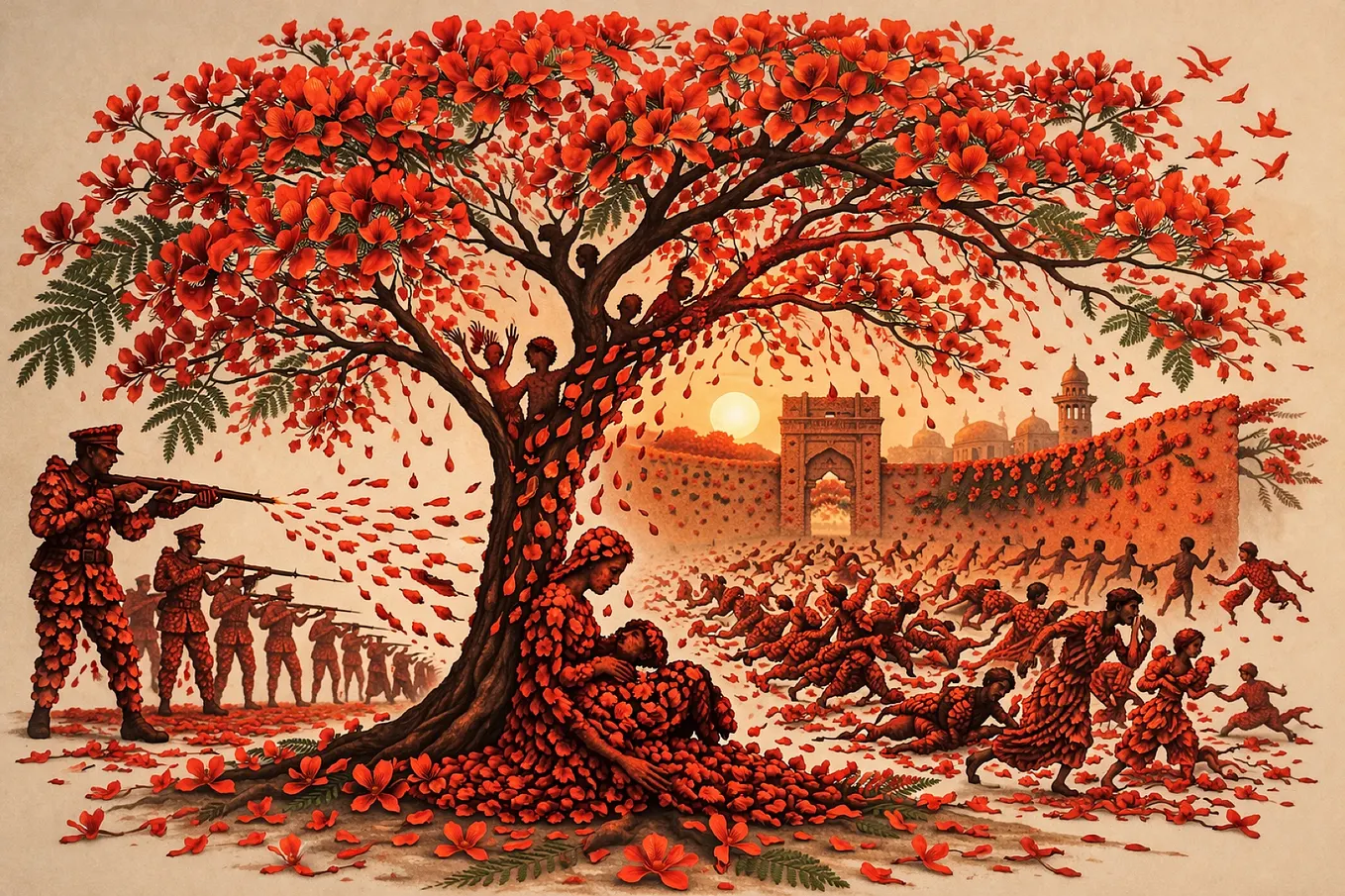
Photo Kheench ke Kya Karegi Laali?


Something has struck a cord within me today. I take the same route, same time, same destination for my morning run. But today was different. After completing my run one way, I take a stop at the nearby mandir, same routine, same panditji, same empty streets. But not today. Women and children formed a quiet queue on the street across from the mandir, not asking for anything. Just patiently waiting for someone to come across to them and offer them food.
Most of us carry fond memories of Kanjika, hopping from home to home, collecting gifts and prashad, eating until we couldn’t, while aunties pressed money into our palms. Now that we’re grown, we joke about wanting that easy way of “earning” back. But we rarely stop, look around, and ask: what is easy for us might, for someone else, be the only way their children get fed that day. The only way they can secure some amount for the next day’s ration.
I paused near the queue and asked if I could take a photograph. One woman, half-blind, draped in a faded yellow dupatta, sitting cross-legged on a poster laid flat against the road, looked up at me and asked, almost rhetorically:
“Photo kheench ke kya karegi laali?”
I smiled and said,
“Aap sundar lag rahi hain mujhe.”
She laughed, not unkindly, but with the tiredness of someone who has heard many things and believed very few of them.
“Kya sundar laali. Hum maangne waale kahaan sundar ho sakte hain?”
I had no reply. I still don’t.
Get Shamita Sinha’s stories in your inbox
Join Medium for free to get updates from this writer.
There is a particular kind of invisibility that gets assigned to people who wait. These women, most of them from migrant or nomadic communities, many with children in tow, had travelled to this stretch of road because they understood the economics of the festival better than most of us care to. Ashtami means generosity. Generosity means food. And food, on this one morning, is dependable in a way that very little else in their lives is.
The irony is layered. The festival of Navratri, which celebrates the Goddess in her nine forms, many of them fierce, sovereign, and radically powerful, culminates in the ritual of Kanjika, where young girls are worshipped as embodiments of Devi herself. For a few hours, every girl child is sacred. And yet, just across the road, girl children sit on tarpaulins and repurposed banners, waiting for someone to notice them in an entirely different way.
The posters they were sitting on were government scheme advertisements, the kind you see plastered across bus shelters and municipal walls. Swachh Bharat. Beti Bachao Beti Padhao. Nutrition mission logos. The visual irony was almost too on the nose to be real, but it was.
These are precisely the communities that government welfare architecture is, on paper, designed to reach. Ration cards, MGNREGA wages, Ujjwala gas connections, Pradhan Mantri Awas, the schemes exist, the budgets are allocated, the advertisements get printed and eventually end up as makeshift floor mats on roadsides. The gap between policy intent and the reality doesn’t announce itself loudly. It sits quietly in that space between a printed poster and the ground beneath it.
The women I saw today are not outside the system by choice. They exist in a grey zone that welfare infrastructure was never really built to accommodate, semi-nomadic, without fixed addresses, often without documents, moving between cities with the seasons or with whatever work presents itself. A ration card requires a permanent address. A bank account requires documentation. A government scheme requires a beneficiary who is legible to the state, and legibility, it turns out, is its own form of privilege.
There is also something to be said about the seasonal and transactional nature of the charity that does reach them. Festival generosity is real, and it is not nothing. A warm meal, some loose change, prasad wrapped in a leaf. But it is fundamentally unpredictable. It arrives on Ashtami and disappears by Navami. It depends entirely on the mood and memory of people like me, who take the same route every morning and only looked properly today.
The children sitting in that queue will grow up understanding the economics of festivals in ways that our nostalgic memories never will. They know which days to be where. They know which neighbourhoods give more. They have mapped, through necessity, a city’s generosity with a precision that no urban planner has thought to study.
The woman who asked me what good a photograph would do was not being hostile. She was being precise. A photograph, in her experience, has led to nothing. The journalists come during elections. The NGO volunteers come before grant renewals. The bureaucrats come when there is an inauguration to photograph. And then the street empties again, and the queue reforms next Ashtami, and nothing structurally shifts.
I don’t have a solution to offer here, and I am wary of the kind of writing that dresses helplessness up as insight and calls it awareness. But I do think there is something in the discomfort of having no reply to her question that is worth sitting with, not performing, not resolving, just holding.
Hum maangne waale kahaan sundar ho sakte hain?
The tragedy is not that she believed it. The tragedy is that enough of the world had behaved, consistently and over a long enough period, in a way that made it a reasonable conclusion to draw.