The Caloric Tax: Why Nobody Uses That Pedestrian Bridge


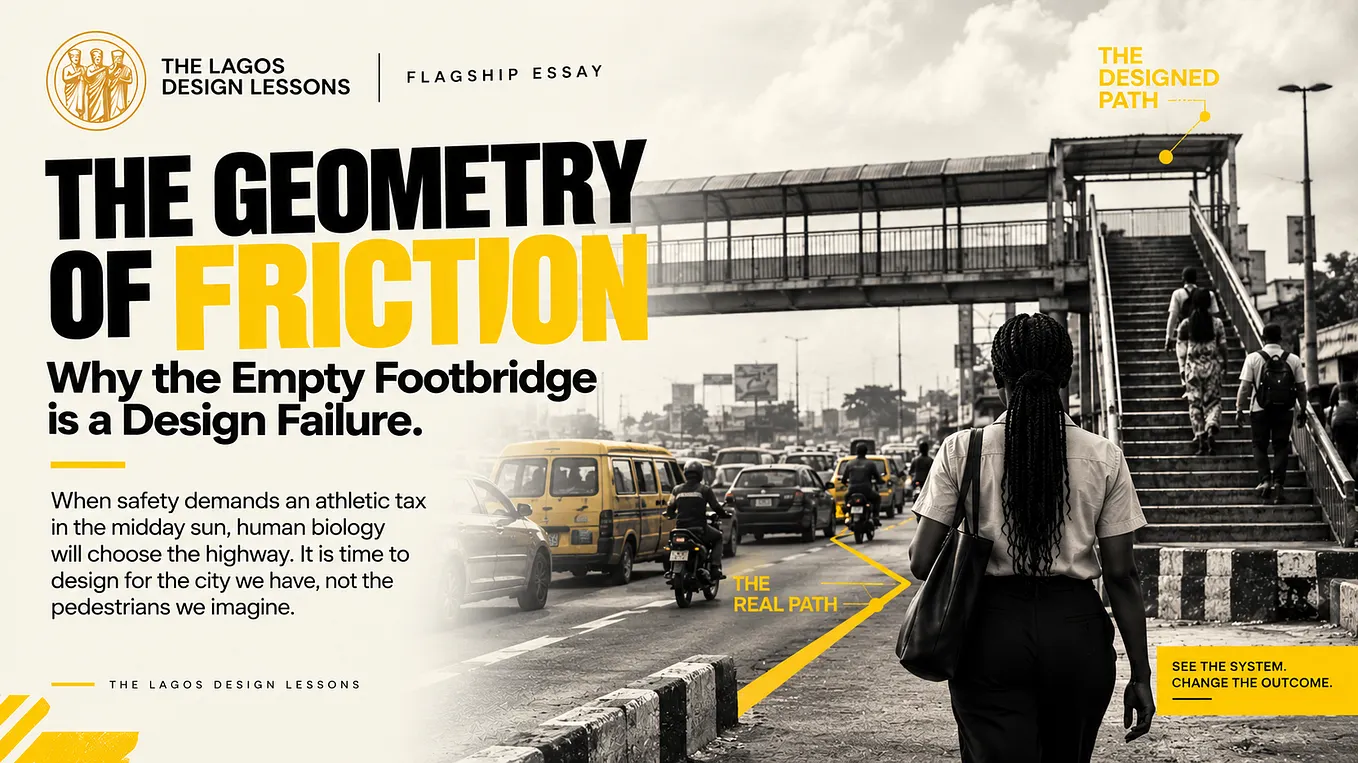
Stand along any major expressway in Lagos at 8:00 AM, and you’ll spot a familiar contradiction: a multi-million-naira pedestrian bridge standing quiet and empty, while a steady stream of people sprints across live traffic directly underneath it.
The usual reaction is moral exhaustion: People are stubborn. People don’t value their lives. People refuse to follow simple rules.
When public appeals fail, the state puts up two-meter iron fences along the median. Within weeks, the wire is clipped, panels are kicked down, and people are back to darting through traffic.
We keep diagnosing this as bad behavior. It’s not. It’s bad geometry.

The Real Math of a Footbridge
To a traffic engineer looking at a blueprint, an overpass makes total sense: lift the walkers into the sky so the cars can fly by down below.
To a human body navigating the city, it’s a terrible deal.
To take that “safe” bridge, a commuter has to:
- Walk 70 meters out of their way just to find the stairs.
- Climb three stories (over 7 meters) of steep concrete in 32°C heat.
- Cross an exposed span under the blazing sun.
- Walk down another three flights of stairs.
- Backtrack to the bus stop they were looking at in the first place.
Now imagine doing that in dress shoes, carrying two heavy market bags, holding a child’s hand, or running twenty minutes late for work.

This is The Caloric Tax — the physical energy, cognitive load, and time that bad infrastructure steals from everyday people.
Probability vs. Exhaustion
Why would someone risk getting hit by a Danfo bus rather than take the stairs?
Get The Lagos Design Lessons’s stories in your inbox
Join Medium for free to get updates from this writer.
Because a collision is a possibility, but sweating through your clothes and exhausting your legs is a certainty.
Crossing at ground level takes thirty seconds. Taking the bridge takes upwards of six minutes of hard physical labor. When an engineer balances their traffic flow by making the pedestrian absorb all the friction, the pedestrian’s body will instinctively rebel.

The commuter vaulting the barrier isn’t suicidal. The worn path through the grass and the clipped gap in the fence are not acts of vandalism — they are raw behavioural data. The pedestrian is simply auditing that caloric tax and refusing to pay it.
Stop Blaming, Start Designing
Great cities don’t expect people to climb small mountains just to cross the street. Instead of asking “Why won’t people use the bridge?” we need to ask: “What makes the alternative so much easier?”

To fix the system, design for human nature:
- Bring crossings back to the ground: Raised crosswalks that act as speed tables force cars to slow down while letting pedestrians cross at street grade.
- Build wide median islands instead of an Anti-crossing barrier: A two-meter refuge in the middle lets people cross three lanes at a time instead of sprinting across six all at once.
- Study friction before applying force: When a system requires fences, raids, and arrests to produce compliance, the design has already failed.
When the safe choice is also the most exhausting choice, people will always pick the shortcut[cite: 6]. If we want safer streets, we have to stop designing for obedient citizens and start designing for real, tired human bodies.