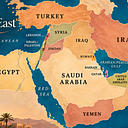
Power Centers in the Middle East from a 1959 perspective!
A summary of an article from 1959.

The following points are a summary of an article published in Foreign Policy magazine.
Titled: Two Centers of Arab Power by Frederick Harbison
July 1959
If we compare this with today, we see how much the Middle East has shifted and where the power centers lie today. The question is how much Iraq and Egypt benefited from their resources and locations to develop and advance?
THERE is some truth in the saying that anything can happen in the Middle East, and probably will. Certainly, few people would have predicted a year ago that within a short time there would be an open struggle between Arab nationalism and Communism. Whatever were Mr. Khrushchev’s reasons for pressing his fortunes with Mr. Kassem at the cost of such grave danger to his relations with Mr. Nasser, his decisions had an inherent logic based on economics rather than politics. For of the two traditional centers of power in the Arab world, Iraq and Egypt, the former may seem to the Soviets by far the more attractive in the long run. This article will contrast the problems of economic development in the two countries and suggest what the differences might mean both for strategic relationships within the area and for the larger power struggle in which the Middle East is not a pawn but a queen.
Summary points:
Egypt vs. Iraq: Development, Dependency & the Cold War Chessboard
Iraq vs Egypt: Contrasting Strengths
Iraq has abundant land, water, and oil wealth — but lacks trained manpower and strong institutions.
Egypt has skilled human capital, a functioning bureaucracy, and an industrial base — but suffers from land scarcity and capital shortages.
Agricultural Potential
Egypt’s land is overpopulated and nearly maxed out agriculturally.
Iraq has underutilized land that could dramatically boost food output with modest investment.
Capital & Investment
Iraq enjoys a steady stream of oil revenues (~£75M/year pre-1958) to fund development.
Egypt requires foreign capital, deficit financing, or painful internal austerity to progress.
Manpower & Institutions
Egypt exports teachers, engineers, and administrators across the Arab world.
Get The Middle East Focus’s stories in your inbox
Join Medium for free to get updates from this writer.
Iraq depends on importing such talent and has limited education infrastructure.
Industrial & Social Development
Egypt is industrializing with native managers in textiles, steel, oil refining, etc.
Iraq remains pre-industrial and dependent on foreign firms to build and run factories.
Arab Nationalism vs Communism
Nasser’s Egypt pursued pan-Arab unity to marry its manpower with Iraq’s resources.
Post-1958, Iraq leaned toward Communism under Kassem, sidelining Nasser’s influence.
Soviet Strategy Shift
USSR initially backed Egypt (1955–1958) with arms, loans, and economic support.
After the 1958 Iraqi revolution, the Soviets pivoted to Iraq for a more pliable partner.
Western Influence Declines
The Suez Crisis (1956) and failed Baghdad Pact show collapse of Western leverage.
The West now seeks to prevent full Soviet domination, not outright alignment.
Geopolitical Implication
The development paths of Egypt and Iraq are complementary, not competitive.
Long-term Arab development may require economic union — combining Iraq’s wealth with Egypt’s skills.
Final Insight
“There is no such thing as stringless aid.”
Economic development in the Middle East is deeply tied to great power competition — neither bloc offers help without influence.
The essay can be found on the following link.