Neutral intervals explained: halfway between major and minor
Answered: What is a neutral third? What is a neutral second? What other neutral intervals are there?

This article is AI-generated

In Western music theory rooted in 12-tone equal temperament, intervals are sorted into strict binary categories: seconds and thirds are recognized exclusively as either major or minor (measured at roughly 200/100 cents and 400/300 cents, respectively); and similarly for sixths and sevenths. These categories feel natural because they align with the harmonic series approximations available in the 5-limit and with the structure of the diatonic scale. Yet between every major and minor pair lies a middle ground — an interval that is neither one nor the other. These are the neutral intervals.
A neutral interval occupies the space roughly halfway between its major and minor counterparts. In 24edo (quarter-tone equal temperament), the neutral third is exactly 350 cents, the neutral second is 150 cents, the neutral sixth is 850 cents, and the neutral seventh is 1050 cents. A neutral interval inverts to another neutral interval: the inverse of a neutral third is a neutral sixth, and the inverse of a neutral second is a neutral seventh. This property distinguishes them from the major/minor pairs, which invert into each other.
Neutral intervals appear across many musical traditions and modern xenharmonic practice. They are not exotic curiosities; they are fundamental resources in Arabic, Persian, Turkish, and other Middle Eastern and Central Asian music systems, as well as in blues, certain folk traditions, and contemporary microtonal composition. Understanding them opens a richer palette of melodic color, harmonic tension, and scale construction beyond the 12-note framework.
Musical character and compositional uses
Neutral intervals carry a distinctive affective quality. A neutral third often feels neither fully bright nor fully bleak in the way major and minor thirds do: it can sound bitter and acidic, suspended and ambiguous, ancient and earth, or rich and vivid, depending on surrounding context, voicing, and learned cultural association. In melodic lines it provides smooth yet non-diatonic stepwise motion often described as ‘bendy’, like bending a spring. In harmony, a neutral triad (root + neutral third + perfect fifth) or more complex neutral sonorities create colors unavailable in 12edo.
Composers use neutrals to:
- Evoke or dialogue with Middle Eastern and related modal systems.
- Expand the expressive range of blues-derived or folk materials.
- Generate new scale types and temperaments whose step patterns feel familiar yet fresh.
- Create smooth voice-leading pathways that pass through the major/minor boundary (like Jacob Collier).
- Explore the beating and timbral effects of 11-limit and 13-limit intervals.
Because a neutral third halves a perfect fifth, scales built from it often possess a balanced, symmetrical feel while still supporting tonal centers. Neutral diatonic-like scales (with a mixture of whole tones and three-quarter-tone steps) offer heptatonic resources that are neither major nor minor in the classical sense.
Realization in equal temperaments
Equal temperament systems that divide the octave into more than 12 parts make neutral intervals available as exact scale degrees.
- In 24edo, every neutral interval appears as an integer number of steps of 50 cents. The system retains all 12edo pitches while adding the quarter-tones between them. Neutral seconds, thirds, sixths, and sevenths are therefore native. Many Arabic theoretical and practical systems relate closely to quarter-tone frameworks, even if actual performance intonation is more flexible.
- 31edo (step size ≈38.71 cents) provides excellent approximations to both 5-limit and higher-limit intervals while offering neutral seconds near 155 cents and neutral thirds near 348–387 cents depending on mapping. It is a strong meantone relative and supports rich harmonic practice that includes neutrals.
- Higher divisions such as 41edo and 72edo refine the approximations further. 72edo in particular matches both 12/11 and 11/10 closely and is a popular choice for detailed microtonal work that still relates transparently to 12edo and 24edo.
In any of these systems the neutral third can serve as a generator. Scales generated by stacking a neutral third (approximately 350 cents) that also contain a good perfect fifth produce characteristic “neutral-third scales.” These often appear as MOS scales (moments of symmetry) such as 4L 3s or 3L 4s forms, or larger structures. The neutral temperament (related to the rastmic clan and tempering the comma 243/242) provides a regular-temperament framework in which the neutral third functions as a consistent generator representing 11/9 or 27/22.
Just intonation and higher primes
In just intonation, neutral intervals most commonly arise from the 11-limit and 13-limit. The undecimal ratios 12/11, 11/10, and 11/9 are the classic neutral seconds and third. The tridecimal ratios 13/12 and 16/13 supply alternatives. Because 11/9 is the mediant of the classic major and minor thirds, simultaneous sounding of a note and its 11/9 produces distinctive beating patterns with the fifth and sixth harmonics that can be used compositionally.
Higher primes and more complex ratios expand the possibilities further, but the 11- and 13-limit already give a rich set of neutrals that sit cleanly between the 5-limit major and minor categories. Temperaments that map these ratios consistently (for example, those tempering 243/242) allow the neutral quality to propagate through chains of intervals, producing coherent neutral diatonic or neutral-third-generated scales.
Notation, instruments, and practical exploration
Standard staff notation can be extended with half-sharp and half-flat accidentals (or other microtonal accidentals) to indicate neutral intervals relative to a 12edo or diatonic framework. Specialized systems such as the Functional Just System (FJS) have been adapted to give consistent names to Pythagorean and higher-limit neutrals. Ups-and-downs or other relative notations work well in equal temperaments that support neutrals.
Get The Microtone Fox’s stories in your inbox
Join Medium for free to get updates from this writer.
Instruments capable of producing neutral intervals include:
- Fretted or fretless string instruments with appropriate fretting or continuous pitch control (oud, violin family, certain guitars).
- Wind instruments with microtonal fingerings or embouchure flexibility.
- Keyboard or MIDI instruments tuned to 24edo, 31edo, or custom scales.
- Synthesizers and software that accept Scala files or other tuning formats.
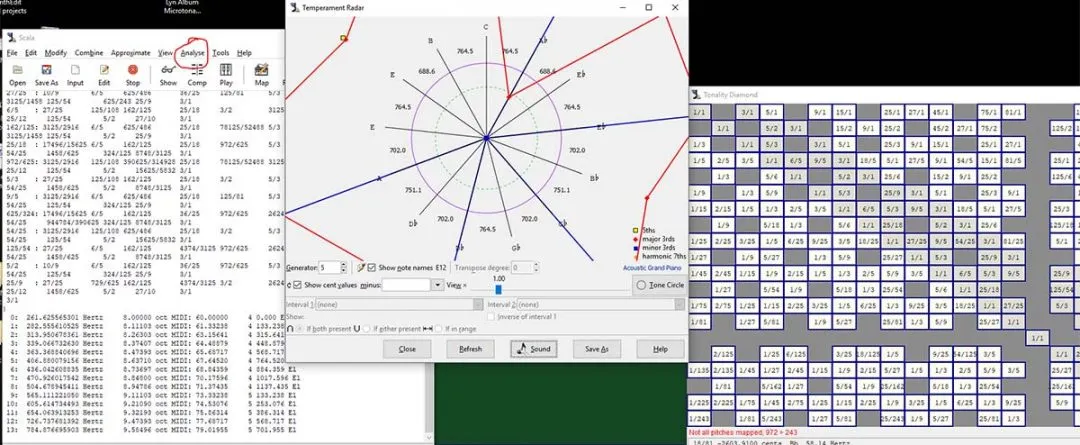
A particularly accessible practical tool is Scale Workshop, a free browser-based application for designing, auditioning, and exporting microtonal scales. Users can generate equal temperaments, enter just ratios or cent values, create MOS scales generated by neutral thirds, import and convert tuning files, and play the results with a computer keyboard, MIDI controller, or virtual keyboard. The resulting scales can be exported for use in a wide range of synthesizers and DAWs. Exploring a neutral-third MOS or a 24edo neutral diatonic scale in Scale Workshop quickly makes the characteristic sound and harmonic possibilities concrete.
Guitarists can experiment with neutral-thirds tuning (strings tuned a neutral third apart), which places many neutral intervals under the fingers on a conventional instrument and facilitates both melodic and harmonic exploration of the territory between major and minor.
Historical roots and the Zalzalian third
The concept of intervals between major and minor has deep historical precedent. In the medieval Islamic world, theorists described a distinctive third that sat between the minor and major. The 8th-century musician and theorist Mansur Zalzal is credited with a fretting on the oud that produced what later writers called the Zalzalian third or wosta. Al-Farabi (10th century) associated it with the ratio 27:22 (approximately 354.5 cents), while Avicenna (Ibn Sina, 11th century) gave 39:32 (approximately 342.5 cents). These values fall squarely in the neutral-third region. The interval was often treated as mobile or variable rather than fixed to a single ratio, reflecting performance practice in which the exact placement could shift according to melodic context, mode, or regional style.
Persian art music and related traditions have long employed neutral seconds and thirds as essential scalar building blocks. Parent scales and fretting systems discussed by medieval theorists and later musicologists show a variety of proposed sizes for these “neutral” steps, often around three-quarter tones. Modern measurements and theoretical proposals continue to refine these values, but the practical reality remains that performers treat them as flexible expressive resources rather than rigid mathematical constants. Similar intermediate intervals appear in other non-Western systems and in the expressive pitch bending of blues and rock guitar, where “blue notes” frequently land in the neutral-third zone between minor and major thirds.
Western theoretical recognition of the neutral third by name is more recent. Jan Pieter Land coined or popularized the term “neutral third” in 1880, drawing on the earlier Arabic and Persian descriptions. Later composers and theorists, including Alois Hába, incorporated neutral intervals into microtonal systems. In the 20th and 21st centuries, the rise of systematic microtonal exploration — particularly through equal divisions of the octave and just-intonation lattices — has given neutral intervals a precise vocabulary and a place in software tools, instrument design, and composition.
Defining the main neutral intervals
The primary neutral intervals are the neutral second, neutral third, neutral sixth, and neutral seventh. Each can be realized in multiple ways: as an equal-tempered step, as a simple just ratio, or as a more complex approximation in higher-limit just intonation or regular temperaments.
Neutral second
Wider than a minor second and narrower than a major second, typically in the region of 130–170 cents (with a common focus near 150 cents). In 24edo it is exactly 150 cents. Just approximations include the lesser undecimal neutral second 12/11 (≈150.6 cents) and the larger 11/10 (165 cents). The tridecimal 13/12 (≈138.6 cents) also falls in or near the region. Two neutral seconds can combine with other intervals to build larger structures; stacking a neutral second with a whole tone, for example, yields a neutral third.
Neutral third
The most discussed of the neutrals. It lies between the minor third (≈300 cents) and major third (≈400 cents), commonly in the 330–370 cent range, with many realizations clustering near 350 cents. In 24edo it is exactly 350 cents — precisely half of a perfect fifth. Key just ratios are the undecimal neutral third 11/9 (≈347.4 cents) and the tridecimal 16/13 (≈359.5 cents). The 11/9 is the mediant of 5/4 and 6/5, giving it special beating properties with the corresponding harmonics. The historical Zalzalian values (27/22 ≈354.5 cents, 39/32 ≈342.5 cents) also sit comfortably here. Two neutral thirds stacked equal a perfect fifth (or a close approximation thereof), which is the generative principle behind many neutral-third scales.
Neutral sixth
The inversion of the neutral third. It falls between the minor sixth and major sixth, around 850 cents in 24edo. Just approximations include 18/11 (≈852.6 cents) and 13/8 (≈840.5 cents).
Neutral seventh
The inversion of the neutral second. It lies between the minor seventh and major seventh, at 1050 cents in 24edo. Corresponding just ratios can be derived from the neutral-second ratios inverted and adjusted by the octave.
These intervals are often difficult for listeners raised exclusively on 12edo to distinguish from one another when they lie within about 12 cents, but once the ear is trained, the character of a neutral third versus a pure major or minor third becomes unmistakable — neither bright nor dark in the same way, but suspended, ambiguous, or distinctly “other.”
Further study and listening
The Xenharmonic Wiki pages on the individual neutral intervals, 24edo, 31edo, MOS scales, and related temperaments provide detailed tables of approximations, generated scales, and theoretical relationships. Historical sources on Arabic and Persian theory, modern analyses of intonation in those traditions, and the growing body of xenharmonic repertoire all reward deeper investigation.
Neutral intervals demonstrate that the space between major and minor is not empty. It is a fertile region of pitch relationships that has been cultivated for centuries in multiple cultures and is now fully available to any musician willing to step outside the 12edo frame. Whether approached through equal temperament, just intonation, historical practice, or experimental composition, the notes between major and minor expand both the technical vocabulary and the expressive horizon of music.
By learning to hear, notate, tune, and compose with neutral seconds, thirds, sixths, and sevenths, musicians gain access to a continuum of interval qualities that the binary major/minor system only samples at its extremes. The result is a richer, more continuous understanding of pitch space — one in which the familiar categories remain useful landmarks, but no longer define the entire map.