The First Black Hole Star Was Just Found — and It Changes Everything
A new class of cosmic object, hiding in plain sight for 13 billion years, may explain how the universe’s largest black holes grew so fast.

In August 2026, a team at MIT published a paper in Nature describing something that had never been directly observed before. Not a new planet. Not a new type of star. A new category of object entirely — one that physicists had theorized about for two decades, that required the most powerful space telescope ever built to find, and that quietly dismantles one of the most persistent puzzles in modern astrophysics.
They called it a black hole star.
The object, designated MoM-BH*-1, sits 13.14 billion light-years away in the constellation Cetus. It existed just 660 million years after the Big Bang, in a universe still running almost entirely on hydrogen and helium. And what makes it extraordinary is not just what it is — but what it implies about everything else, including the galaxy we live in.
What JWST Kept Finding (And Couldn’t Explain)
Since James Webb began returning data in 2022, astronomers have noticed something strange in nearly every deep-field image: tiny, compact, intensely red points of light scattered across the early universe. They called them little red dots, because no better name was available.
They showed up everywhere. One per image, on average, across surveys pointed at different parts of the sky at different times. And their spectra — the breakdown of their light by wavelength — didn’t match anything cleanly. Some showed signatures consistent with actively accreting black holes. Some looked more like dense stellar populations. Some showed both simultaneously, in proportions that fit neither model with any comfort.
Little red dots are common enough to be cosmologically significant, yet they essentially vanish by the present day. Something made them. Something ended them. For years, no one could say what either thing was.
The Survey That Found the Wrong Thing
Rohan Naidu and his team at MIT’s Kavli Institute weren’t looking for a new class of object. They were running a survey called Mirage or Miracle — designed to sort bright early-universe sources into two categories: genuine distant galaxies (miracles) or closer objects mimicking them (mirages).
While working through their targets, one source stopped cooperating.
It appeared as a compact red point in the constellation Cetus, unremarkable at first glance. But when they pointed NIRSpec at it for 4.5 hours in December 2024, what came back was a spectrum unlike anything in the existing classification system. Not a galaxy. Not a quasar. Not any of the things little red dots had been provisionally identified as.
The object was at a redshift of 7.7569. The universe, when this object existed, was 660 million years old.
Why Dust Didn’t Explain It
The first assumption was dust. It usually is. When an astronomical object looks unusually red, tiny carbon and silicate particles in and around the source absorb shorter blue wavelengths and let longer red ones through — the same physics that turns a sunset orange when wildfire smoke drifts in. Astronomers have been reading this signature for decades.
The team ran the standard diagnostics. Some features pointed toward dust. But others didn’t cooperate. The spectral shape didn’t follow the smooth slope that dust reddening produces. The chemistry was wrong. And then there was the feature that ruled dust out entirely.
The Number That Broke the Rules
MoM-BH*-1 showed a Balmer break of 7.7.
The Balmer break is a sharp drop in brightness at 364.6 nm, caused when hydrogen atoms absorb photons above a specific energy threshold. It appears in stellar spectra and in gas-rich environments. For any physically plausible combination of stars — any dust-free stellar population with any mass distribution — the maximum break strength is approximately 3.0. That ceiling is set by atomic physics. You cannot squeeze more break out of stars than the atoms will physically produce.
MoM-BH-1’s Balmer break of 7.7 is more than double the theoretical stellar maximum.* It is not a marginal excess. It is not a measurement uncertainty. It is a factor of more than two above the hard physical limit for any known stellar object.
The spectrum also showed the object was almost entirely hydrogen and helium — no measurable signatures of heavier elements. The chemical fingerprint of matter that formed before the first stars had time to seed the universe with anything more complex.
100 Billion Times Too Bright
The luminosity made the problem worse.
MoM-BH*-1 shines roughly 100 billion times more brightly than any known star. Not 100 billion times the Sun — 100 billion times the most massive, most energetically extreme stars that physics permits to exist. Nuclear fusion, the process that powers every star, cannot produce energy at this scale. The Eddington luminosity for even the most massive possible stellar object falls orders of magnitude short.
Only one mechanism generates energy at these levels: a black hole accreting material, converting gravitational potential energy into radiation at efficiencies between 6 and 42 percent — compared to fusion’s 0.7 percent. The team incorporated an accreting black hole into their models and found the closest match. The result pointed to a central black hole somewhere between 100,000 and 10 million times the mass of the Sun, surrounded by a dense hydrogen envelope spanning roughly the size of our solar system.
They had found something that had a theoretical name but had never been seen.
What a Black Hole Star Actually Is
A normal star is a dense ball of gas powered by nuclear fusion at its center. The fusion releases energy that works its way outward through the gas over thousands of years before escaping from the photosphere — the depth at which the gas becomes thin enough for light to finally get out.
A conventional accreting black hole grows via a thin, flat disk of infalling material that radiates intensely from its innermost regions. No photosphere. No stellar structure. Just a disk, a dark center, and often jets.
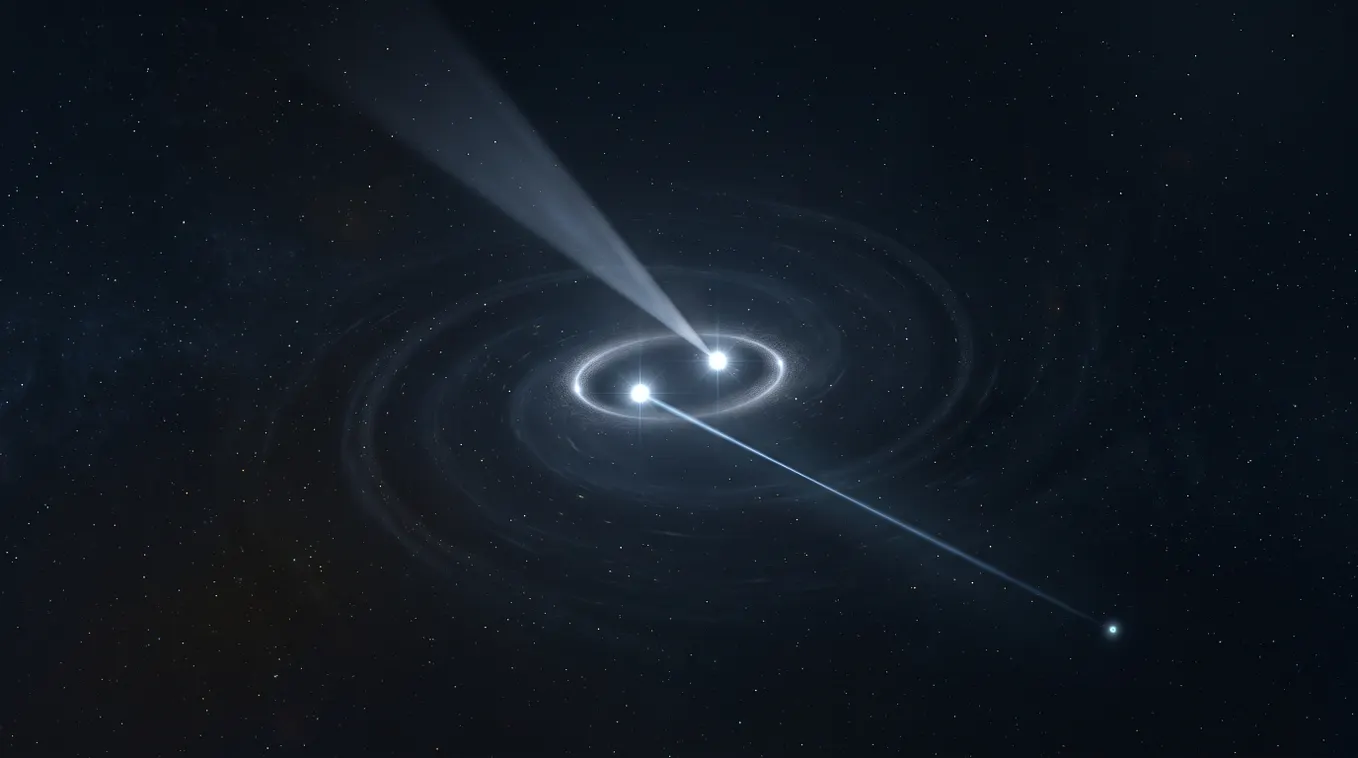
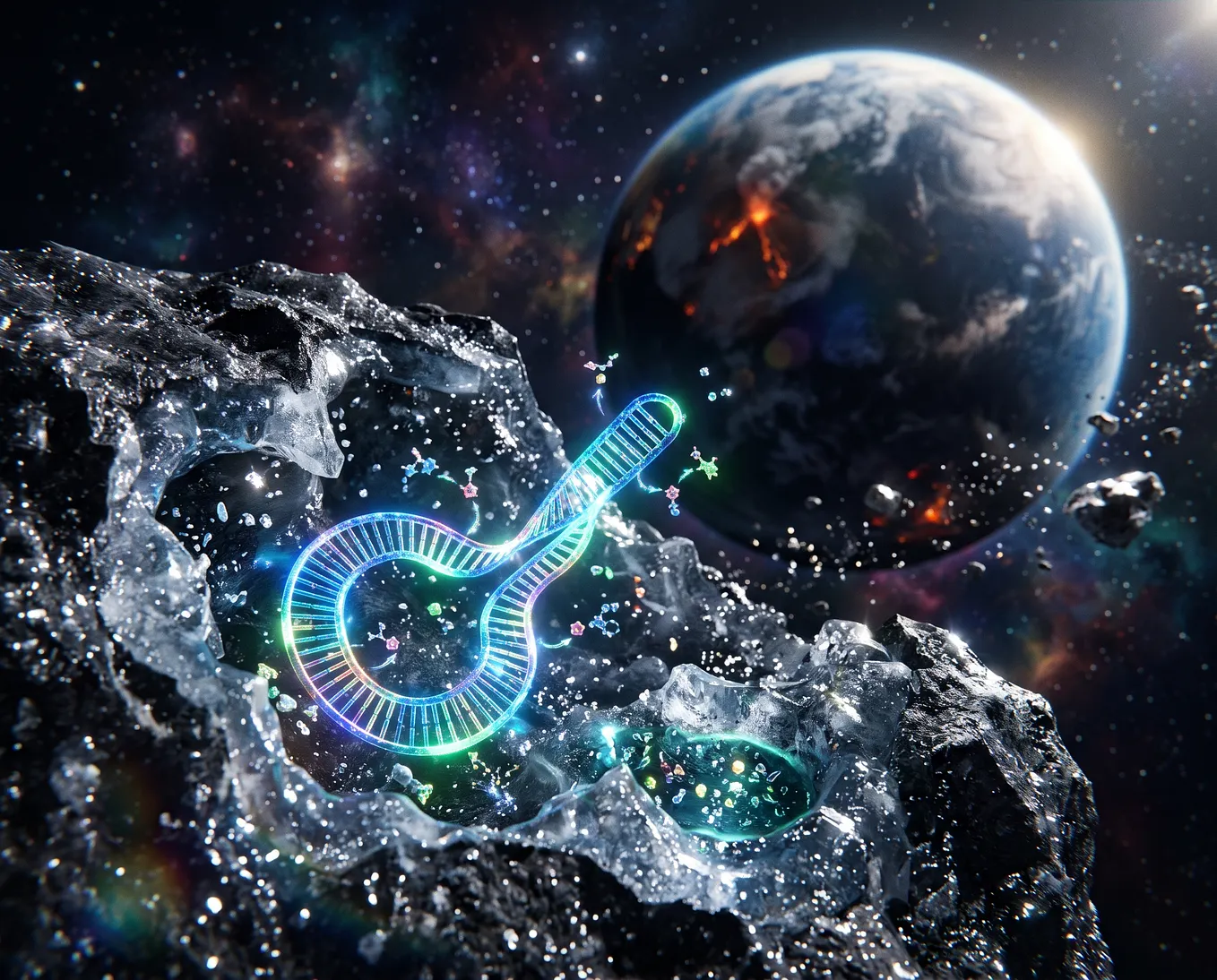
A black hole star is a third structure: a nascent black hole surrounded by a hydrogen cocoon so dense that the whole system radiates exactly like a star. The accreting black hole plays the role that nuclear fusion plays in a normal star. The surrounding gas acts as a pseudo-photosphere. The energy generated near the black hole fights its way outward through billions of kilometers of dense hydrogen before escaping as light — producing a spectrum with a Balmer break, hydrogen atmospheric features, and a thermal profile indistinguishable from a stellar surface.
There is no stellar surface. There is a black hole.
The Pseudo-Photosphere
The surface of a black hole star exists only because you cannot see past it. When photons generated by accretion near the black hole travel outward into the envelope, they are almost immediately absorbed and re-emitted, diffusing slowly through the gas the way heat moves through a dense material. At the outer edge of the envelope — where the density finally drops enough that light can escape — there is a layer that functions exactly like a stellar photosphere.
Get The Sleepy Physicist’s stories in your inbox
Join Medium for free to get updates from this writer.
Every measurement you take of this object through its spectrum says: star. Beneath that apparent surface is a black hole.
The 50-Year Problem It Helps Solve
Supermassive black holes weighing billions of solar masses have been observed less than a billion years after the Big Bang. This has been a problem for fifty years.
The standard growth model — a stellar black hole seed of tens to hundreds of solar masses, accreting at the Eddington rate — has a fixed doubling time of approximately 45 million years. Starting from 100 solar masses and accreting continuously at the maximum possible rate for 500 million years produces roughly 200,000 solar masses. Not a billion. Not even close. The arithmetic simply doesn’t close.
Force-Feeding: How the Cocoon Changes Everything
Inside the black hole star’s hydrogen envelope, radiation cannot escape freely. The gas is too dense for photons to travel outward as a coherent pressure force. Instead, radiation diffuses through the envelope the way heat diffuses through a thick material — and the weight of the gas pressing inward overwhelms the thermal pressure pushing outward.
The result is accretion at rates that can exceed the Eddington limit by an order of magnitude. The doubling time drops from 45 million years to 4.5 million years. Eleven doublings at 10 times the Eddington rate covers the same 500 million years — but reaches billions of solar masses instead of hundreds of thousands.
The cocoon doesn’t just make the black hole star look like a star. It makes the black hole grow like nothing else in the universe can.
A Prediction That Waited 20 Years
In 2006, theoretical astrophysicist Mitch Begelman published a paper proposing the existence of objects he called quasi-stars: black holes inside massive stellar envelopes, forming from the collapse of enormous Population III stars in the pristine hydrogen environment of the early universe. The physics was coherent. The conditions required for their formation existed only in a specific window of cosmic time. The objects would be rare, short-lived, and extraordinarily luminous.
No instrument existed to confirm them.
JWST launched in December 2021. By August 2026, Naidu’s team had a spectrum. Begelman’s prediction, made two decades earlier with no prospect of near-term confirmation, was sitting in the data. He was right for twenty years before anyone could prove it.
What It Means for the Little Red Dots
The team superimposed the spectrum of MoM-BH*-1 with that of a companion galaxy sitting 60 kiloparsecs away at nearly the same redshift. The combined result — a black hole star’s red optical emission added to the host galaxy’s ultraviolet — produced a V-shaped spectral energy distribution.
That V-shape is the defining signature of a little red dot.
The mystery that accumulated across hundreds of JWST images may not require a single exotic explanation. Many little red dots could be composite systems: a black hole star embedded in or adjacent to an early host galaxy, their combined light producing the signature that had been catalogued without explanation for years.
“The dots were always pairs. They just looked like points.”
Black Holes First, Galaxies Second
The standard picture of galaxy formation places the black hole inside the galaxy. Gas collapses, stars form, galaxies assemble, and somewhere in that process a black hole appears at the center and co-evolves with its host.
MoM-BH*-1 sits inside a host galaxy far less massive than its black hole’s growth history implies. The black hole is too big for the galaxy around it. That ratio is wrong in a direction the co-evolution model doesn’t naturally produce.
The evidence is pushing toward an inversion: black holes may not have formed inside galaxies. Galaxies may have assembled around black holes.
The galaxy is what happens after the black hole finishes what it started.
The Milky Way’s Hidden Origin
Sagittarius A*, the black hole at the center of our galaxy, weighs approximately four million solar masses. It is older than the Milky Way in any recognizable form — it preceded the disk, the spiral arms, the solar system, everything.
Naidu stated it directly: every massive black hole, including ours, may have passed through a black hole star phase. Before the Milky Way existed, before a single star in what would become our galaxy had ignited, the black hole at our galactic center may have been wrapped in a hydrogen cocoon the size of a solar system, shining 100 billion times brighter than any star.
Whatever it was before, it kept going.
What Remains Uncertain
The paper does not claim to have explained everything. The gas envelope model is simplified — real gas structures are turbulent and asymmetric in ways that a spherical approximation doesn’t capture. The black hole mass range of 100,000 to 10 million solar masses spans two orders of magnitude and is model-dependent. Population confirmation for the broader little red dot class has not yet been established. A second confirmed black hole star has not been announced.
A result that knows its own edges is more useful than one that pretends not to have them.
The Object Named One
The team called it MoM-BH*-1. The asterisk is standard astronomical notation for a star. The one is deliberate — it implies a population not yet counted.
When you name something “one,” you are claiming that two and three and everything after exist somewhere in the data. The catalogue has one entry. What it eventually reaches toward is a count that hasn’t been made yet — a survey that will take years, more spectra, better models, the slow accumulative work of a field characterizing something it only just learned existed.
MoM-BH*-1 is 13.14 billion light-years away. Its light left before our solar system existed. It produced a Balmer break that no star can explain, a luminosity that only a black hole can generate, and a spectrum that looked — until someone looked carefully enough — exactly like a star.
The asterisk means star. The one means there will be others.
We don’t know how many.
If this kind of physics is what you read before sleep, The Sleepy Physicist publishes long-form science explorations at patreon