LOOKBACK: Unique Hormel campaign in 1940 promoted tongue
Canned pork product called ‘Spam’s New Brother;’ phased out by company in 1990s
By Tim Ruzek
Mystery men and women in 1940 spread out around Austin seeking to find people in with a specific, hometown product.
And, no, it wasn’t Spam.
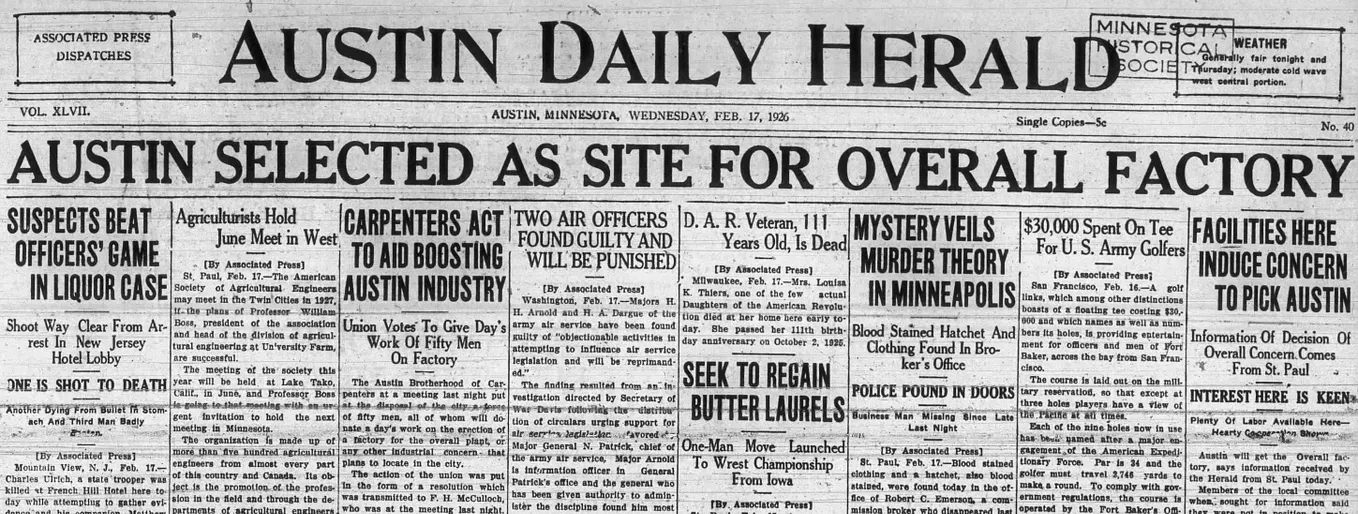
“Put Hormel Tongue on Your Tongue Today — and be a lucky shopper,” read a Hormel advertisement Aug. 5, 1940, in the Austin Daily Herald.
Already with an extensive portfolio of pork products, the Geo. A. Hormel & Co. launched a campaign to increase sales of its new, canned pork tongue often advertised next to Spam luncheon meat, which was created three years earlier.

Although Hormel previously sold canned tongue — particularly with national advertising in 1929 — Hormel in 1940 described its 12-ounce, cooked pork tongue as “Spam’s New Brother.” Canned tongue cost 29 to 31 cents per can, depending on the store — about a nickel more than Spam.
This effort was called a “unique ‘tongue-on-tongue’ campaign” officially started Aug. 2, 1940, as part of the company’s drive to boost tongue consumption.

Hormel’s mystery men and women sought to single out “people on the street, in their homes, offices or anywhere the occasion permits” to ask them: “Do you have a can of Hormel tongue?”
Those with a can received $5 (about $120 today).
“Here’s luck to the clever Austin housewives who use Hormel tongue,” an ad stated.


A week later, Hormel ran a list of its first round of “lucky shoppers,” all women, in the Herald.
Miss Mary Garry of South St. Paul Street (1st St SW today) was the first winner listed with store clerk Herman Scheibel at Red Owl. Other stores with a winner were Clara’s Grocery, West Side Market, Nelson’s Grocery, Kasak’s Grocery and Main Street Market.
Get Tim Ruzek’s stories in your inbox
Join Medium for free to get updates from this writer.
“These clever Austin housewives and store clerks had Hormel tongue on their tongue and were awarded $5.00 absolutely free!” a Hormel ad stated.
Despite a note saying more winners would be listed in the next day’s Herald, that does not appear to have happened. Only one can be found listing winners of the tongue campaign.

While an odd product today, canned tongue often was listed in grocery ads.
Austin’s Piggly Wiggly ran an ad in 1940 listing prices for Spam, olives, pickles and “fresh-baked, fancy” marshmallow cookies. Under the cookies, it listed “Tongue” for Hormel’s product.
That year at Clara’s Market, you could spend $1 to get a can of Spam; can of Hormel Tongue; one pound of dairy lard; one quart of Hormel pigs’ feet; and a half pound of “Minnesota sliced bacon” by Hormel.
During this time, Hormel ran ads with drawings of housewives discussing what was new with summer sandwiches.
“Spamwiches” — sliced Spam combined with tartar sauce or with lettuce and mayonnaise — were the new thing. The ads also suggested combining Spam — “the new miracle meat by Hormel” — with jelly, chopped olives or Russian dressing.
As for tongue, Hormel touted it as “delicious” and a “new meat sensation” but the company had sold tongue in some form for decades.
In its first decade in business in the 1890s, Hormel sold products at its Provision Market on North Main Street. This included pork feet, tongue and heart along with spiced vinegar pickled hocks, among other items.
In 1894, Hormel’s market — the “headquarters for all kinds of fresh, salt and smoked meats” — promoted “potted tongue — a great delicacy for putting up sandwiches, etc.”
By the 1920s and 1930s, Hormel offered an array of products from hogs: pork roast, pork shoulder, picnic hams, lard, boiled ham, pork sausage, pork liver and bacon ends. That was in addition to pigs’ feet, ears, hearts, hocks, snouts and, of course, tongues.
As World War II increased overseas, Hormel started providing large amounts of meat, especially in cans, to the U.S. government.
“Some of the meat, particularly the canned Spam, canned tongue and canned ham, is going across the sea, apparently,” the Herald wrote July 7, 1941, noting so much product was being provided that it adequately serving regular customers had become a problem.
After World War II, canned tongue continued to be featured prominently in recipe booklets, including in the late 1940s when Hormel rolled out Deviled Tongue as a “different, delicious, new” product. This was promoted as something that “rounds out your sandwich shelf,” giving variety and interest to finger foods and a nice addition to hearty salads.
Hormel also featured a tongue gelatin mold in a 1948 book of 253 recipes. This recipe called for one can of Hormel tongue with unflavored gelatin, diced celery, stuffed olives, cream cheese and more.
Across the country, Hormel tongue recipes were printed in newspapers, such as in 1949 when a Louisiana newspaper ran an article titled, “Three Things To Do with Hormel Tongue.” A Maine newspaper published a large ad stating, “Have yourself a sandwich of Hormel tongue.”
By 1954, a 12-ounce can of Hormel tongue sold for 71 cents or nearly $9 today.
Tongue eventually decreased in production by the 1970s and 1980s before being faded out completely by Hormel in the 1990s.