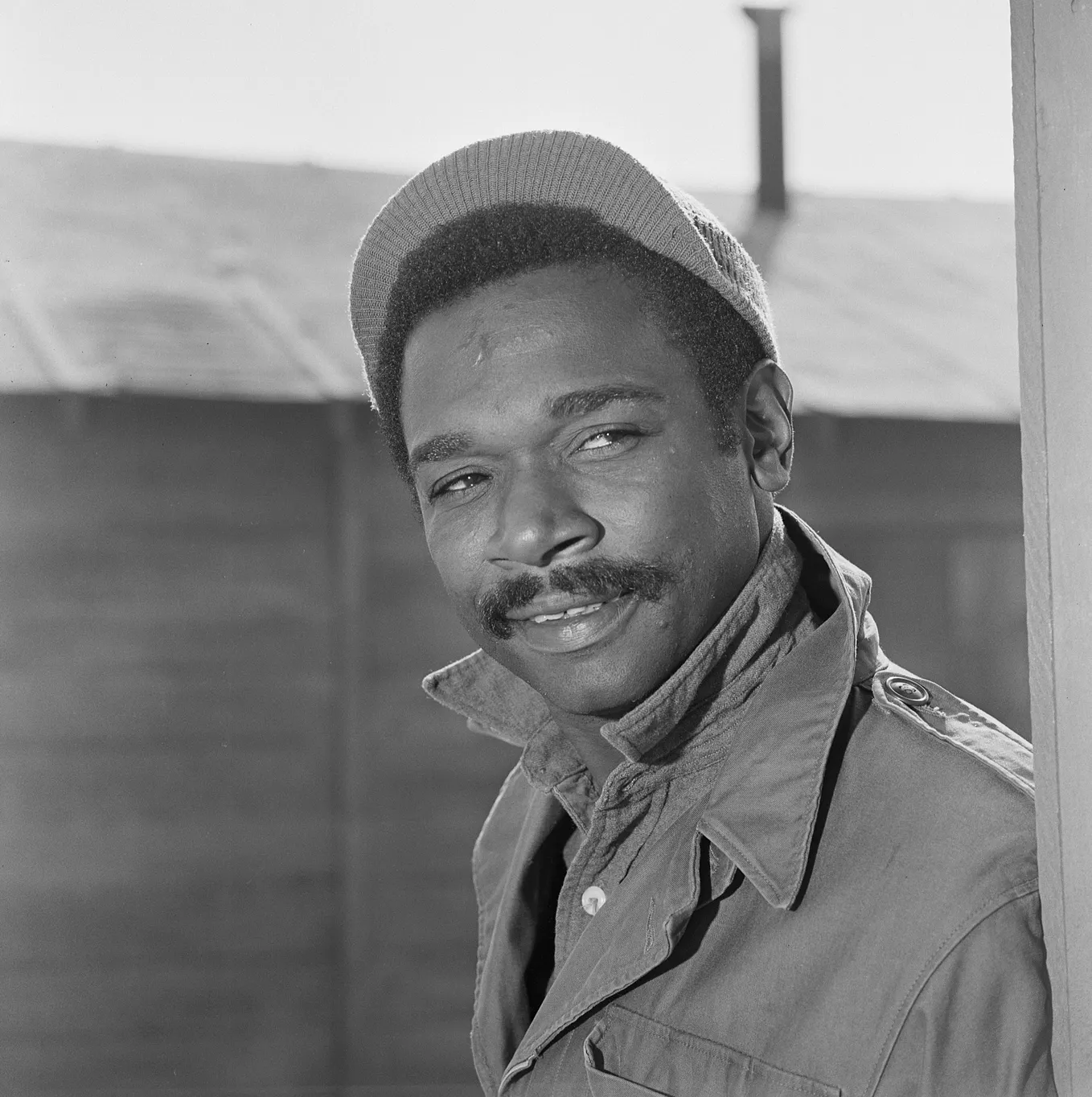
Gil Scott-Heron at the Crossroads by Mark Anthony Neal


As the story goes, Robert Johnson, one of the most influential guitarists of the twentieth-century, met the “Devil” at a crossroads in Clarksdale, Mississippi. Accordingly, Johnson sold his soul to that “Devil” that day, in exchange for the ability to play the guitar with a power and precision that many deemed otherworldly. The “Devil,” in this instance, was likely the Yoruba Orisha of the crossroads, alternately known as “Legba,” “Elegba,” “Eshu Elegbara” and Papa Labas in the fiction of Ishmael Reed. That power and precision that Johnson wielded so effectively, might be better referred to as truth, not so neatly packaged in the Blues tradition — a tradition that notably transcends the musical genre that shares its name.
A year before his death Gil Scott-Heron released, I’m New Here, his first studio recording in fifteen years. Fittingly, the lead single was a cover of Robert Johnson’s “Me and the Devil,” and while the choice of material may not have wholly been Scott-Heron’s, the song — as the spiritual embodiment of its composer — for damn sure chose Gil Scott-Heron. And this is not to suggest that Scott Heron — who often referred to himself as a “Blues-ologist” — was unaware of Johnson.
Scott-Heron, like Johnson, had spent a lifetime at the mythical crossroads that have defined much of Black vernacular culture. I’m New Here was a dark and brooding reminder of the costs associated with the power that the crossroads engenders. Burn away all the bells and whistles, bleeps and blurs, and Scott-Heron is standing at that same intersection of Highways 61 and 49 in Clarksdale, Mississippi with Robert Johnson, Billie Holiday, Henry Dumas, Linda Jones, Son House and so many others.
Shame on every writer who described Gil Scott-Heron as the “Godfather of Rap,” writers who have completely missed the point of the man’s career. It was a term that Gil Scott-Heron was not ambivalent about: “There seems to be a need within our community to have what the griot provided supplied in terms of chronology; a way to identify and classify events in black culture that were both historically influential and still relevant (Now and Then: The Poems of Gil Scott Hereon, xiv).
This is less Scott-Heron distancing himself from Hip-hop (though he would do so from time to time), but more a recognition that what he did, sat at the feet of traditions that came before him. He writes, “there were poets before me who had great influence on the language and the way it was performed and recorded: Oscar Brown, Jr., Melvin Van Peebles, and Amiri Baraka were all published and well respected for their poetry, plays, songs and range of other artistic achievements when the only thing I was taping were my ankles before basketball practice.” (xiv)
“The Revolution Will Not Be Televised” is easily the best known of Gil Scott-Heron’s compositions. Written and recorded just as the most militant energy of the Civil Rights and Black Power era seemed to be waning, the song was a sharp and prescient view of the commodities of struggle and resistance — the place where revolutionary acts give way to market forces and prime time ratings. In 1971, Scott-Heron couldn’t have imagined 24-hour news programming, cable television or podcasts, though “Revolution” proves as relevant now, as it might have even been when he wrote it.
To be sure, Gil Scott-Heron did pay a price for his truth-telling and his willingness to make politically relevant music accessible to all that would have it. Accessible is the telling term here, as Scott-Heron admitted that “because there were political elements in a few numbers, handy political labels were slapped across the body of our work, labels that maintain their innuendo of disapproval to this day.” (xv)
Perhaps we’ll never fully know if the drug-addiction and other dependencies that so often derailed Scott-Heron’s vision were part of some COINTELPRO inspired conspiracy, denying our most gifted and passionate, access to the thing that matters the most — their right minds (surely cheaper and neater than assassination). When Albert King sang “I Almost Lost My Mind” he wasn’t just whistlin’ in the dark about the warm body that had just left his bed — somewhere folk like Huey P. Newton, Etheridge Knight, Esther Phillips, Sly Stone, Flavor Flav, and a host of others, including Scott-Heron, fully understood what he lamented.
Get Mark Anthony Neal’s stories in your inbox
Join Medium for free to get updates from this writer.
Yet can’t help to think though, that Gil Scott-Heron knew that he was not here to be simply loved; that there were hard truths that he had to tell us and his addictions would always guarantee that we would keep him at an arm’s distance. Those times he went silent, it was as much about those addictions, and it was his unwillingness to bullshit us for the sake of selling records. If he couldn’t tell us the truth, he wouldn’t tell us anything, returning regularly to those crossroads via the needle or the pipe.
It is important to remember that Gil Scott-Heron was also a prodigy — coloring outside the lines in ways that were significant, but not all that remarkable, for a generation of young Black folk who understood the importance of challenging boundaries from the moment they took their first breaths. Some might call that freedom. There was the grandmother, Lily Scott, who made sure the young boy read books and read the weekly edition of The Chicago Defender — the closest thing to a Black national newspaper for Black Americans in the mid-20th Century — where Scott-Heron first read the columns of Langton Hughes. Before he married beats (and melodies) and rhymes, a 19-year-old Gil Scott-Heron had written his first novel.
Thankfully Scott-Heron took to heart Haki Madhubuti’s (the Don L. Lee) adage that revolutionary language really didn’t matter if it couldn’t reach folk on the dance-floor; Scott-Heron took it a step further, recognizing, as the Last Poets and Watt Prophets did, that some of the cats never left the street corners. (At that same moment, Nikki Giovanni also understood there were also souls to be saved in the pews, hence her Gospel inspired Truth is on the Way). Those earliest Gil Scott-Heron recordings, like Small Talk at 125 Street, Pieces of a Man, Free Will and Winter in America, released on independent labels like Bob Thiele’s Flying Dutchman and Strata-East, seemed like sonic counterparts to the $.05 cent poetry broadsides that poet and publisher Dudley Randall used to sell on the streets of Chicago in the 1960s.
The revolution might not have been televised then, but if you listen closely to songs like “No Knock,” (in response former Attorney General John Mitchell’s plan to have law enforcement enter homes without knocking first), “Home is Where the Hatred Is” (on drug addiction) and “Whitey on the Moon” the revolution was clearly being recorded and pressed. The difficulty in those days was making sure that distribution of Scott-Heron’s music could match demand for it.
Gil Scott-Heron got unlikely support from Clive Davis — yes, the same Clive Davis who later created boutique labels for L.A. Reid and Kenny “Babyface” Edmonds, Sean “PuffyDiddyDaddy” Combs, and served as Svengali for Whitney Houston and Alicia Keys. Davis, who funded the now infamous “Harvard Report” on Black music while at Columbia Records, had been deposed from the label, and started a new label, Arista. Davis needed acts, and acts that already had an established base, and Scott-Heron fit the bill.
It was an odd marriage indeed — notable that Davis never really signed another political artist of Scott-Heron’s stature — but it also allowed Scott-Heron to experience the most prolific period of his career, with defining albums like First Minute of a New Day (1975), From South Africa to South Carolina (which featured the anti-apartheid anthem “Johannesburg”), Bridges (1977), and Reflections (1981), which featured his 12-minute scouring of then just elected President Ronald Reagan on “B-Movie” (released months after Reagan’s 1981 shooting and after Scott-Heron had completed a national tour opening for Stevie Wonder).
For all our memories of Scott-Heron’s political impact, his music covered a full gamut of experiences. A track like “Lady Day and Coltrane” paid tribute to Black musical traditions, while songs like “A Very Precious Time” and “Your Daddy Loves You” found Scott-Heron thinking about issues of intimacy. Well before proto-Harlem Renaissance writer Jean Toomer would be recovered by scholars and critics, Scott-Heron used Toomer’s Cane as inspiration in his music. Even as young activists make the connection between Black life and environmental racism, Scott-Heron offered his take on the plaintive “We Almost Lost Detroit.”
“We Almost Lost Detroit” was later sampled by Kanye West for Common’s “The People,” speaking to the ways that Scott-Heron remained relevant some thirty years after his popularity peaked. Much was made about West’s “duet” with Scott-Heron on “Lost in the World” (drawn from Scott-Heron’s “Comment # 1”) and Scott-Heron’s use of West’s “Flashing Lights” on I’m Here Now’s “On Coming from a Broken Home.”
The latter song was inspired by Scott-Heron’s tribute to his grandmother Lily Scott, who died in 1999. In a society in which fatherlessness continues to be deemed as simply pathology, Scott-Heron defiantly asserted “I come from what they called a broken home/but if they had ever really called at our house/they would have known how wrong they were…My life has been guided by women/but because of them I am a man.”
On Friday May 27, 2011, Gil Scott-Heron went home to reunite with his grandmother; His job was done.
Mark Anthony Neal is the James B. Duke Distinguished Professor of African American Studies and Professor of English and Gender, Sexuality and Feminist Studies at Duke University. The author of several books including Looking for Leroy: Illegible Black Masculinities and Black Ephemera: The Crisis and Challenge of the Musical Archive, both from NYU Press. Neal’s next book Save a Seat for Me: Notes on American Fatherhood will be published by Simon & Schuster in August of 2026.