A Table Where No One Watches the Clock


I had driven out past the towers, past the roads that carry everyone somewhere urgent, until the city thinned and the water appeared. That is where Fico sits, at 1300 East Coast Parkway, close enough that the air tastes faintly of salt. You don’t pass it on the way to something else. You choose it. You book ahead, you make the drive, and by doing so you agree to give the evening more time than you usually would.
There is honesty in a restaurant that plants itself by the beach instead of in the middle of town. It asks something of you before you even sit. It asks you to arrive differently.
The room is built around open air and light. The Lo & Behold Group made it feel like a masseria, one of those old farmhouses in the Italian south where dinner unspools for hours and nobody thinks to check the time. As the sun dropped, tables filled around me. Laughter carried across the space, louder as the night went on, the sound of people who had nowhere better to be.
I came with friends. We shared, the way you’re meant to here.
The San Marzano focaccia came first.
Airy inside, crisp at the edge, thats the kind of bread focaccia is, it gives a little before it yields. On top, the tomatoes tasted of sun rather than acid, sweet and unhurried. A little olive oil. Some basil. Nothing more.
I held a piece for a moment before eating it. Bread and tomato, handled with care, can be a whole thought on their own. The plainness wasn’t a shortcut. It was the entire point, and it took confidence to leave it that bare.
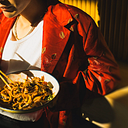
Then the Denti Del Drago, handmade pasta with an honest bite and edges that weren’t quite even, which told you a person shaped them. A white ragu clung to it, deep and savoury without weighing anything down. Ricotta softened the whole plate, folding creaminess through the meat. This is what they mean by Cucina Povera. Humble things, old methods, a dish that carries more than its parts suggest.
Get Tony Min’s stories in your inbox
Join Medium for free to get updates from this writer.
The charcoal grilled octopus belonged to the sea outside. Tender under a lightly charred surface, smoke on the skin, the sweetness of the octopus still intact underneath. Crisp at the edges, soft at the centre. Passed around the table, it made sense in a way it might not have somewhere landlocked.
We drank as we ate. I started with the Fig Espresso Martini, Wheatley vodka, fig syrup, coffee liqueur, espresso, the coffee reaching you first and the fig arriving behind it. Later, the La Marchesana 2024, a Primitivo full of dark berries and plum, velvet against the pasta and the grill.
Dessert was the surprise I didn’t expect. Burrata gelato, savoury and mild, lifted by strawberry, grounded by tomato jam, finished with olive oil. Sweet and not-sweet holding hands. It sat somewhere between the familiar and the strange, and I liked it there.
Behind it all is Chef Mirko Febbrile, whose cooking is deeply shaped by the food traditions of Puglia. He isn’t chasing spectacle. You taste that. He seems more interested in the truth of a tomato than in impressing anyone at the table, and that restraint runs through everything the kitchen sends out. Plenty of places hide behind their technique. Here the cooking steps aside and lets the produce speak for itself.
That is rarer than it sounds.
I’ve been thinking about why a place like this matters in a city that moves the way ours does.
We’re good at eating on the way to something. But every so often a room reminds you that a meal can be the destination and not the interval between other things. That fascinates me. There’s always something about an evening you stay longer than you meant to that changes the shape of a meal. I like how establishments understands that the setting can matter as much as the plate, that a long table by the water with friends and a bottle of wine is its own kind of nourishment.
I’ve been thinking about why a place like this matters in a city that moves the way ours does.
There was no weight of expectation laid on the evening. Just good food, open air, and time enough to use it.
I drove home in the dark with the windows down. The salt was still there, faint on the air. And I thought about how easy it is to forget that dinner can be something you sink into rather than get through.
Some nights, you leave a table full in more ways than one.