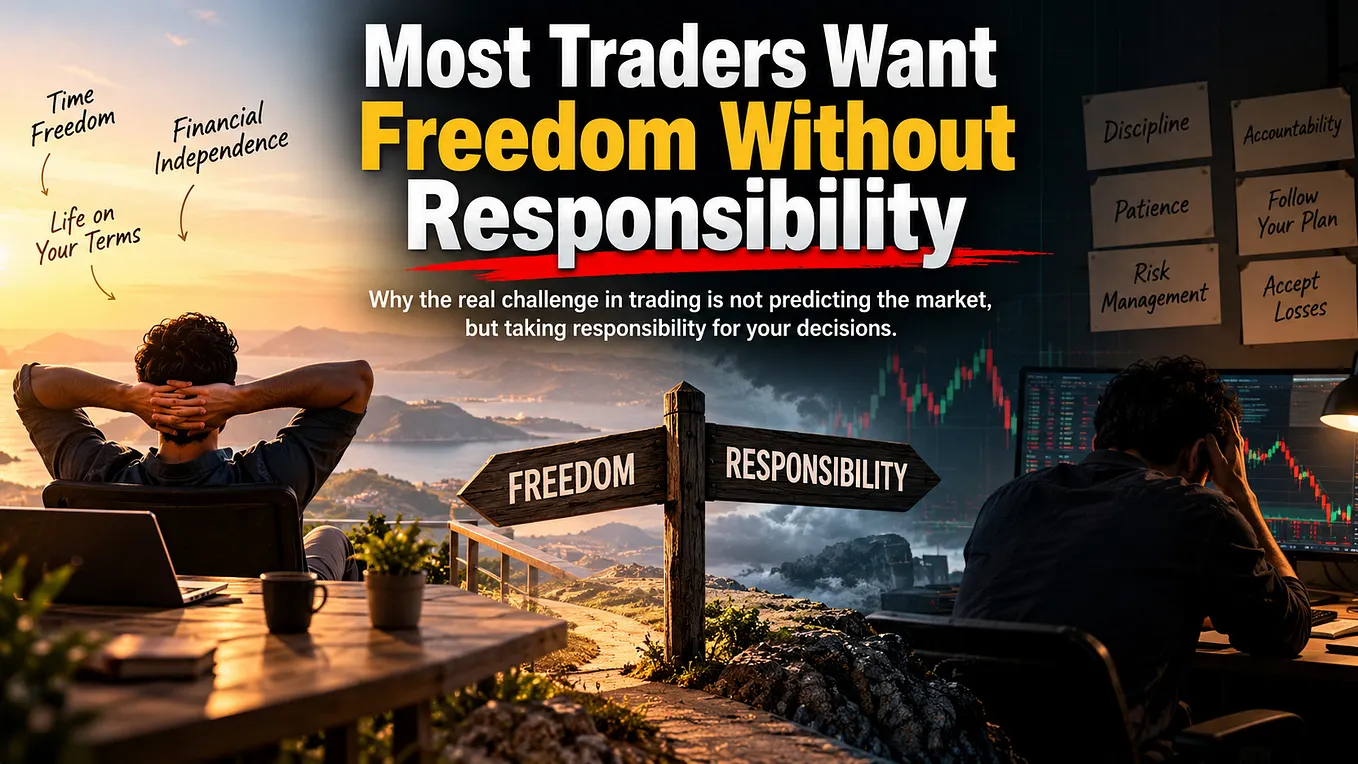
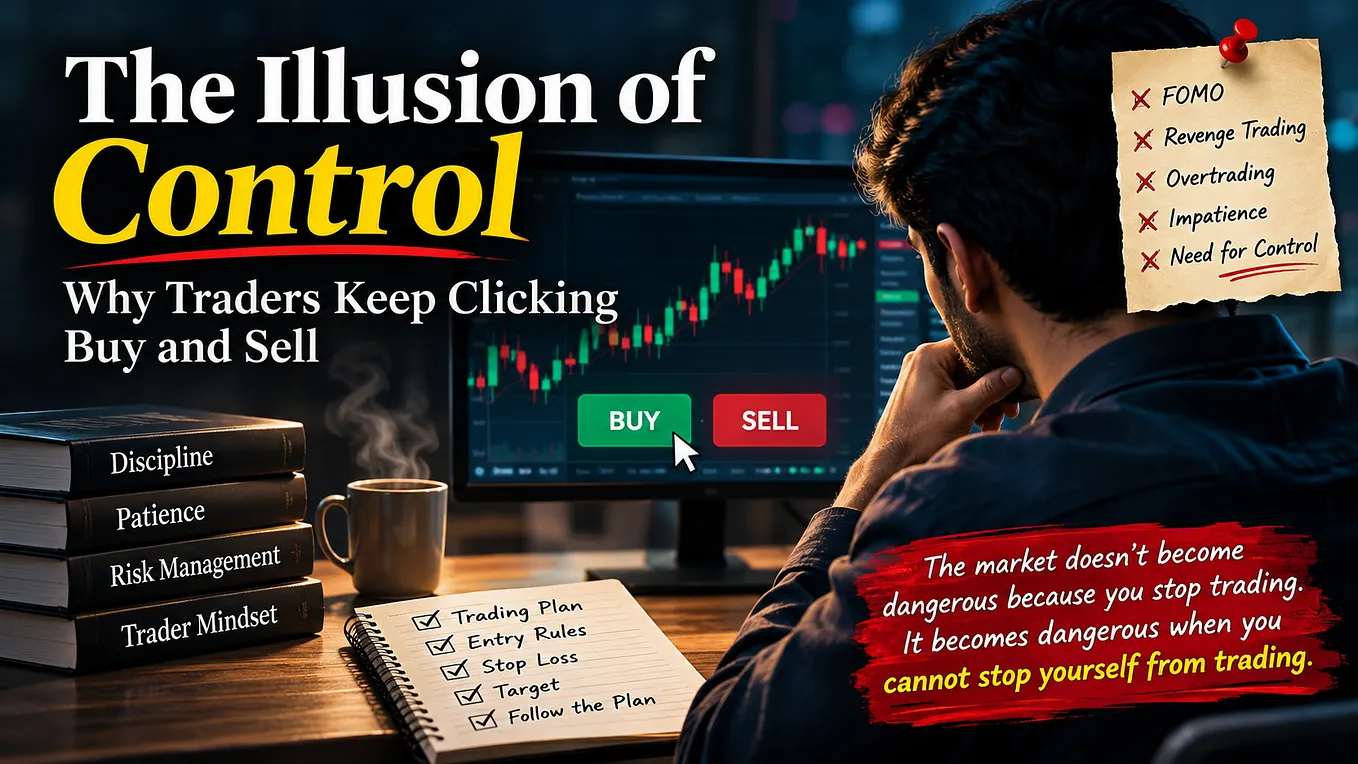
The Market Owes You Nothing


There is a point in every trader’s journey when one simple truth becomes impossible to ignore: the market does not have to behave according to our expectations.
You can spend hours studying a chart, mark your levels carefully, wait for your setup, and still watch price move without you. You can take a trade exactly according to your plan and get stopped out a few minutes later. And sometimes, you can take a poor trade and still make money.
That is one of the strange things about trading. A good decision can produce a loss, and a bad decision can produce a profit. If you do not understand this difference, it is very easy to learn the wrong lessons from your own results.
The Market Does Not Know Your Story
One of the biggest mistakes traders make is bringing their personal situation into the chart.
You lost money yesterday, so today you want to recover it. You missed a strong move in the morning, so the next setup feels like something you cannot afford to miss. You have had several losing trades, so you start thinking, “This one has to work.”
But none of those things change the next setup.
Price does not know how much you lost yesterday or how badly you want to finish the week in profit. The chart only shows what is happening in the market. The emotional story is something we add ourselves.
Once you understand that, many trading situations become easier to handle.
A Good Setup Can Still Lose
Imagine a setup that matches your strategy perfectly. The trend is clear, your level is respected, your entry condition appears, and your risk is defined. You enter the trade, and a few candles later your stop-loss is hit.
The natural reaction is, “But everything was right. Why did I lose?”
Because a valid setup creates an opportunity, not a guarantee.
This is one of the hardest lessons to accept. A strategy gives you a framework for making decisions under uncertainty; it cannot tell you what the next candle will do.
A professional mindset is not, “If I follow my strategy, I will win.” It is closer to, “If I follow my strategy, I have made the decision correctly. Now I let the market produce the outcome.”
That distinction is extremely important.
The Trade You Missed Is Not Automatically a Mistake
Missing a move can sometimes feel worse than taking a small loss.
Imagine you are waiting for a breakout. Your level is marked, but your confirmation has not appeared yet. You wait, price suddenly breaks, and then it starts moving strongly in the direction you expected.
The first thought is usually, “I knew it would go up.”
Maybe you did.
But knowing where price might go is not the same as having a valid entry.
If your rules required confirmation and that confirmation never came, chasing the move afterward does not correct the missed opportunity. It creates a new decision, usually under emotional pressure.
Sometimes the right response to a missed trade is simply to accept that you did not get an entry.
There will be other charts and other setups.
The Market Is Not a Recovery Machine
Suppose you lose ₹2,000 on a trade.
The next setup appears, but instead of looking at it objectively, your mind is still focused on that ₹2,000. You increase your position size because you want to recover the loss quickly.
Maybe the trade wins.
That can actually make the habit more dangerous.
A profitable recovery trade can convince you that increasing risk after a loss was a good idea. The next time you lose, you may do it again, and eventually the position size becomes driven by your previous result instead of the quality of the current setup.
The next trade should be evaluated on its own conditions.
A previous loss is information, not a reason to change your risk impulsively.
“The Market Has to Come Back”
Few thoughts create more trouble than this one.
A trader buys, price falls, and the first reaction is, “It will come back.” Price falls again, and the trader starts thinking, “It cannot go much lower.” At some point, the original trading idea may no longer matter. The trader is no longer managing the setup; he is trying to avoid accepting the result.
This is where a defined invalidation level becomes important.
If your original reason for entering the trade is no longer valid, staying in the position simply because you want to be right does not improve the analysis. It only delays the decision.
Your entry price is important to your account, but it has no special meaning to the market.
A Stop-Loss Is Not a Personal Failure
Some traders take a stop-loss personally.
They feel the market has proved them wrong, so they immediately search for another entry. The next position becomes an attempt to recover confidence rather than an independent setup.
But a stop-loss is simply part of the risk structure of a trade.
If your setup becomes invalid and your predefined risk is reached, accepting the loss can actually mean that you followed your plan correctly.
You can have a losing trade and make a good decision. You can also have a winning trade that was poorly managed.
That is why I believe profit alone is a poor way to judge trading quality.
Not Every Movement Is an Opportunity
Open a trading platform at almost any time and you will see movement.
Candles are moving, levels are being tested, price is breaking small ranges, and it can feel as if something needs to be done.
But activity does not automatically create an opportunity.
Sometimes the market is simply unclear.
A trader who waits for a proper setup is not necessarily missing out. He is filtering the situations that do not fit his plan.
This is especially important for traders who feel uncomfortable doing nothing. The desire to stay active can quietly turn into overtrading.
No trade can be a perfectly valid decision.
The Market Does Not Pay You for Effort
Trading can create an unusual expectation.
You study for hours, watch charts, read books, back test, maintain a journal, and improve your strategy. Naturally, you may start feeling that all this effort should eventually produce a return.
The work is valuable, but it does not guarantee a particular result.
Someone can spend five hours studying and lose the next trade. Someone else can spend thirty minutes preparing and have a winning trade. That does not tell us whose process is better.
Get SM Abbas Rizvi’s stories in your inbox
Join Medium for free to get updates from this writer.
Skill is measured over a meaningful sample, not by one lucky outcome.
This is why experienced traders tend to pay attention to repeated behavior rather than getting emotionally attached to individual results.
What You Actually Control
Trading becomes much clearer when you separate control from uncertainty.
You can control your trading hours, the setups you accept, your position size, your maximum risk, your entry rules, your stop-loss, your trade management, and whether you chase or revenge trade.
You cannot control the next candle, a sudden spike, whether your setup wins, whether price reaches your target, or whether the market moves before your entry.
Trying to control the second list creates unnecessary frustration.
Working on the first list creates improvement.
That is where your attention is better spent.
A Simple Example From Real Trading
Imagine you are waiting for a breakout above an important level. You have already decided that you will enter only after a proper confirmation.
Price reaches the level and moves slightly above it, but the confirmation is not convincing. You stay out. A little later, price breaks strongly and runs.
Now you feel frustrated because the direction was correct.
This is where many traders make their next mistake. They enter late simply because they do not want to watch the move happen without them.
But the trade they take now is not the trade they originally planned.
The market has not changed their rules; their emotions have.
Learning to recognize that moment is an important part of becoming consistent.
Ask Better Questions After a Trade
Instead of asking only, “Did I make money?”, ask yourself a few better questions.
Did I follow my setup? Was my risk appropriate? Did I enter for the reason defined in my plan? Did I manage the position according to my rules? If the same situation appeared tomorrow, would I make the same decision?
These questions can tell you much more about your development than one green or red number.
A trader who reviews decisions rather than only profits and losses can start seeing patterns that are otherwise easy to miss.
Maybe you enter too early.
Maybe you become aggressive after two losses.
Maybe you close winning trades too quickly.
Maybe you trade more when you are frustrated.
Those patterns are often more useful than another indicator on the chart.
The Real Problem Is Often Expectation
After spending time studying charts and observing trader behavior, I have noticed that many trading mistakes begin with an expectation.
We expect the setup to work, we expect price to come back, we expect a loss to be recovered, we expect our analysis to be correct, and sometimes we even expect our hard work to produce profit.
When reality does not match those expectations, behavior starts changing.
We chase, increase risk, move stops, enter too early, or hold too long.
The important point is that the problem often begins before the mistake appears on the chart.
The expectation creates the pressure, and the pressure influences the decision.
Understanding this has changed the way I look at trading psychology.
Professional Trading Can Look Boring
Professional trading does not always look exciting.
Sometimes it means waiting for hours. Sometimes it means taking a small loss. Sometimes it means watching a large move happen without participating because the conditions were not right.
From the outside, it may look like nothing happened.
But protecting capital and protecting your decision-making process are both part of trading.
The goal is not to participate in everything the market does. The goal is to stay prepared for the situations that genuinely fit your method.
That can make good trading look surprisingly boring.
And that is not necessarily a bad thing.
What I Have Learned
The more I study trading, the more I believe that consistency is less about predicting the market and more about managing uncertainty.
Some trades will work and some will not. Some good opportunities will pass without an entry. Sometimes a poor decision will even make money.
The important question is what happens repeatedly.
Are you taking similar setups for similar reasons? Are you keeping your risk controlled? Are you responding to losses without changing your behavior? Are you able to stay out when conditions are unclear?
Those are the things that gradually shape a trader.
For me, this is one of the biggest changes in the way I look at trading. Earlier, it was easy to focus mainly on whether a trade worked. With experience, I have found that the more useful question is whether I handled the situation correctly.
One result disappears quickly.
A habit can stay with you for years.
Before You Take Your Next Trade
The next time a trade does not go the way you expected, take a moment before reacting. You do not need to prove your analysis right, recover a previous loss, or catch every move.
Look at the setup in front of you, respect your risk, and make the decision your plan allows.
Trading becomes easier when you stop expecting certainty from the market and start becoming comfortable with uncertainty.
The market will do what it does. Your job is to decide how you will respond.
The market does not owe you a result. Your responsibility is to make the best decision you can with the situation in front of you.
About Me
I am SM Abbas Rizvi, a trader and writer interested in the practical side of trading, especially the decisions, habits, and emotions that shape a trader’s results.
My book, The Market Is Not Your Enemy; Your Mind Is, explores the psychological side of trading and how our own thinking can influence the decisions we make in the market.