If AI Can Label Data, Why Is the Annotation Market Still Growing?


If AI Can Label Data, Why Is the Annotation Market Still Growing?
For the past couple of years, one prediction has been repeated almost everywhere in the AI industry:
“Data annotation will soon become obsolete.”
The logic seems convincing. Foundation models keep getting better. Auto-labeling tools can annotate thousands of images in minutes. Synthetic datasets are becoming easier to generate, and modern computer vision APIs recognize common objects with impressive accuracy.
So why is the annotation market still growing?
That question sent us down a rabbit hole. We compared forecasts from Mordor Intelligence, IMARC, SkyQuest, Statista, Coherent Market Insights and several other research firms. We also looked at what we’re seeing firsthand at US-DATA while working on computer vision projects.
One thing became clear very quickly.
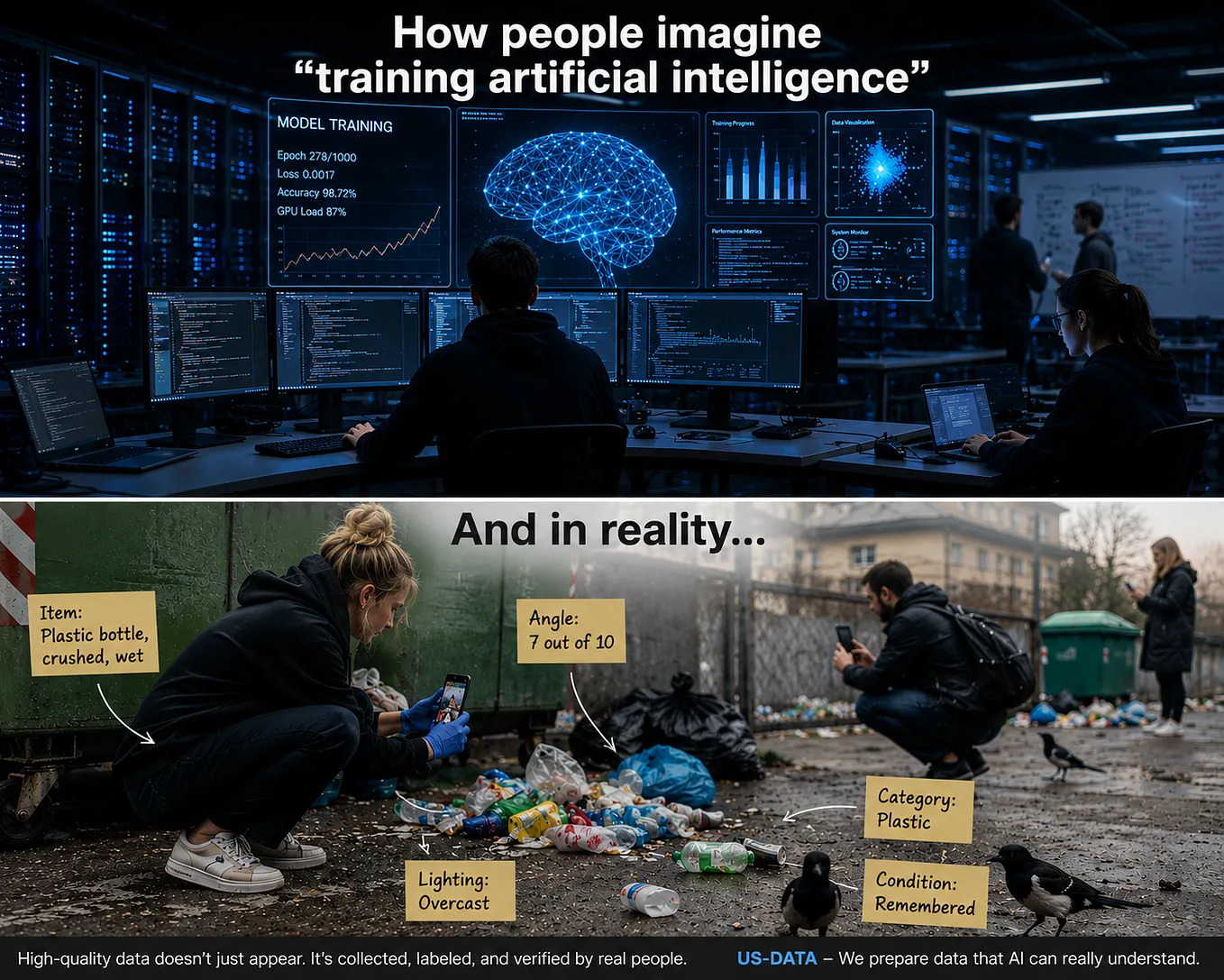
Automation is changing annotation — but it isn’t replacing it.
The market is growing. Actually, several markets are.
The computer vision industry continues to expand across manufacturing, healthcare, logistics, retail, autonomous systems and public safety. Depending on which analyst you read, the numbers differ, but the direction is remarkably consistent.
What’s even more interesting is that the AI-powered computer vision segment is expected to grow faster than the overall market.
That makes sense.
Companies are no longer buying image recognition software. They’re investing in systems that can understand scenes, support decisions and continuously improve after deployment.
And that’s where data suddenly becomes far more important than many expected.
The real bottleneck isn’t the model anymore
A few years ago, conversations around AI were almost entirely about model architectures.
Today those conversations sound different.
Teams ask questions like:
- Why does performance suddenly drop after deployment?
- Why does the model fail on rare scenarios?
- Why do two nearly identical datasets produce different results?
More often than not, the answer isn’t hidden somewhere inside the neural network.
It’s hidden inside the data.
As models become increasingly capable, incremental improvements in architecture matter less than improvements in training data. Better labels, better coverage, and fewer inconsistencies often deliver bigger gains than switching to the latest model release.
That wasn’t obvious five years ago.
Today it feels almost self-evident.
Yes, routine annotation is disappearing
There’s no point pretending otherwise.
Drawing thousands of bounding boxes by hand isn’t where the industry is heading.
AI-assisted labeling has become standard practice for many projects. Human annotators are spending less time creating annotations from scratch and considerably more time reviewing, correcting and validating machine-generated results.
Synthetic data is pushing the same trend even further.
In automotive, robotics and industrial automation, entire training datasets can now be generated inside simulated environments with annotations included by default.
That’s real progress.
It also explains why some people assume annotation companies are about to disappear.
They’re looking at only half of the picture.
The difficult part has never been drawing boxes
Anyone can train a model to recognize a car on a sunny day.
Things get interesting when it starts snowing.
Or when a pedestrian is partially hidden.
Or when a production defect occupies only a few pixels.
Or when two medical specialists disagree on the diagnosis.
Those aren’t annotation problems.
They’re knowledge problems.
And knowledge doesn’t scale nearly as easily as automation.
At US-DATA, we’ve noticed a gradual shift in client requests. A few years ago discussions were dominated by throughput — how many images could be labeled in a week, how quickly a dataset could be delivered.
Get US-DATA Data Annotation’s stories in your inbox
Join Medium for free to get updates from this writer.
Now the conversation is different.
Customers ask about reviewer agreement, QA procedures, edge-case handling, annotation guidelines and consistency across millions of samples.
Nobody is excited about bounding boxes anymore.
They’re interested in trustworthy data.
Annotation is quietly becoming part of MLOps
Another change is happening behind the scenes.
Datasets used to be treated as project deliverables. Once the labeling was finished, everyone moved on.
That approach no longer works.
Models deployed in production continue learning from new environments, changing customer behavior and previously unseen situations. Datasets need maintenance just like software does.
For many organizations, annotation has become a continuous process rather than a one-time task.
Version control.
Quality metrics.
Dataset monitoring.
Re-annotation.
Model retraining.
The workflow looks much more like software engineering than outsourcing.
Regulation is accelerating the shift
Technology isn’t the only reason this is happening.
Regulation is adding pressure as well.
Frameworks such as the EU AI Act are pushing organizations to document how AI systems are trained, monitored and governed. High-quality labels alone aren’t enough anymore.
Companies increasingly need traceability.
Who reviewed the data?
Which guidelines were used?
How were disagreements resolved?
These questions barely appeared in enterprise conversations a few years ago.
Today they’re becoming part of procurement discussions.
The winners probably won’t be the cheapest vendors
Automation is reducing the value of repetitive manual work.
At the same time, it’s increasing the value of expertise.
That sounds contradictory, but it isn’t.
The annotation companies most likely to succeed over the next decade probably won’t be the ones with the largest labeling workforce. They’ll be the ones capable of designing workflows, managing quality, supporting domain experts and integrating seamlessly into customers’ ML pipelines.
In other words, annotation providers are gradually becoming data engineering partners.
That’s a very different business.
Final thoughts
People often ask whether AI will replace data annotation.
After looking at the numbers — and comparing them with what we’re seeing in real projects — I think the question itself misses the point.
Routine labeling? Yes, much of it will continue to be automated.
Expert annotation?
Not anytime soon.
As computer vision systems move deeper into healthcare, manufacturing, autonomous vehicles, retail analytics and industrial automation, the demand for reliable, well-governed training data is likely to increase rather than disappear.
Models are improving.
Expectations are rising even faster.
Want the full research?
Read the complete market analysis, including industry forecasts, charts, sources and detailed commentary:
Learn more about Data Annotation services: