Beyond the Idol

The Hidden Psychology and Sacred Technology of Eastern Iconography

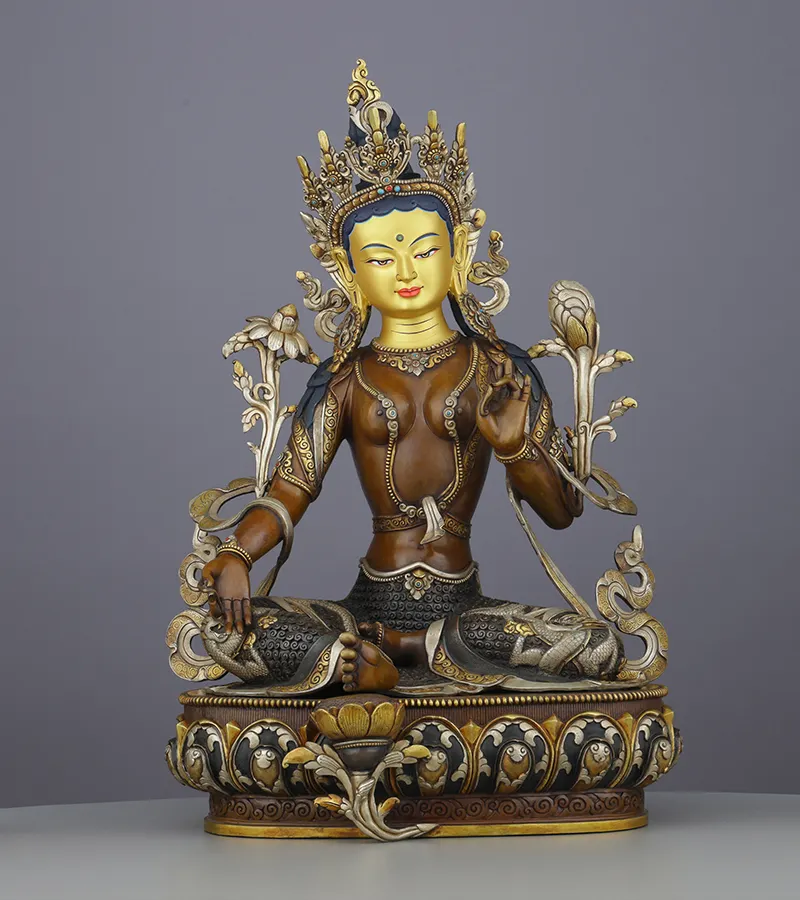
When you walk into a traditional Asian art gallery or step inside an ancient monastery, you are immediately greeted by an overwhelming visual spectacle. Towering statues of fierce guardians with multiple heads, serene Buddhas bathed in golden light, and multi-armed goddesses draped in silk and jewels command the space. To the modern, secularized eye, or even through a conventional Western religious lens, these figures are easily mistaken for literal gods, mythological characters, or idols of worship belonging to a distant, exotic pantheon.
We tend to ask questions like, “Which god is this?” or “What kind of divine power do people expect to receive by praying to it?”
However, this materialistic and literal interpretation misses the entire point of Eastern sacred art.
In traditions such as Vajrayana (Tantric) Buddhism and esoteric Hinduism, these sculptures are not physical deities sitting on clouds in some celestial realm. Instead, they are something far more sophisticated: sacred technology. They are precise, meticulously engineered visual blueprints of enlightened human consciousness. They do not point outward to a supreme being who grants favors; they point inward, serving as external mirrors for the ultimate psychological and spiritual potential hidden within every human mind.
1. The Great Misunderstanding: From External Deity to Internal Mirror
To understand why these traditions utilize such elaborate forms, we must first unlearn our habitual tendency to spatialize the sacred. In the modern West, religion has largely been defined by a subject-object split: God is up there or out there, and you are down here, praying from a position of separation.
Eastern esoteric traditions radically dismantle this binary.
When a practitioner looks at a statue of a deity, they are not looking at an external master or a ruler of the universe. They are looking at a materialized map of their own mind. The statue is a pedagogical tool, a scaffolding constructed to help the human brain grapple with concepts that defy ordinary language. Because ultimate reality, absolute awareness, and boundless compassion are inherently formless and beyond conceptual thought, the mind requires a bridge.
Iconography provides that bridge. It translates the abstract qualities of enlightenment into tangible, recognizable shapes, colors, and symbols so that the human psyche can interact with them directly.
2. Metaphorical Emanations: The Anatomy of Wisdom and Compassion


Every single element of an Eastern sacred sculpture, from the posture of the feet to the number of eyes, the implements held in the hands, and the emotional aura of the face, is deeply intentional. Nothing is left to artistic whim or decorative preference.
The Two Pillars: Prajna and Karuna
At the heart of almost every iconic form lie two complementary forces: wisdom (Prajna) and compassion (Karuna).
- Wisdom represents the direct realization of reality, seeing things precisely as they are, free from the distortions of ego, illusion, and mental clinging.
- Compassion is the natural, spontaneous expression of that wisdom outward into the world, seeking to alleviate the suffering of all sentient beings.
Archetypes in Action
Consider a multi-armed deity, such as Avalokiteshvara (or Chenrezig), often depicted with a thousand arms. To a literalist, this looks like a bizarre anatomical anomaly. But to a practitioner of sacred technology, it is a brilliant psychological archetype.

A human being trying to help others often feels constrained by physical and emotional limitations: I only have two hands, I only have twenty-four hours in a day, I can only solve one problem at a time. The multi-armed deity shatters this psychological limitation. It visualizes the mind’s profound capacity to operate simultaneously on multiple levels. Holding patience in one hand, skillful action in another, fierce protection in a third, and gentle solace in a fourth. It is an artistic rendering of radical, multi-dimensional presence.
Get Vajraicon’s stories in your inbox
Join Medium for free to get updates from this writer.
Similarly, expressions range from deeply peaceful and serene to terrifyingly wrathful. Peaceful deities cultivate tranquility, gentleness, and inner stillness. Wrathful deities, often adorned with skulls and standing in dynamic, fierce postures, are not symbols of evil or anger; they represent the fierce, uncompromising energy required to demolish deep-seated ego, ignorance, and toxic mental patterns.
3. The Laboratory of the Mind: Rishis, Mahasiddhas, and Sadhana
These complex visual forms did not emerge from abstract philosophy alone. They were discovered, mapped out, and verified in the rigorous “laboratory” of deep meditation.
In ancient times, spiritual scientists, known as Rishis (seers) in the Vedic traditions and Mahasiddhas (great accomplished masters) in Tantric Buddhism, spent decades in intense contemplative practice, or Sadhana. Through advanced states of meditative absorption (samadhi), these masters pushed their consciousness past the chatter of the everyday ego and directly experienced the unconditioned, formless substrate of reality.
Translating the Formless into Form
When the human mind touches ultimate reality, it encounters an absolute expanse that has no shape, color, or boundary. Yet, upon returning to ordinary waking consciousness, the mind seeks a way to anchor, remember, and transmit that transcendent experience.
Through profound creative vision, the masters allowed their awareness to shape that formless energy into visual metaphors. They noticed that certain geometric proportions, specific color palettes (such as deep blues for space or fiery reds for transformation), and specific hand gestures (mudras) reliably triggered specific states of inner clarity, emotional stability, and psychological awakening.
These visions were not kept as private mystical experiences; they were systematically documented. Using sacred geometry and canonical texts (such as the Shilpa Shastra in India or traditional Tibetan thangka grid systems), masters recorded these forms with mathematical precision. They created a standardized blueprint, a psychological technology that could be reliably replicated by anyone willing to follow the instructions.
4. The Living Chain of Lineage (Parampara)
This brings us to a crucial safeguard in these traditions: Lineage (Parampara).
Why are traditional artists and practitioners so strict about preserving every minute detail of an icon’s proportions, hand positions, and attributes? Why not let modern artists “innovate” or redesign the statues to fit contemporary aesthetic trends?
Think of it like a chemical formula. If you are mixing compounds to produce a life-saving medicine, you cannot casually swap out ingredients or alter measurements just to make the recipe more creative. If you change the formula, the chemical reaction changes, and the medicine loses its efficacy.
Sacred iconography operates on the exact same principle. The precise alignment of symbols, weapons, ornaments, and postures forms a proven psychological catalyst. When a lineage strictly passes down these exact rules from generation to generation over thousands of years, it maintains an unbroken energetic and instructional chain.
Because of this lineage, a practitioner meditating in a modern city today can use an icon structured exactly the same way as a master did in the caves of Ajanta or the monasteries of the Himalayas millennia ago. The design is a timeless conduit.
5. Deity Yoga: Stepping Inside the Archetype
The ultimate purpose of this sacred technology culminates in a practice often called “Deity Yoga.”
In ordinary life, we are heavily identified with our small, fragile, egoic selves, our anxieties, our social roles, our transient moods, and our perceived limitations. Deity yoga provides a radical method to deconstruct this tiny identity.
During meditation, the practitioner does not pray to the statue across the room. Instead, through visualization, they dissolve the statue, dissolve their own ordinary self into emptiness (shunyata), and then allow the vivid, luminous form of the deity to arise from that emptiness, as themselves.
For a brief, transformative period, the practitioner breathes, sits, and perceives the world through the archetype of boundless wisdom and compassion. They are not engaging in a childish game of pretense; rather, they are temporarily stepping out of the small ego to inhabit their own highest, deepest potential. They recognize that the wisdom and compassion embodied in bronze, stone, and pigment are not alien qualities belonging to a god. They are the true, native state of the human mind.
How does viewing sacred art as an internal psychological technology rather than external mythology shift your understanding of spiritual traditions? Have you ever practiced meditation or engaged with art that felt like a direct mirror of your inner state?
Discover more at https://vajraicon.com/