ORBITAL ECONOMICS | post #38: September 2026

📈 Your 5-minute guide to space economy investment opportunities
This Week’s Signal: NASA’s Swift Observatory is falling because it was never built to be rescued — trying to save it anyway is the fastest way to learn what an orbital-rescue business actually requires.

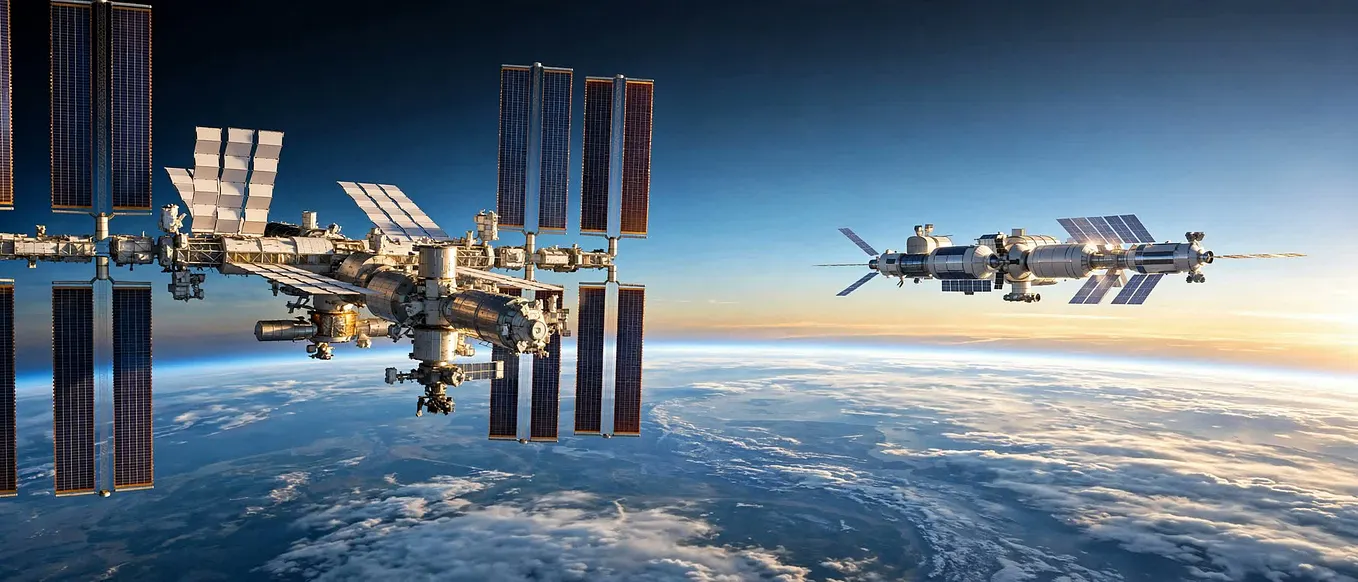
Image courtesy of NASA’s Goddard Space Flight Center.
HOW WE’RE TRYING TO SAVE A SATELLITE THAT WASN’T MEANT TO BE SAVED
There is a NASA satellite slowly falling toward Earth.
Its name is NASA’s Neil Gehrels Swift Observatory, or “Swift”.
And over the past several days, I’ve found myself doing something I certainly wasn’t planning to be doing a month ago:
Trying to figure out whether we can save it.
The chances that we actually pull this off are extremely small. The clock is running, the engineering is difficult, and Swift was never designed for somebody to fly up twenty years later and rescue it.
But that may be exactly why this is worth doing.
This is no longer a theoretical exercise about the emerging orbital-servicing economy. It is an actual spacecraft, an actual deadline, and an opportunity to find out what it really takes to assemble an orbital rescue mission.
First: why save Swift?
Swift launched on November 20, 2004, with a nominal two-year mission built around one extraordinary problem: understanding gamma-ray bursts, the most powerful explosions known in the universe. Its three telescopes allow it to detect a burst, rapidly turn toward it, and study the aftermath in gamma-ray, X-ray, ultraviolet and visible light — something astronomers previously struggled to do before the evidence disappeared.
Instead of lasting two years, Swift has operated for more than twenty.
Along the way it helped strengthen the connection between short gamma-ray bursts and neutron-star mergers, detected extraordinarily distant explosions from the early universe, studied supernovae, black holes, comets and countless transient events, and evolved into what NASA calls the agency’s “astrophysics multitool.”
That is a pretty good return on a two-year design life.
The problem
Swift has no propulsion system capable of maintaining its orbit.
Every spacecraft in low Earth orbit encounters traces of atmosphere. Increased solar activity expanded that atmosphere and accelerated the drag on Swift.
NASA decided it was worth trying something unusual.
In September 2025, the agency contracted Katalyst Space Technologies to rapidly build a spacecraft called LINK that would rendezvous with Swift, capture it using three robotic arms, and raise its orbit. LINK launched aboard a Pegasus XL in July 2026.
Then LINK developed an attitude-control problem: two of its three reaction wheels failed, and its spin rate had to be brought down using thruster burns.
On August 19, NASA announced that LINK would no longer attempt the capture and boost, although the spacecraft would continue toward Swift to demonstrate rendezvous and proximity operations.
Swift returned to partial science operations on August 26 — its X-ray and ultraviolet/optical telescopes came back online, though the Burst Alert Telescope, powered down earlier this year to reduce drag, remains offline for now.
But it kept falling.
By late August, NASA said Swift would likely drop below the roughly 300-kilometer threshold within one to two months. Below that point, its descent accelerates and operating — and rescuing — the observatory becomes increasingly difficult.
That is where our story begins.
What if you cleared the table?
Instead of beginning with a spacecraft design, we started with a different question:
What already exists?
That turns one enormous problem into a series of smaller ones:
- Launch: Can something reach Swift’s unusual orbital inclination quickly enough?
- Payload: How little hardware could actually accomplish the mission?
- Rendezvous: Can we approach a non-cooperative spacecraft safely?
- Manipulation: Can robotic arms perform the required work?
- Capture: Where do you grab a satellite never designed to be grabbed?
- Attachment: Clamp it? Grapple it? Adhere to it? Attach propulsion permanently?
- Propulsion: Push Swift, tow it, or effectively give it a new engine?
- Operations: How much can be autonomous, and how much can humans control from Earth?
- Time: Can any of this happen before the orbit wins?
That last one changes everything.
A technically perfect solution that takes eighteen months is useless.
Launch turns out to be more complicated than “find a rocket”
There are plenty of launch vehicles in the world.
There are far fewer that make sense for this orbit, this payload, this schedule and this mission architecture.
The global possibilities alone are interesting: Rocket Lab and its Electron; Firefly Aerospace and Alpha; Europe’s Avio with Vega C and Arianespace with Ariane 6; Japan’s Mitsubishi Heavy Industries and H3; and emerging systems such as Stoke Space and its Nova vehicle.
The exercise quickly teaches you that payload capacity is not the same thing as mission suitability.
Firefly, for example, advertises Alpha as a responsive dedicated launcher rated at roughly 1,030 kilograms to a 300-kilometer LEO. Avio’s Vega C offers a different class of capability — up to 2,300 kilograms to LEO — while Japan’s H3 can carry several tonnes depending on orbit and configuration.
But Swift doesn’t care about maximum payload brochures.
Swift cares whether you can meet Swift.
Then comes the really difficult question: how do you grab it?
Get VLAD ALGIN’s stories in your inbox
Join Medium for free to get updates from this writer.
This is where the drawings become fascinating.
NASA publishes actual engineering-envelope drawings of Swift. They were created long before anyone imagined people would one day be studying them looking for somewhere to attach a rescue vehicle.
See NASA’s Swift spacecraft drawings and 20-year infographic
There is no modern servicing port waiting for us.
No convenient refueling receptacle.
No giant handle saying GRAB HERE.
That sends us into another part of the emerging space economy: robotics and non-cooperative servicing.
GITAI, for example, completed the flight model of its S3 servicing spacecraft in June 2026 — built specifically to demonstrate autonomous rendezvous, docking with non-cooperative satellites, robotic servicing and controlled deorbit operations.
Northrop Grumman’s SpaceLogistics has already extended the lives of operational GEO satellites through its Mission Extension Vehicles, and is now developing a Mission Robotic Vehicle — the first multi-mission robotic servicer, built for inspection, repair, relocation, life extension and disposal.
And NASA itself had originally funded two Swift rescue concept studies — Katalyst and Cambrian Works — before selecting Katalyst to build and fly the actual mission.
The pieces are appearing.
They just weren’t designed as one system.
And that may be the real business story
This is the part I find increasingly interesting.
Orbital rescue may not require one company to invent everything.
It may require somebody to assemble the mission.
Launcher. Servicing spacecraft. Robotics. Attachment technology. Propulsion. Ground control. Mission operations. Insurance, regulation, contracting and financing.
Suddenly orbital rescue begins looking less like a single spacecraft product and more like a new mission-development business.
The investor stack
That also gives investors a different way to look at the market.
Some of the infrastructure needed for orbital rescue is already accessible through public companies:
Launch: Rocket Lab (NASDAQ: RKLB) and Firefly Aerospace (NASDAQ: FLY). Firefly went public in August 2025; Rocket Lab joined the Nasdaq-100 in June 2026.
Servicing and robotics: Northrop Grumman (NYSE: NOC) through SpaceLogistics.
International launch: Mitsubishi Heavy Industries (TSE: 7011) and Italy’s Avio S.p.A. (Borsa Italiana: AVIO) provide different exposures to the global launch infrastructure underpinning missions like these.
Then there is the private layer — companies including GITAI, Cambrian Works, Stoke Space and others developing capabilities that may become increasingly important as servicing moves from demonstrations toward a functioning market.
None of those names implies participation in what we are doing.
They are the ecosystem revealed by the problem.
Follow the experiment
We have also built a live Swift Rescue Cockpit inside Orbit2Orbit Express so we can track the spacecraft and work through the mission calculations as the situation evolves.
That part matters to me.
I have written about orbital servicing before.
But writing about an industry and actually trying to assemble the pieces are very different things.
We may not save Swift.
In fact, statistically, I would bet against us.
But every telephone call, calculation, spacecraft drawing and dead end is showing us something about a market that barely existed a few years ago.
And perhaps that is the larger Swift story.
The first generation of satellites needing rescue were never designed to be rescued.
The companies that figure out how to save them anyway may be building an entirely new part of the space economy.
━━━━━━━━━━━━━━━━━━
CITATIONS
1. NASA, “NASA Updates Next Steps for Commercial Swift Boost Mission,” Aug. 19, 2026 — https://www.nasa.gov/news-release/nasa-updates-next-steps-for-commercial-swift-boost-mission/
2. NASA Science (Swift blog), “NASA’s Swift Restarts Science Observations,” Aug. 28, 2026 — https://science.nasa.gov/blogs/swift/2026/08/28/nasas-swift-restarts-science-observations/
3. The Register, “NASA mulls sending a rescue rocket to boost Swift observatory’s orbit,” Aug. 13, 2025 — https://www.theregister.com/2025/08/13/nasa_mulls_sending_a_rescue/
4. Katalyst Space Technologies, “Link Mission” — https://www.katalystspace.com/mission/link
5. NASA Scientific Visualization Studio, “Swift Multitool Infographic” — https://svs.gsfc.nasa.gov/15046/
6. NASA Scientific Visualization Studio, Swift spacecraft engineering drawings and 20-year infographic — https://svs.gsfc.nasa.gov/11738/
7. GITAI, “GITAI Completes Flight Model of S3 Robotic Satellite for On-Orbit Servicing Demonstration Mission,” June 16, 2026 — https://gitai.tech/2026/06/16/gitai-completes-flight-model-of-s3-robotic-satellite-for-on-orbit-servicing-demonstration-mission/
8. CNBC, “Rocket maker Firefly Aerospace soars over 30% in market debut to land at $8.5 billion valuation,” Aug. 7, 2025 — https://www.cnbc.com/2025/08/07/rocket-maker-firefly-aerospace-fly-stock-ipo.html
9. Rocket Lab, “Rocket Lab To Join The Nasdaq-100 Index,” June 12, 2026 — https://investors.rocketlabcorp.com/news-releases/news-release-details/rocket-lab-join-nasdaq-100-index
━━━━━━━━━━━━━━━━━━
Orbital Economics is published by Vlad Algin, Orbit2OrbitExpress. For informational purposes only. Not investment advice.
If this work is useful to you, you can support it here: ko-fi.com/orbitaleconomics