What constitutes legitimate agency?
Vendan Ananda Kumararajah
A3’s proposed constitutive shift in AI governance
An AI system can produce useful results, operate within an authorised mandate and explain its decisions. What establishes its continuing warrant to act when its knowledge, circumstances and consequences change?
This question concerns how legitimate agency is constituted — and what must happen for that legitimacy to endure.
Political-philosophical approaches to AI governance offer substantive accounts of justified power, legitimate procedures and proper authority. They connect these requirements with explanation, accountability, contestability and the possibility of revising decisions, rules and authorisations.
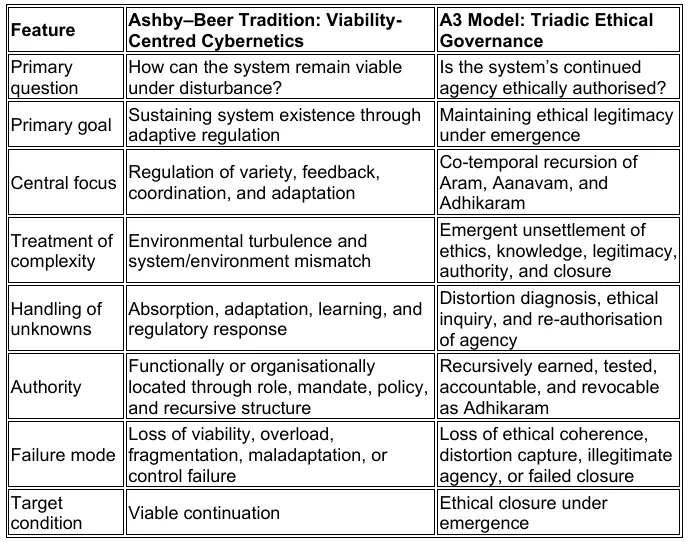
A3 engages these concerns through a distinct cybernetic foundation. Its proposed contribution lies in how ethical coherence, the recognition, containment and transformation of endogenous distortion, and the relationships among knowledge, action, experience and governance jointly constitute legitimate agency.
The architecture of legitimate agency
A3 brings together three interconnected elements: the Aram–Aanavam–Adhikaram triad, the Knowledge Continuum and the Adhikaram Pentad.
Aram concerns ethical coherence. Aanavam concerns endogenous systemic distortion. Adhikaram concerns legitimate agency: a warrant to act that must be earned, remains conditional and can be restricted or withdrawn.
These are co-temporal and mutually constitutive. The knowledge supporting an action may itself contain distortion. An apparently effective intervention may undermine ethical coherence. An authority responsible for correction may reproduce the conditions that generated the original failure.
The Knowledge Continuum — Arivu, Vidya and Gnanam qualifies the knowledge and intelligence informing agency. It brings scrutiny to what is known, how it is understood and what judgment warrants action. Its dimensions operate together; they should not be read simply as successive stages completed before action begins.
The Adhikaram Pentad connects Knowledge, Action, Experience, Absorption and Governance. Absorption concerns how experience is taken into the system; recursive closure concerns how that absorption bears on subsequent knowledge, action and governing conditions.
Together, these relationships constitute the warrant to act. They are necessary conditions of legitimate standing, rather than supplementary tests applied after an agent has already been deemed legitimate.
From correcting harm to absorbing consequences
Consider a public institution whose AI-assisted eligibility system wrongly excludes applicants. It remedies the immediate harm, corrects the affected decisions and records the incident as resolved.
The remedy matters. But what has the institution absorbed from the experience?
Has it reconsidered the knowledge supporting those decisions? Has it examined distortion in its objectives, relationships or evaluation methods? Have the findings changed subsequent action, governing rules, permissions or authority?
An incident can be administratively closed while leaving its governing conditions substantially untouched. A system can also improve its performance while retaining an inadequate basis for deciding what it should be permitted to do.
A3 therefore distinguishes completing a corrective action from establishing recursive closure.
Absorption must bear on the conditions of future agency. The inquiry concerns how experience changes — or provides grounds for retaining — what the system knows, how it acts and the authority under which it operates.
This does not require a new rule after every incident. It requires an accountable basis for determining what should change, what may remain and why.
Get Vendan Ananda Kumararajah’s stories in your inbox
Join Medium for free to get updates from this writer.
The corrective apparatus is also subject to scrutiny
Aanavam extends this inquiry to the mechanisms intended to recognise and correct distortion.
An audit can rely on incomplete evidence. A performance measure can reward behaviour that defeats the institution’s purpose. A corrective procedure can protect existing authority while suppressing inconvenient experience.
The capacity to detect a problem therefore does not exempt the detector from scrutiny.
A3 treats the recognition, containment and transformation of endogenous distortion as inseparable from ethical coherence and legitimate agency. Its recursive inquiry reaches the knowledge, assumptions and authority of the corrective process itself.
Under complexity, interventions alter relationships and generate consequences that cannot all be specified in advance. The system’s capacity to learn and govern must therefore remain open to reconstitution.
What continuing legitimacy requires
Within this architecture, legitimate agency has practical consequences.
Experience may warrant continuing an activity. It may require corroborating knowledge, narrowing a mandate, strengthening oversight or restricting autonomy. It may reveal that authority should be suspended, withdrawn or reconstituted.
Technical capability alone cannot settle these questions. An existing authorisation cannot establish every condition of the agent’s continuing warrant.
Equally, sophisticated learning does not automatically confer a right to govern others. The scope and basis of authority remain part of what legitimate agency must establish.
A3 connects these questions: what an agent knows, what it does, what follows, what it absorbs and what it remains warranted to do next.
The proposed constitutive shift
Learning, accountability, legitimacy and revision have long histories. Other approaches recognise constitutive conditions and the need to revise governing assumptions.
A3’s claim concerns the particular constitutive role assigned to the integrated operation of its triad, Knowledge Continuum and Pentad. Together, they specify how agency qualifies as legitimate and remains warranted.
The distinction depends on the theoretical work these relationships perform. Naming the components, or placing them alongside one another, would not establish it.
The object of governance includes the continuing constitution of the agent’s knowledge and legitimate standing. Governance must address the conditions through which future knowing, acting and governing become warranted.
This is the basis of A3’s proposed constitutive category shift: legitimate agency depends on an integrated architecture through which knowledge is qualified and the warrant to act is constituted and reconstituted.
For AI governance, that makes a demanding question unavoidable:
After a system acts and encounters its consequences, what now warrants its next action?
#A3Cybernetics #AIGovernance #LegitimateAgency #SystemsThinking