Interactive Experience Center for Real Estate Developers Selling Unbuilt Projects


You have an approved layout, a strong plot, and a launch date on the calendar — and eighteen months before the first slab is poured, your channel partners are already asking to bring buyers to “see” the project. This is the moment where most developers lean on renders, a scale model, and confidence. An interactive experience center gives you something stronger: a way to put 200 channel partners, NRI buyers on a video call, and a walk-in family in front of the same believable version of a building that doesn’t exist yet. For developers selling unbuilt inventory, that single capability changes how fast a launch converts into bookings.
At its core, an interactive experience center is a dedicated sales environment — built before or alongside construction — that uses digital twins, IoT scale models, and immersive display technology to make an unbuilt project feel inspectable. Instead of asking your sales team to sell a promise, it lets them demonstrate one.
Why Selling Unbuilt Inventory Is a Different Problem
Selling a ready-to-move project and selling an unbuilt one are not the same sales motion, even though many developers treat them identically. When there’s nothing to walk through on site, every objection gets harder to answer:
- Buyers can’t verify the view, the light, or the finish quality — they’re taking your word for it
- Channel partners, who need to convince their own client base, have nothing tangible to show either
- NRI and out-of-city buyers, often a meaningful share of premium launches, can’t visit the site at all before deciding
- A single sample flat — if one even exists yet — can’t represent dozens of different unit configurations and orientations
The result is a longer, more fragile sales cycle, where deals stall not because buyers dislike the project, but because they can’t get comfortable committing to something they can’t see.
What an Interactive Experience Center Actually Solves

Rather than trying to describe a finished project, the technology lets a buyer or channel partner move through it. A properly built center combines:
- Digital twins rendered at 4K, 60FPS, giving a navigable, photorealistic version of the exterior, interiors, and amenities — built from architectural data, not marketing renders
- IoT-integrated scale models that sync in real time with LED visuals, so a location advantage or zoning detail can be shown physically and digitally at once
- Anamorphic 3D content, which projects future infrastructure — an upcoming metro line, a sea link, a business district — into the room with real depth, so buyers experience distance and connectivity spatially instead of reading it off a slide
- Panoramic, floor-specific window views, built from drone-verified data, so a buyer evaluating a 24th-floor unit sees exactly that view, not a generic skyline shot
For a project that’s still a hole in the ground, this is the closest thing to a finished sample flat that technology currently allows.
Experience Center Development: What the Process Looks Like
Because timing matters so much for a pre-launch project, it helps to know what experience center development actually involves before committing a launch date to it. The typical build runs through four phases:
- Discovery and site audit (1–2 days) — assessing the physical sales space or site office for sightlines, layout, and visitor flow
- Customer journey mapping (6–7 days) — designing the sequence buyers and channel partners will move through, from arrival to closing conversation
- Technology and content integration (1–3 months) — building the digital twin of the actual architectural plans, in parallel with hardware staging
- Hardware deployment and team training (2–6 days) — final calibration and onboarding the sales team to run the experience consistently
Because content integration is the longest stretch, developers planning a grand launch event need to start this process well before the date is public — not after invitations have already gone out.
Which Unbuilt Projects Benefit Most
This approach isn’t necessary for every pre-launch. It earns its cost fastest on:
- Premium and ultra-luxury towers where the ticket size makes buyer confidence non-negotiable
- Projects anchored by future infrastructure — a coastal road, a metro corridor, an airport — where the value proposition is largely about what’s coming, not what’s there today
- Launches built around a channel partner network, where dozens or hundreds of partners need a consistent, convincing pitch they can repeat to their own clients
- Projects targeting NRI or remote buyers, where a web-based version of the same digital twin lets a sales team run a guided tour over video call
The Buyer and Channel Partner Journey
For an unbuilt project, the walkthrough usually needs to do more explaining than it would for a finished one. A structured journey typically moves through:
- An orientation on a large curved LED screen, establishing developer credibility and the project’s location story
- Anamorphic 3D content in a dedicated space, mapping the infrastructure and connectivity the project is betting on
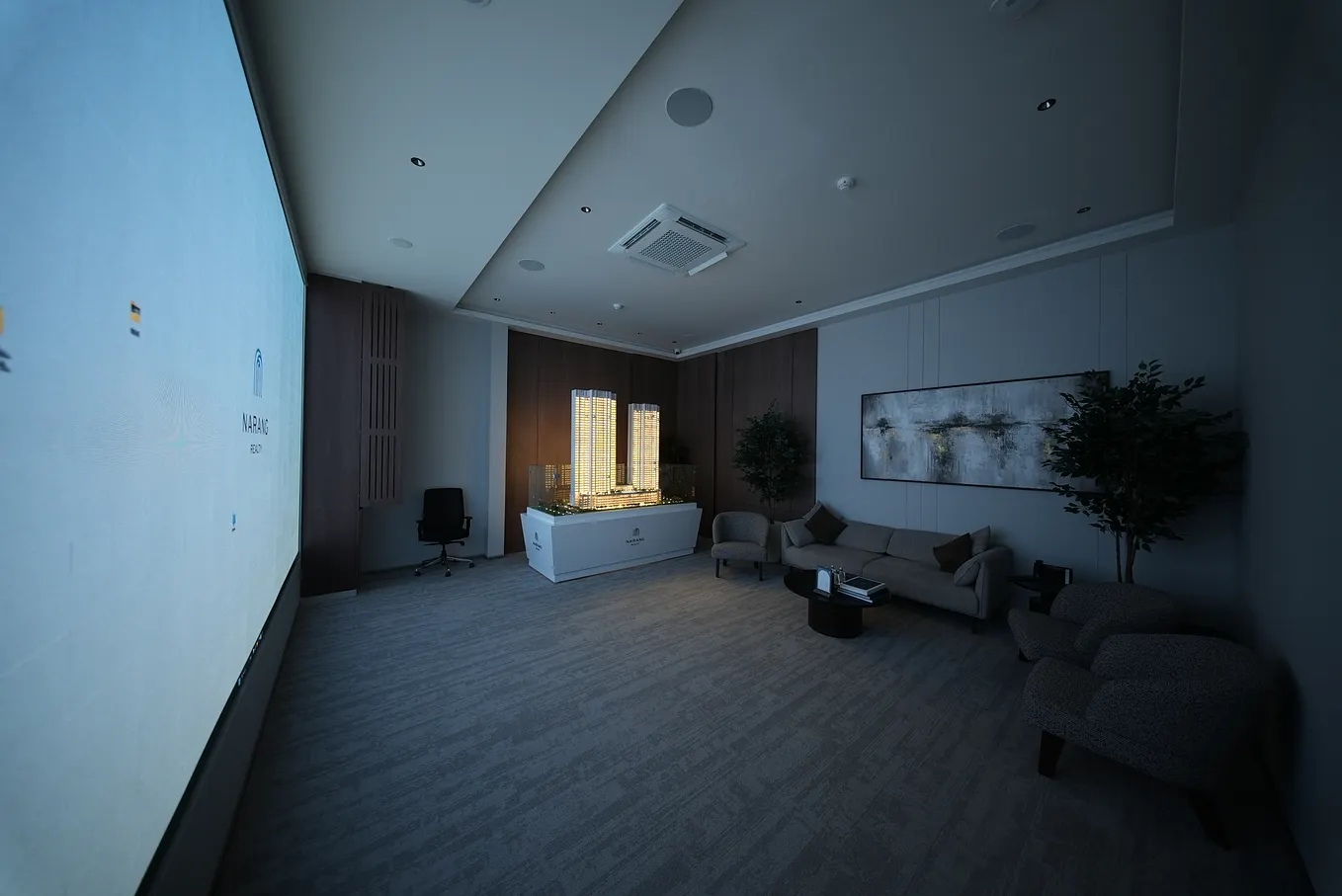
- A physical, IoT-lit scale model that shows tower positions, zoning, and density — turning an abstract master plan into something you can point at
- Simulated sample flat views, built from drone-verified data, so specific units can be validated even without a physical show flat
- A closing conversation in a private pod, where inventory and pricing are discussed against the same visuals the buyer just experienced
For channel partner launch events specifically, this sequence is often compressed into a scripted, repeatable group presentation — so every partner walks away having seen the identical, high-conviction pitch.
What Changes for Your Sales and Channel Teams
An interactive experience center doesn’t just change what buyers see — it changes how your team sells:
- Presentations become consistent across every sales executive and every channel partner, instead of varying by who’s on shift
- Partners can be trained once, on the same digital twin, rather than relying on each partner’s individual pitch
- A live dashboard shows which zones and units get the most engagement, giving you real signal on what’s resonating before you’re deep into the launch
- Remote and web-based versions of the same experience let your team run guided tours for buyers who can’t be on site
Case Study: How L&T Realty Sold an Unbuilt Landmark to a Room of 200 Channel Partners

L&T Realty faced this exact challenge with The Gateway Project in Sewri — a premium high-rise with uninterrupted sea views and strong connectivity across Mumbai, launched before there was anything on site to walk through. The brief had three clear objectives: give prospective buyers an immersive sense of the architectural design and sea views, create a seamless experience for international and remote clients, and generate strong early momentum through a grand launch event for more than 200 channel partners and stakeholders at the Jio World Convention Centre.
Get vestate’s stories in your inbox
Join Medium for free to get updates from this writer.
The launch used 3D anamorphic content to build that early excitement, translating what a Realty representative later described as the project’s engineering depth into something buyers and partners could instantly grasp — strengthening the quality of sales conversations well before the first floor was cast. That early momentum translated directly into accelerated initial bookings.
You can see how V-Estate approached L&T’s immersive real estate experience center for this kind of large-scale, pre-launch environment.
The Technology Stack Behind Pre-Launch Experience Centers
For unbuilt projects specifically, the stack leans heavily on accuracy and remote reach:
- Real-time 4K rendering engines (commonly Unreal Engine) with accurate sun and shadow mapping tied to real GPS coordinates
- Drone-verified 360° data, stitched into a navigable stack so any floor or wing can be checked instantly
- Web-based digital twins with remote-assistant access, so a sales executive can guide an NRI buyer through the same experience from any browser
- IoT-synced physical models controlled from a single iPad, keeping the physical and digital sides of the presentation in lockstep
The Results That Justify the Investment
The pattern across pre-launch, immersive-sales deployments is consistent: developers who invest in this kind of dedicated sales environment for channel partner engagement see that early energy convert into faster initial sales momentum, and industry data on immersive digital-twin adoption points to sales cycles compressing from a typical six-to-nine-month range down to three to five months, alongside conversion improvements well above the 8–12% baseline that traditional pre-launch sales have historically delivered.
Planning Considerations for Pre-Launch Developers
Before committing a launch date to this approach, it’s worth planning around a few realities:
- Lead time matters most here — a 1–3 month content integration window means this needs to start well ahead of any announced launch date
- Architectural data needs to be finalised enough to build an accurate digital twin, which can be a constraint for very early-stage projects
- Channel partner training should be built into the rollout, not treated as optional, if consistency across 100+ partners is the goal
- Remote access infrastructure needs testing ahead of time if NRI or international buyers are a meaningful part of the target audience
- Ongoing content updates will be needed as design details, pricing, and inventory evolve between launch and possession
Frequently Asked Questions
Can an unbuilt project realistically get a full digital twin before construction starts? Yes — the digital twin is built from finalised architectural data, not photographs of the finished building, which is exactly why it works for pre-launch sales.
How does this help with channel partner launches specifically? It gives every partner the same high-conviction, repeatable presentation, rather than relying on individual pitching skill to carry a launch event.
Is this practical for NRI or remote buyers? Yes — a web-based version of the same digital twin, with remote-assistant access, lets a sales executive guide a buyer through the experience over a video call.
How early should development start before a planned launch? Given the 1–3 month content integration window, most developers begin the process at least three to four months ahead of a public launch date.
Does this replace the need for a physical sample flat? It significantly reduces dependence on one. Floor-specific, drone-verified view simulations can represent units that don’t have a matching physical show flat.
Give Your Launch Something Real to Show
If your next launch is riding on renders and a promise, you’re asking your buyers and your channel partners to do more imagining than closing. V-Estate builds interactive experience centers specifically for developers selling unbuilt inventory — combining the Spaci digital twin platform with a full experience center build designed around your launch timeline. Book a demo with V-Estate and see what your unbuilt project could look like to the next room full of buyers.