Make Every Project Presentation Stronger With Interactive Sales Tools


The Presentation That Costs You Sales Without You Knowing
Here’s a scenario that plays out in sales centres every day. A developer has spent crores building a genuinely excellent project. The experience centre looks polished. The sales team is trained. The brochures are designed.
But in the room, the presentation is still fundamentally the same as it was ten years ago: a sales associate, a set of printed materials, a physical scale model, and a video that plays on a loop in the background.
The buyer sits, listens, nods, says the project seems nice, and leaves to visit three more projects before the weekend is over. You don’t know what you lost. But you lost something.
Interactive sales tools don’t just improve presentations — they restructure the entire dynamic between what you show and what buyers decide. When a project is presented with the right tools, the conversation changes from one-directional to collaborative. From informative to immersive. And immersive presentations close more sales.
What a Stronger Presentation Actually Looks Like
Let’s define what we mean by a “stronger” presentation — not stronger in the sense of more aggressive or more persuasive, but stronger in the sense of more effective at serving the buyer’s decision-making process.
A stronger presentation:
Answers questions before they’re asked. Good interactive tools anticipate what buyers need to know and surface that information naturally — through visual exploration rather than prompting.
Makes complex information simple. A large residential development with multiple tower configurations, dozens of amenities, and hundreds of unit types is genuinely complex. The best presentation tools take that complexity and make it navigable — layering information in a sequence that builds understanding rather than creating overwhelm.
Responds to the individual in the room. A family with two teenagers has different priorities than a young professional couple. An end-user buying a first home has different questions than an investor evaluating yield. A strong interactive presentation can be navigated differently for each buyer — not playing the same script to every visitor.
Creates an emotional experience, not just an informational one. The most important real estate purchases are made when a buyer feels something, not just when they understand something. Visual immersion is what creates that feeling.
How V-Estate’s Platform Makes Every Session Different

One of the most consistent themes in V-Estate’s work across projects like Rustomjee Verdant Vista is that the best interactive presentations aren’t templates — they’re conversations conducted through a visual medium.
The V-Estate platform is structured to support exactly this kind of conversational flexibility. Here’s what that means in practice:
Sales teams can start anywhere. For a buyer who arrives already knowing the project location and masterplan, the presentation can skip directly to units and amenities. For a buyer who’s heard of the project but knows little about it, the platform supports a comprehensive introduction that covers every layer.
Every element is accessible at any point. The vicinity map, the amenity showcase, the unit walkthroughs, the masterplan overview — these aren’t sequential slides. They’re interconnected components that the sales team can navigate between in response to buyer interest and buyer questions.
The platform supports both team-led and buyer-led exploration. In some sessions, buyers want to be taken through a guided experience. In others — often with technically sophisticated or highly analytical buyers — they want to drive the exploration themselves. The V-Estate interface is intuitive enough for buyers to navigate directly when the sales team steps back.
Multiple presentation contexts are supported. The same platform that powers an in-centre presentation can support a remote session for an NRI buyer, a pre-visit digital exploration for a buyer preparing for their first appointment, or a post-visit follow-up for a buyer who wants to revisit details they saw in the experience centre.
The Rustomjee Verdant Vista Standard: What 30+ Amenities Looks Like When Properly Presented

The Rustomjee Verdant Vista project in Thane is a useful reference point because it represents exactly the kind of large-scale, amenity-rich development where presentation quality makes a decisive difference.
With 30+ amenities spanning recreational, fitness, wellness, and community facilities, Verdant Vista offers a lifestyle proposition that is genuinely compelling — but only if the buyer can see that proposition clearly. A list of amenity names on a brochure page does not create a compelling lifestyle proposition. An interactive experience that takes the buyer through the pool area, the landscape garden, the children’s play zone, and the multipurpose hall — that does.
The challenge V-Estate addressed at Verdant Vista was one of scale: how do you ensure that buyers leave the experience centre having genuinely absorbed the full value of the project, rather than being overwhelmed by the quantity of information?
The answer was structural: a platform that guided buyers through the project in a logical, progressive sequence — starting with the overall development, moving into the key lifestyle highlights, and then zooming into the specific units and configurations most relevant to each buyer. The 30+ amenities didn’t feel like a list. They felt like a world to explore.
Get vestate’s stories in your inbox
Join Medium for free to get updates from this writer.
Interactive Masterplan Navigation: The project’s masterplan was presented as an interactive environment — not a static diagram. Buyers could tap on any area of the development and navigate directly to a visual of that space. No mediation, no verbal description. Direct.
Amenity Walkthroughs at Demand: When a buyer expressed interest in a specific amenity — the gym, the party hall, the jogging track — the sales team could navigate there instantly. The pace of the presentation was always determined by the buyer’s interest, not by a preset running order.
Live Availability Overlay: Unit availability was visible in real time within the masterplan view — allowing buyers to understand the current sales momentum of the project and make their unit selection with accurate information.
For a project of Verdant Vista’s scale and ambition, this level of presentation infrastructure was not a luxury — it was the appropriate match for the quality of what was being sold.

The Problem of Inconsistency in Sales Presentations
One aspect of interactive sales tools that doesn’t get discussed as often as it should is what they do for consistency.
In a sales team of ten people, you have ten different presentation styles, ten different levels of product knowledge, and ten different abilities to communicate the project’s value under pressure from a skeptical buyer. The best salesperson on your team probably closes significantly more per presentation than the least experienced one.
Good interactive tools narrow that gap. When the presentation framework is built into the platform — when the sequence, the content, and the visual quality are all set — the salesperson’s job becomes connecting with the buyer and navigating the platform, rather than carrying the full weight of the project’s narrative on their own.
New team members onboard faster. High-pressure situations (a challenging buyer, an end-of-month sales sprint) are managed with better consistency. The best version of your project presentation gets delivered every time, not just when your most experienced person is in the room.
This consistency dividend is hard to quantify precisely, but experienced sales managers who have introduced interactive tools consistently report it as one of the most practically valuable outcomes — perhaps more immediately valuable, in day-to-day operations, than any individual feature of the platform.
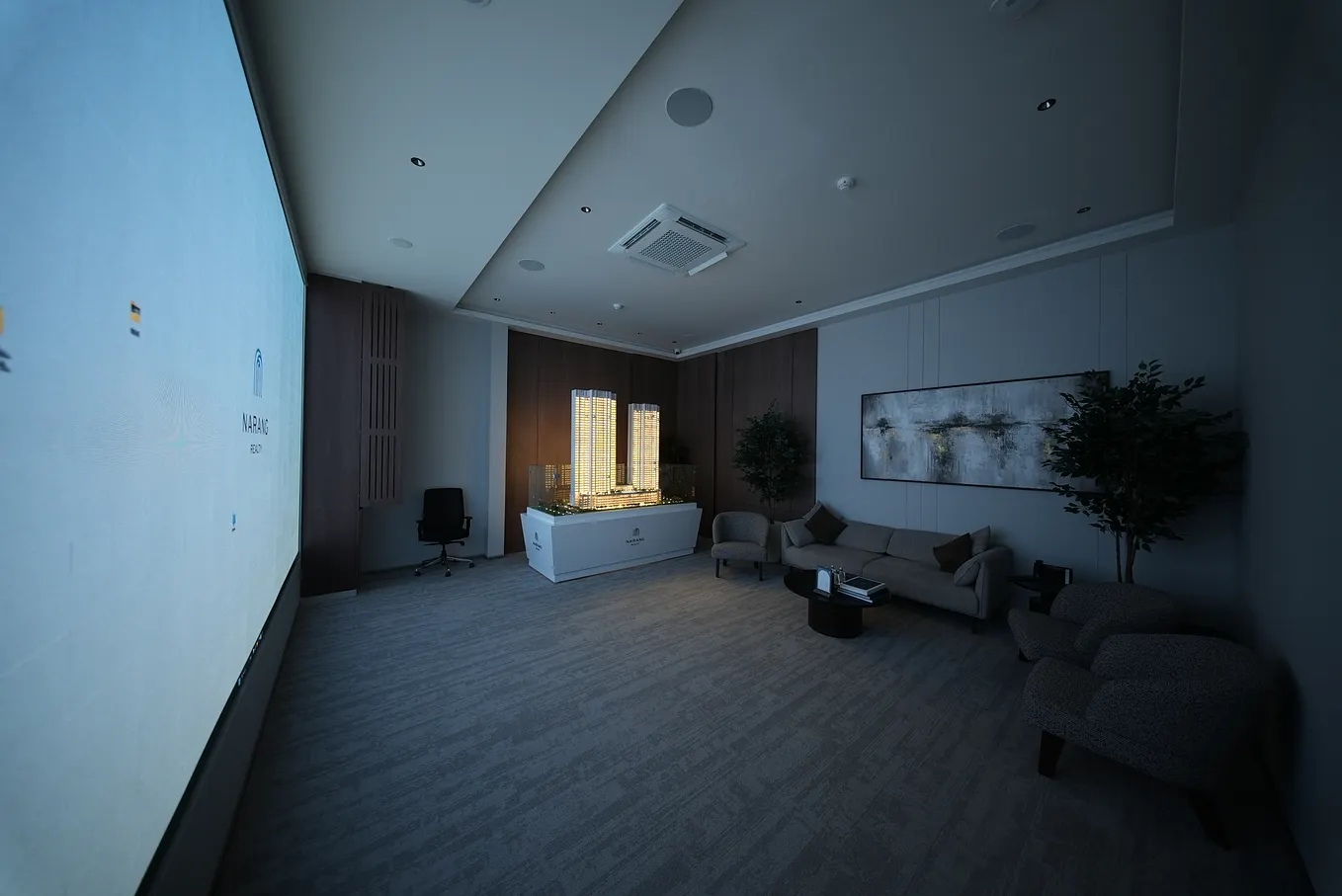
Beyond the Screen: Physical Experience Centre Design
The best interactive sales presentations don’t exist only on screens — they exist within a physical space that amplifies and extends the visual experience. V-Estate’s experience centre solutions address this physical dimension explicitly.
Dynamic projection mapping can breathe life into scale models — projecting lighting conditions, building features, and surrounding landscape context onto a physical three-dimensional model in a way that static models can never achieve.
360-degree projection environments can immerse buyers in a panoramic visual experience of the project and its surroundings — useful for township-scale developments where the relationship between the development and its wider context is a key value driver.
Video wall installations at the entrance create an immediate, high-impact first impression that sets the quality standard for the entire experience before the formal presentation even begins.
These physical elements, combined with the interactive digital platform, create an experience centre environment that communicates the quality and character of the project at every touchpoint — from the moment the buyer walks in to the moment they sit down with the sales team.
The Compound Effect: When Strong Presentations Drive Word-of-Mouth
One benefit of genuinely impressive sales presentations that rarely gets credit in the marketing ROI conversation is their impact on word-of-mouth.
Buyers who have an exceptional experience at a project’s experience centre talk about it. In India’s property market, where referral-based buying decisions are significant, the impression made by a great presentation echoes beyond the immediate session.
A buyer who brings a friend, sibling, or colleague to the experience centre brings them with a pre-established level of enthusiasm. “You have to see this presentation” is a recommendation that carries more weight than any advertising channel.
Great presentations become part of the project’s reputation. In a competitive launch environment, that kind of organic credibility is invaluable.
Present Like Your Project Deserves
Your project has been designed with care. It’s been engineered for quality. It’s been positioned for a buyer who has the means and the desire to invest in something exceptional.
The presentation they experience in your experience centre should match that standard.
Interactive sales tools from V-Estate have been deployed across some of India’s most respected residential developments to create presentations that genuinely do justice to the projects they’re showing.
Book a demo with V-Estate and discover how your next project presentation can be built to reflect the true quality of what you’re selling.
Because every project deserves a presentation as strong as the project itself.