The Phone Call That Asked If They Had Enough Flags
A soldier’s account of Pulwama, and the strange discipline that makes a 15-minute response possible in the first place
The sound came first. Not confirmation, not a report — just a blast, audible from wherever Major Harshavardhan Chava happened to be that afternoon, roughly fifteen to twenty minutes from what would become one of the deadliest single-day attacks on Indian security forces in decades.
In Kashmir, he explains, you don’t get to assume the worst-case interpretation of a loud sound and you don’t get to assume the best either. A tire bursting and a bomb going off can sound close enough to each other that the only responsible reaction is total alertness until someone confirms which one it was. That day, February 14, 2019, confirmation came fast and ugly: an IED attack on a CRPF convoy — soldiers traveling by bus, hit directly.

What was already there by the time he arrived
Chava’s unit rushed toward the site immediately. Units stationed five to ten minutes away had already reached it by the time he got there; by his own estimate, twenty minutes to half an hour had passed between the blast and his arrival. What he found on that highway is the kind of image that doesn’t need embellishment to be unbearable: the bus destroyed, and the road itself scattered with the remains of the soldiers who’d been riding in it. Forty-four CRPF personnel were martyred that day.
He went back to his office afterward, sat down, and got a phone call from CRPF. The question on the other end was almost unbearably logistical, given everything that had just happened: did his unit have any spare flags?
The reason for the question tells you something about Kashmir in that period that no casualty count can fully convey on its own. Indian flags were genuinely hard to find in local shops. Not because of supply chain issues — because shopkeepers were afraid to stock them. It took a terrorist as little as two or three seconds to conceal a pistol, walk up to a shop that looked a little too openly pro-India, fire, and disappear. One killing like that sent a psychological ripple through an entire market; nobody wanted to be the next visible target. So flags simply weren’t something you could reliably buy. And nobody — not CRPF, not the Army, not anyone planning for that day — had stocked enough flags in advance, because nobody expected forty-four people to die in a single attack. You keep some on hand for the ordinary, tragic occasion. You don’t keep dozens on hand for a day like that one.
The discipline of controlling what you feel
Chava describes that day as the only time in his entire service where he felt something closer to rage than pain — and immediately follows that admission with the specific discipline officers are trained into: you have to control your emotions, because your soldiers are watching you and taking their emotional cue from how you respond. There’s a saying in the Army for this, half in Hindi, half explained on the spot: josh mein hosh nahi hona — roughly, don’t let excitement or fury switch off your judgment. Losing that switch isn’t just a personal failure. It’s a leadership failure, because soldiers can’t be led by someone who’s stopped thinking clearly.
Get Vivekkataru’s stories in your inbox
Join Medium for free to get updates from this writer.
That discipline gets tested in a specific, almost unbearable way after an attack like Pulwama, because the emotional pressure doesn’t only come from the battlefield. It comes from home. A soldier’s family finds out through the news before he can call them himself. Then the calls start — a father asking why his son is even in a place like that, a wife, frightened, asking him to take leave and come home immediately. And the soldier is standing inside a genuine dichotomy: he took an oath to defend the country’s borders regardless of personal cost, and the people who love him most are, in that exact moment, asking him to break it.
Chava’s framing of an officer’s job in that moment is direct: your biggest responsibility isn’t tactical, it’s emotional. You reassure your soldiers. You remind them that the people who died — even if they wore a CRPF uniform rather than an Army one — were working toward the exact same goal, wearing a uniform just like theirs. You tell them, and mean it, that if something happens to any one of them, they will not be left behind. My buddy will carry me back, is how he puts the underlying promise. Not abstractly — literally. Injured, hit by shrapnel, whatever happens, your fellow soldier brings you out. Nobody’s body gets left on the ground.
Why fifteen minutes is even possible
Here’s the detail that reframes the entire account: how did Chava’s unit get to that site as fast as they did in the first place? The answer runs back through a kind of training that sounds, on its own, almost comic — until you understand exactly what it’s building toward.
At the academy, cadets go through something called Patti Parade. An officer needs roughly eight or nine different uniforms depending on the occasion — physical training, office duty, combat, ceremonial functions, sports. In Patti Parade, a batch of forty cadets gets assembled, then given two minutes to run to their rooms, change into a specified uniform, and reassemble in formation. Two minutes, for forty people, changing into gear that isn’t designed for speed. It’s close to physically impossible. If thirty-five of the forty make it in time and five don’t, the entire batch of forty goes again — from scratch. This can run from ten at night until four or four-thirty in the morning, cycle after cycle, until all forty succeed inside the time limit simultaneously.
There’s a lighter side to academy discipline too, and Chava tells one story that’s become something of a legend among his batch. A cadet named Neeraj — tall, well-built, a former model from Delhi, barely two or three days into training — got stopped by a senior who asked if he worked out. Neeraj, proud of his gym background, said yes. The senior said, “Give me 20.” He meant twenty push-ups. Neeraj, genuinely not understanding the phrase, reached into his pocket and handed the senior an actual twenty-rupee note, assuming he wanted change for something. The senior treated the misunderstanding as disrespect — and for the next month, any time he spotted Neeraj anywhere on campus, the demand came again: give me 20. Ten times a day, sometimes twenty. Neeraj, by Chava’s account, spent more time in the push-up position that month than standing upright.
Funny, and also not incidental. That relentless, repetitive, seemingly excessive drilling — uniform changes at 2 a.m., push-ups triggered by an old joke, weapon handling practiced blindfolded until you can strip and reassemble a rifle in total darkness without thinking about it — is exactly what turns a fifteen-minute response time from a boast into a fact. By the time an officer is actually leading a unit, none of it requires conscious thought anymore. It’s muscle memory. Bulletproof jacket, helmet, weapon, ammunition, sniffer dogs loaded into vehicles, siren on, no traffic allowed to obstruct the road — inside fifteen minutes of the call coming in, you’re at the location. Chava describes doing it so many times in training that eventually you could do it with your eyes closed. Which, on the actual night an operation happens in a pitch-black apple orchard with no lighting, is exactly what you need to be able to do.
What holds a unit together after a day like that
Two things, in Chava’s account, give a soldier the confidence to keep operating after witnessing something like Pulwama: the training itself, and the certainty of brotherhood. Not sentiment — an actual, structural certainty that no soldier gets left behind, dead or wounded, regardless of what it costs to bring him back. That’s what the Rashtriya Rifles is built on, in his telling: protecting the country’s integrity, protecting its people, without asking who the soldier next to you is or what he believes. Someone picks up a weapon against this country, that’s the only fact that matters. Everything else — the training that gets you there in fifteen minutes, the discipline of controlling your fury, the promise that your buddy carries you home — exists in service of that one, singular commitment.
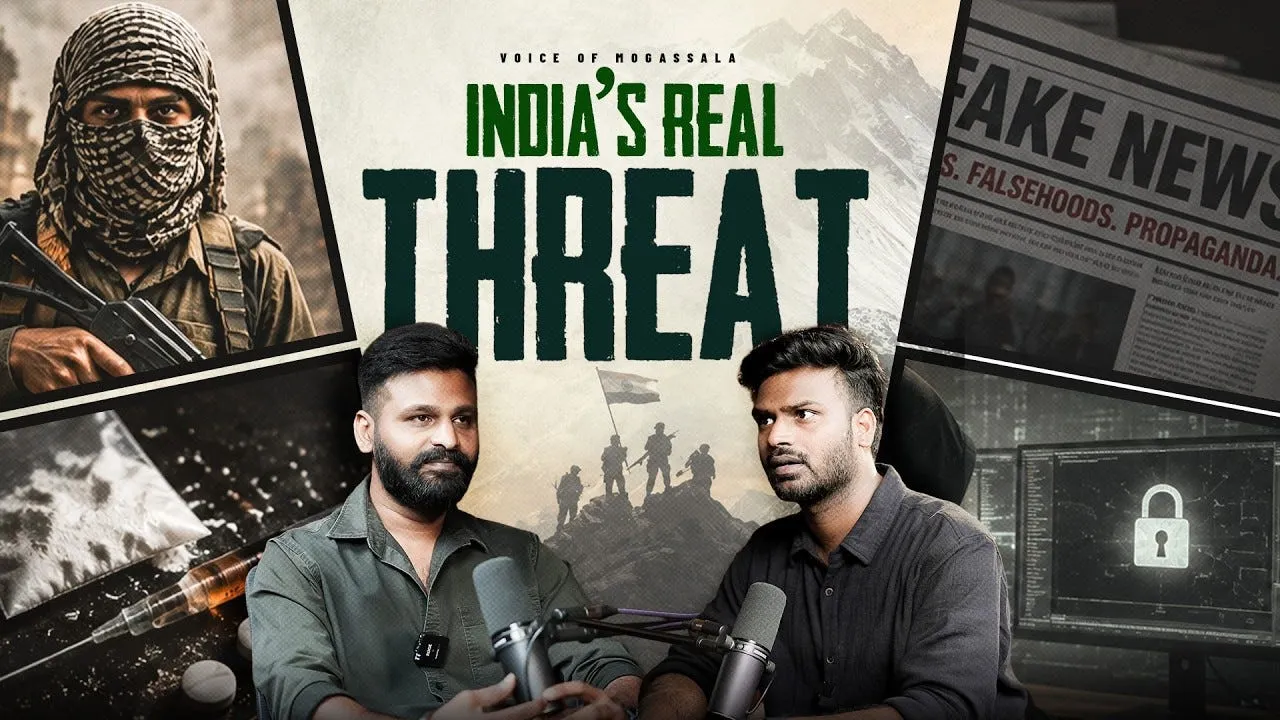
This account is drawn from Major Harshavardhan Chava’s conversation on VOM | Voice of Mogasala. Watch the full episode here for his complete telling of that day and the training behind it.
Tags: national security, india, pulwama, military, defense 1,320 words · ~5 min read