WHERE DOES DELHI POLL RESULT LEAVE HINDUTVA NARRATIVE?


By Venkata Vemuri
There is a Whatsapp forward going viral after the Delhi election counting trends massively tilted towards Aam Aadmi Party (AAP):
“Amit Shah asked the people of Delhi: Vote kisko diya?
Pat came the reply: Aap ko diya.”
That’s the thing. The answer’s clear. Unclear as well.
What does BJP’s loss in Delhi mean? Is it that the Hindutva platform of hate has no takers? Is it that Hindutva pales before ‘real’ vikas? Is it that a majority of the voters of Delhi are not communal? How to assess Kejriwal’s smashing victory in political terms?
Not an easy task. Nothing is cut and dry. For instance, is there is a ready answer to the question: Is Kejriwal secular? Think again….take your time….you cannot give a yes or no answer.
The Delhi results are being analysed across the media platforms. However, nobody is finding a closure. Why? The reason is, the answer is evident but it is not really palatable; not political correct to say it aloud either.
Get VVP Sharma’s stories in your inbox
Join Medium for free to get updates from this writer.
‘Bharat Mata ki jai.’ Kejriwal at the end of his victory speech. He followed it up with a salutation for Hanuman. He said it matter of factly. As if it was a natural progression of his speech. He didn’t have to say he is a Hindu. Is that expected of only Hindus by chance?
The AAP workers cheered him. The BJP workers who watched him on TV could not jeer him after they heard the twin salutations. Nobody, none of the BJP spokespersons on the various channels, called Kejriwal a Hindu or Hindutva hater. Nobody, neither the Congress nor the Shaheenbagh protesters, called him secular.
A large section of the analysts called Kejriwal a shrewd politician for having kept the Hindutva forces at bay by simply ignoring them. By not acknowledging the communal agenda. By not referring them even once. That, this section believes, is how Kejriwal triumphed over the communal brigade. Vikas versus Vinash as a creative analyst put it in a tv debate. It is because of this strategy that Kejriwal distanced himself from Shaheenbagh as well.
Ah! We now come to ground zero. If you go by this section of analysts, what happened is this: The people of Delhi benefitted from the positive governance of Kejriwal. The sizeable amount of money they were saving every month thanks to reduced bills was Manna from heaven. Their children were better off studying. They themselves were given respect when they attended Parent-Teacher Meetings where they got to sit on chairs and talk to principals and teachers as equals. They didn’t have to go far if they fell ill. And much more. The Hindu benefitted. The Hindutva benefitted. The Muslim benefitted. ‘Aap ko diya.’ Makes sense, does it? Material stuff, like money, free bus travel, cheap electricity, ranks far above ideology.
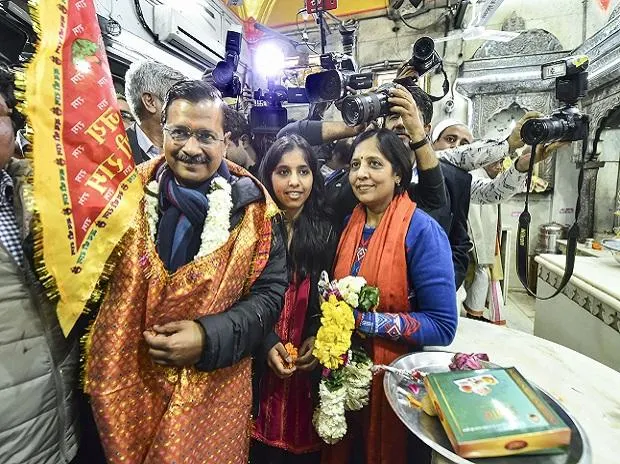
Is that what it is, then? Not really. There is another narrative that has sprung up after the trends became clear: Kejriwal performed his ‘raj dharma’. He worked hard. He made the people receive tangible benefits. He did not indulge in communal talk. He did not counter Hindutva with his brand of ‘vikas’. He did not refer to Shaheenbagh. He did not refer to Muslims. He visited temples. . Yes, he visited temples. By ‘purifying’ the temple Kejriwal visited, the BJP president of Delhi, Manoj Tewari, only helped the people retain the memory of Kejriwal visiting the temple!
In short, Kejriwal is the quintessential ‘Rama the good boy’. He is a good Hindu, what with that ‘tika’ from the temple, though he never talks about being a Hindu. He is not talking about minorities and their protests. He is talking of clearing up the protests so that commuters are not inconvenienced. His actions speak for themselves; they leave an imprint of him as a Hindu. His governance speaks for itself; they leave a visible imprint of his work. What more does Delhi want? Isn’t he what Narendra Modi should ideally have been?
See how the narrative has been progressing within hours of the counting trends. The tv anchors were ready with their next question: Will Kejriwal now have national ambitions? How come they ask this question of Kejriwal alone and not the so many regional leaders who in recent years established their electoral popularity in the states much bigger than Delhi? Some sections of the social media began comparing Prime Minister Narendra Modi with Chief Minister Arvind Kejriwal. Why the clamour, the urgency, to fit Kejriwal into a groove, something said in low voice, like ‘soft Hindutva leader’? Not so easy to answer whether if Kejriwal is secular, is it!
The chatterati of Delhi are by now clearly divided along ideological lines. But which ideology? The ‘ruling’ ideology. How does this narrative take shape? Like this: The BJP may not have got many seats. But its combative communal ideology is pervasive. The party has been defeated, not its ideology. The BJP kept hammering the same message throughout the campaign: It dumped all pretence. There was no talk of development, jobs, populisms for Delhi-ites, etc. There was CAA, NPR, Muslims, Pakistan, Shaheenbagh. Day in. Day out. It peaked with the likes of Yogi Adityanath and Anurag Thakur spewing unpardonable stuff. The entire AAP leadership, from Kejriwal to the junior-most candidate, side-stepped the Hindutva issue. Okay, it might be that they countered communalism with development and tasted victory. But the point remains that (a) their actions on the ground were softer versions of the aggressive, abusive campaign of the BJP and (b) they did not counter communalism with secularism. The communal campaign, in the end and till the end, remained unchallenged.
Last but not the least, who are the Kejriwal supporters? A closer inspection will reveal they come from the very same sections which bear the brunt of sedition cases and anti-national charges these days. These are the sections which are at the forefront of the fight against virulent communalism. And they vote for Kejriwal who not once in his Delhi campaign acknowledged their efforts, well knowing he would anyway get their votes because he does give them benefits accruing from his hard work.
Either of them — communalism or secularism — has been re-defined in the Delhi assembly elections, 2020. Can’t really say which.
Maybe too much is being read into what is a simple case of a chief minister being returned to power for his performance.