Brief explanation of each PostgreSQL commands

Here’s a brief explanation of each PostgreSQL command you’ve listed and their typical usage:
Database Administration Commands:
1. `createdb`: Creates a new PostgreSQL database. It’s a wrapper around the `CREATE DATABASE` SQL command.
2. `createuser`: Adds a new PostgreSQL user. It’s a wrapper around the `CREATE USER` SQL command.
3. `dropdb`: Removes an existing PostgreSQL database. It’s a wrapper around the `DROP DATABASE` SQL command.
4. `dropuser`: Deletes a PostgreSQL user. It’s a wrapper around the `DROP USER` SQL command.
5. `reindexdb`: Rebuilds indexes for a PostgreSQL database to optimize performance. It’s a wrapper around the `REINDEX` SQL command.
6. `vacuumdb`: Cleans up and analyzes a PostgreSQL database to reclaim storage and update statistics. It’s a wrapper around the `VACUUM` SQL command.
7. `vacuumlo`: Removes large objects (LOs) that are no longer in use in the PostgreSQL database.
Database Maintenance and Management Commands:
8. `pg_amcheck`: Checks the integrity of PostgreSQL tables and indexes.
9. `pg_archivecleanup`: Cleans up WAL archive files that are no longer needed.
10. `pg_basebackup`: Creates a base backup of a PostgreSQL database cluster, which is useful for setting up replication or creating a backup.
11. `pgbench`: A benchmarking tool for PostgreSQL, used to generate a workload on a database to test its performance.
12. `pg_checksums`: Verifies data checksums in a PostgreSQL database cluster, helping to detect data corruption.
13. `pg_controldata`: Displays information about the control data file of a PostgreSQL database cluster, including system identifiers and checkpoint information.
14. `pg_ctl`: A utility to start, stop, restart, and manage a PostgreSQL server.
Get Sheikh Wasiu Al Hasib’s stories in your inbox
Join Medium for free to get updates from this writer.
15. `pg_isready`: A simple utility to check the status of a PostgreSQL server, indicating whether it is ready to accept connections.
16. `pg_receivewal`: Receives and stores WAL (Write-Ahead Logging) files to support continuous archiving or streaming replication.
17. `pg_resetwal`: Resets the WAL logs of a PostgreSQL cluster. This is a dangerous operation that should only be used in emergencies, as it can lead to data loss.
18. `pg_restore`: Restores a PostgreSQL database from an archive created by `pg_dump` or `pg_dumpall`.
19. `pg_rewind`: Rewinds a PostgreSQL database cluster to a previous state, which is useful for rejoining a failed master to a replication setup.
20. `pg_test_fsync`: Measures the performance of different synchronization methods to find the best option for PostgreSQL’s fsync behavior.
21. `pg_test_timing`: Tests the timing overhead of PostgreSQL on a system to help configure `pg_test_fsync`.
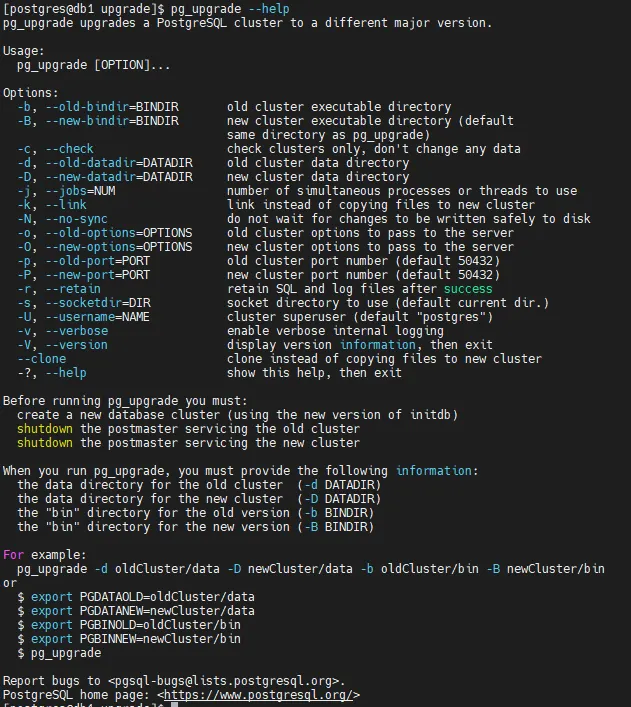
22. `pg_upgrade`: Upgrades a PostgreSQL database cluster to a newer major version.
23. `pg_verifybackup`: Verifies the integrity of a backup created with `pg_basebackup`.
24. `pg_waldump`: Displays the contents of WAL files, which can be used for debugging and auditing purposes.
Client and Configuration Commands
25. `pg_config`: Displays configuration information about the PostgreSQL installation, such as version, directories, and compilation options.
26. `postgres`: The main PostgreSQL server executable. This is typically started by the `pg_ctl` script or a system service manager.
27. `postgresql-14-check-db-dir`: A script for verifying the directory structure and configuration of a PostgreSQL 14 database cluster.
28. `postgresql-14-setup`: A script for setting up, initializing, and managing a PostgreSQL 14 database cluster.
29. `psql`: The interactive terminal for interacting with PostgreSQL databases, executing SQL commands, and managing database objects.
30. `postmaster`: Another name for the main PostgreSQL server process, which listens for connections and manages database sessions. It is generally not used directly, with `postgres` being the preferred executable.
These tools are commonly used for managing, maintaining, and interacting with PostgreSQL databases. Always refer to the official PostgreSQL documentation for detailed usage instructions and best practices.