Why Buying Cheap Woodworking Tools First Is a Beginner’s Biggest Mistake


There’s a moment almost every beginner reaches, often without realizing how important it is.
You’re scrolling through an online store late at night, or standing in front of a long aisle under harsh lights. Two tools sit side by side. Same purpose. Same promise. One costs half the price of the other. The choice feels obvious, almost virtuous.
Start cheap. See if it sticks. Upgrade later.
We’ve heard this reasoning countless times. We’ve also seen where it leads, just as often. Not because beginners are careless or naïve, but because woodworking has a way of exposing decisions that make sense on paper and quietly fail in real life.
This is one of them.
When someone begins woodworking, they aren’t just buying tools. They’re establishing a reference point. Every cut, every joint, every adjustment is interpreted through the behavior of the tool in their hands. That behavior teaches them what woodworking feels like, long before they can put it into words.
If that signal is distorted from the start, learning becomes slower, heavier, and far more frustrating than it needs to be.
The first months are not about speed or output. They’re about calibration. About understanding resistance, pressure, alignment, and feedback. A beginner is constantly asking silent questions: Is this normal? Is this how it’s supposed to feel? Am I doing something wrong?
Cheap tools rarely answer those questions clearly.
They don’t usually fail in dramatic ways. They cut, but not cleanly. They measure, but not consistently. They hold an edge, but not for long. Each small inconsistency adds a layer of doubt. And doubt, repeated often enough, reshapes behavior.
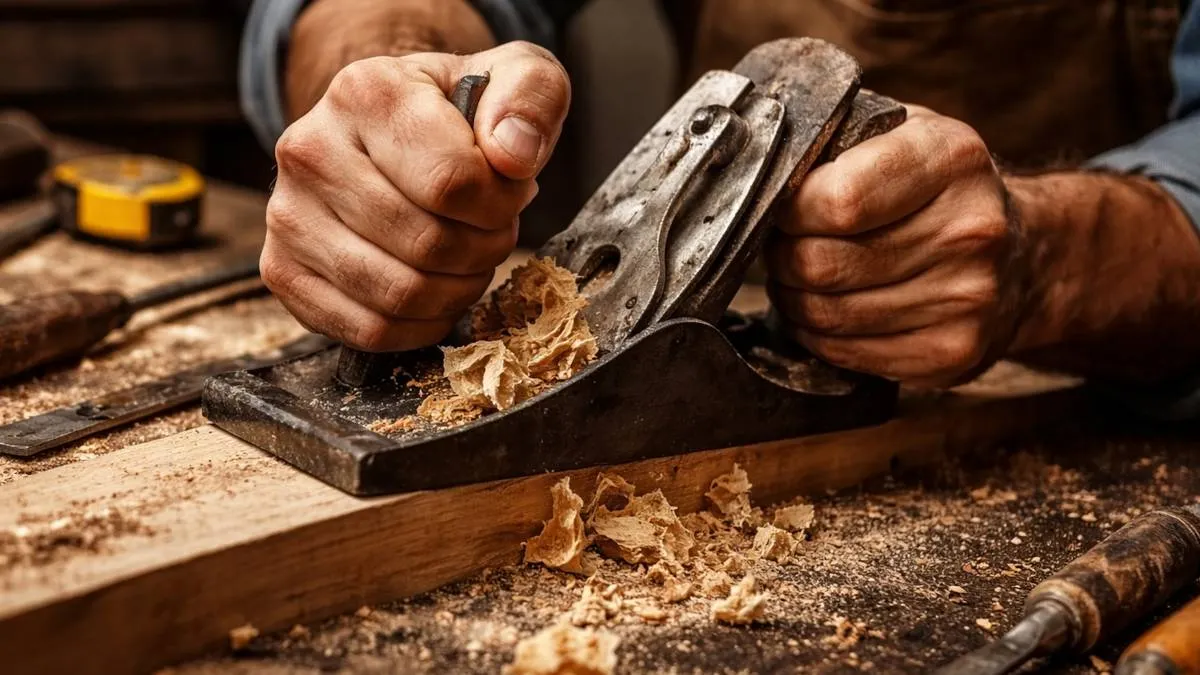
A chisel that won’t stay sharp doesn’t teach sharpening. It teaches compensation. A saw that drifts doesn’t teach control. It teaches force. A square that’s slightly out doesn’t announce itself as faulty. It simply spreads error quietly, joint after joint.
What we see, again and again, is that beginners almost never blame the tool. They blame themselves. They assume they lack skill, patience, or talent. They push harder. They sand more. They correct blindly, without understanding what went wrong in the first place.
This is how bad habits are born.
Woodworking depends on feedback loops. You make a cut, the tool responds, and you adjust. When the response is unreliable, adjustment turns into guesswork. Guesswork turns into routine. And routines formed under noisy conditions are hard to unlearn.
There’s a persistent idea that precision comes later. That early projects are meant to be rough, and accuracy is something you earn with time. In woodworking, this belief causes more trouble than almost any other.
Precision is not an advanced concept. It’s a requirement.
A millimeter out of square at the beginning doesn’t stay small. It compounds. A slightly twisted reference edge throws off every operation that depends on it. A cut that’s almost straight forces every following step into correction mode. By the time the problem becomes visible, it’s already embedded in the piece.
Cheap tools introduce error before the work even begins. No amount of care can fully compensate for that.
Get Woodwork Tools Guild’s stories in your inbox
Join Medium for free to get updates from this writer.
We’ve watched many beginners fall into the same loop. A tool is bought because it’s affordable. Frustration appears, but it’s tolerated. Progress slows. Projects stall halfway through. Eventually the tool is replaced, often quietly, without acknowledging how much time and energy it consumed.
The original tool ends up in a drawer, or at the back of a shelf, carrying a vague sense of disappointment. What’s rarely counted is the real cost. Not just money, but wasted wood, abandoned ideas, and the erosion of confidence that happens when effort doesn’t translate into results.
Buying twice is common. Learning twice is not.
There’s another hesitation we see frequently, and it’s understandable. The feeling that better tools should come later, once skill justifies them. That it’s somehow irresponsible to invest in reliability before “earning” it.
Experience suggests the opposite.
Reliable tools don’t reward skill. They make learning possible. They behave predictably. They remove variables. They tell the truth.
A clean cut shows what worked. A poor cut shows exactly what didn’t. That clarity accelerates improvement faster than any tutorial, video, or book ever could. Without it, even good advice becomes hard to apply, because the feedback doesn’t match the instruction.
Starting smart doesn’t mean starting big. It means starting intentionally.
We’ve seen beginners with a single bench, a handful of tools, and very little space make steady, satisfying progress. We’ve also seen large workshops filled with equipment produce nothing at all. The difference is rarely enthusiasm. It’s trust.
When a tool does what it’s supposed to do, attention shifts from fighting mechanics to understanding process. Confidence grows naturally, not because the work is perfect, but because it’s understandable.
This mistake is so common because it feels sensible. It mirrors how most hobbies work. You test the waters, keep costs low, and decide later whether to commit. Woodworking looks like it should fit that model. In reality, it doesn’t.
Woodworking is tactile. It’s cumulative. And it remembers every early compromise.
Cheap tools don’t fail loudly. They fail quietly, consistently, and early. They shape how beginners move, how they think, and how they interpret mistakes. Over time, they define what woodworking feels like. And if that feeling is constant resistance, many people decide the craft simply isn’t for them.
We’ve noticed something telling over the years. The people who stay with woodworking aren’t always the most talented. They’re not necessarily the fastest learners. They’re often the ones who didn’t spend their first months fighting their tools.
That’s not coincidence. It’s cause and effect.
When tools are reliable, mistakes are informative. When tools are unreliable, mistakes are discouraging. One invites curiosity. The other breeds doubt.
If you’re at the beginning, or close to it, the principle is simple. Buy fewer tools. Choose reliability over bargains. Avoid starter kits designed around price instead of performance. Let each tool earn its place by doing one thing well and doing it consistently.
Cheap tools promise flexibility. They suggest an easy exit. Good tools offer direction. They quietly encourage commitment, not through cost, but through clarity.
And in woodworking, clarity matters far more than speed.
(Next in this series, we’ll look at which tools actually deserve priority at the beginning, and which ones can wait.)