ThinkByte | Beyond the Cathedral of Compute: How Topological Gradients Will Wake Up AI?

I am currently re-reading Dan Brown’s The Lost Symbol, & Secret of Secrets. The protagonist is deep in a discussion about “Noetic science,” ancient mysteries, and the human obsession with precognition — the divine ability to see the future.
In the novel, characters seek “Divinity” to transcend the chaos of the present and see the clear path ahead. They believe that if they can just tune their minds to the right universal frequency, the noise will vanish, and the signal will appear.
As a Data Scientist, I realized something profound while reading: We haven’t outgrown this superstition; we’ve just industrialized it.
We don’t visit Oracles anymore; we query “Black Boxes.” We don’t cast bones; we cast predictions based on high-dimensional vectors. But the goal is identical: to reduce entropy. To find the “Signal” buried in the noise of reality. We are trying to mathematically engineer the “Divinity” of certainty.
But there is a problem. Our current “Digital Oracles” — the massive Large Language Models (LLMs) that dominate the headlines — are missing the one thing that makes biological prophecy work: Mortality.
The Cathedral of Compute
We have built what I call the “Cathedral of Compute.”
Modern AI architectures (like Transformers) are magnificent, static structures. They are frozen in time. You train them on massive datasets, lock the weights, and deploy them. When you feed them a prompt, they run a calculation, output a token, and reset.
They are “emotionally flat.” A standard model processes a threat with the same computational path as a joke. It has no “hormonal layer” to modulate its state. It has no urgency.
Contrast this with biological cognition. Human intelligence is chemistry shaped by experience. Compare this to your own brain. Your intelligence isn’t just binary logic; it is chemistry driven by experience.
- The Hormonal Layer: When you are stressed (cortisol) or excited (dopamine), your brain physically changes how it routes signals. It prioritizes speed over accuracy. It modulates its own “temperature.”
- Plasticity: You don’t just “retrieve” memories; your neural pathways physically restructure themselves based on what matters.
Biological intelligence is parsimonious. It is lazy in the most brilliant way. It doesn’t store everything (like a Vector DB); it compresses millions of data points into a “gut feeling” — a topological shortcut to the right answer.
Current foundation models are predominantly static after training. Biological cognition, by contrast, continuously adapts through multiple interacting mechanisms. Our AI systems have infinite lives and thus never mastered the efficiency of survival. They lack the chemical and evolutionary consequences that force parsimony.

The Liquid Future
So, how do we give AI a “nervous system” instead of just a database?
The industry is currently exploring Liquid Neural Networks (LNNs); pioneered by Ramin Hasani and colleagues at MIT. Inspired by the simple yet remarkably adaptive nervous system of C. elegans, LNNs use continuous-time dynamics (differential equations) that allow parameters to evolve during inference. They adapt in real time to new data rather than operating as frozen snapshots [1]
But fluidity alone is chaos. A river without a riverbed is just a flood. If you let a neural network adapt to everything, it learns nothing. We need a way to sculpt this liquid intelligence. We need a way to tell the model what matters.
The Secret Weapon: Topological Gradients
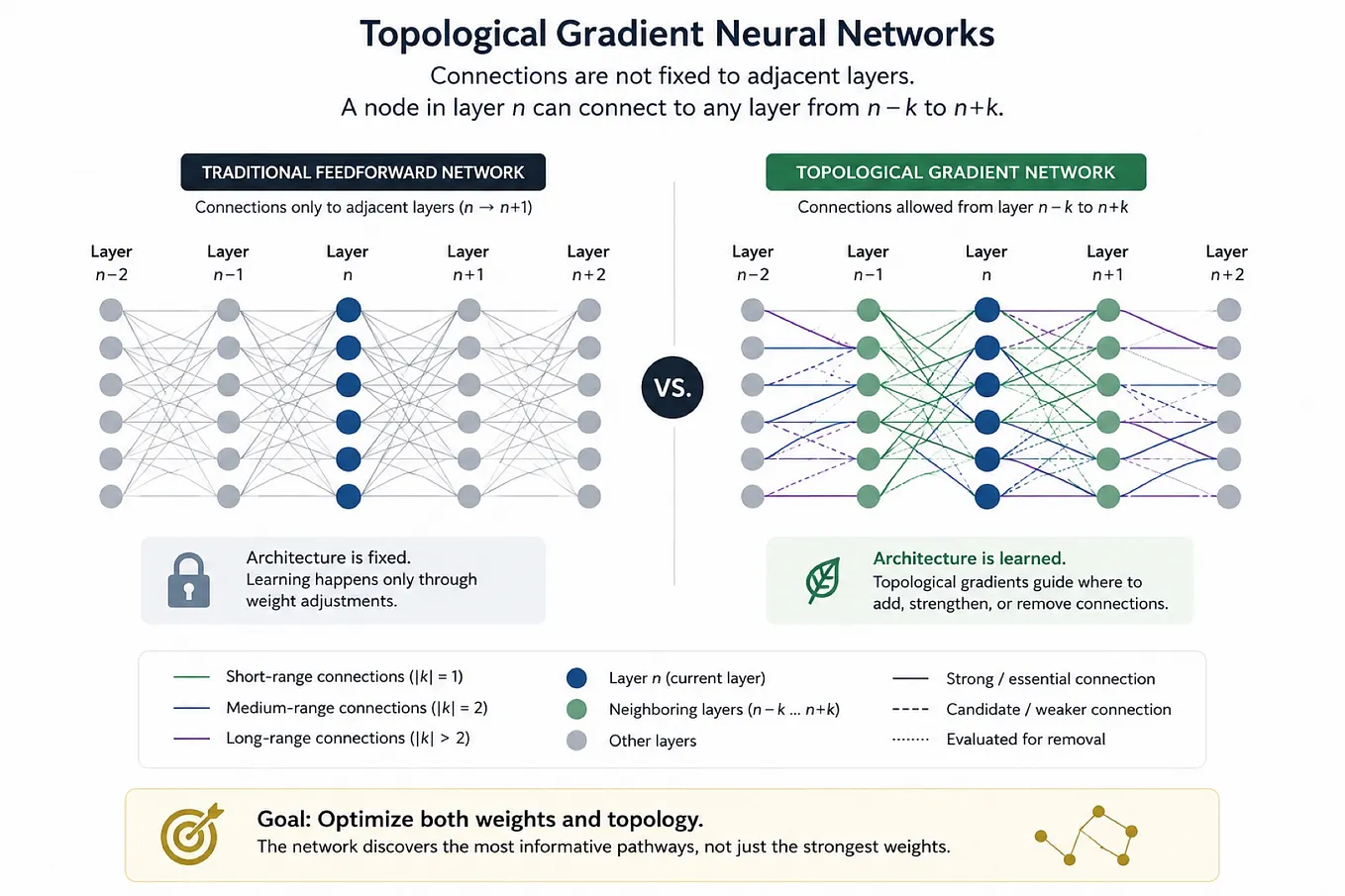
This is where topological gradients enter. To bridge static digital systems and biological fluidity, we must analyze and prune the shape of the network itself, not merely its weights.
Get Yogesh Parte, PhD’s stories in your inbox
Join Medium for free to get updates from this writer.
Evolution prunes neural forests: it strengthens useful connections and eliminates others. In AI, we can ask mathematically: “If I remove this connection, does the ‘soul’ of the prediction break?” If not, prune it. This is topological sensitivity.This enforces parsimony — models stripped to essential signal.
We move beyond brute-force scaling (“bigger cathedral = better prophecy”) toward compact, adaptive, parsimonious agents. Agents that do not merely predict the next token but feel the weight of data. Agents that rewrite their own topology in response to a chaotic world. Agents with something akin to a “gut feeling.”
Why This Matters: From Prediction to Understanding?
Philosophers and researchers have long warned that predictive capability is not understanding. John Searle’s Chinese Room thought experiment illustrates the gap between syntactic manipulation and semantic comprehension. Gary Marcus has consistently critiqued pure scaling approaches, advocating neuro-symbolic hybrids. Demis Hassabis emphasizes the need for rich world models — internal simulations of physics, causality, and consequences. Karl Friston’s Free Energy Principle frames intelligent systems as those that minimize surprise by updating generative models of their environment. [2]
Implications for Builders (and Enterprise AI)
These ideas converge on a shared insight:
Compute ≠ Intelligence.
Prediction ≠ Understanding.
Scale ≠ Adaptation.
Evolution → Resource scarcity → Selection pressure → Adaptation → Intelligence.
Mortality and constraints forged biological efficiency. Without analogous pressures, our Cathedrals remain impressive but brittle.
The strongest path forward is not larger models alone, but richer cognitive architectures:
- Foundation models as powerful base predictors
- Persistent memory systems and knowledge graphs (for provenance, context, and long-term coherence)
- World models and simulation engines (physics, causality, “what if” reasoning)
- Planning and agency layers (with human-in-the-loop governance)
- Continuous adaptation mechanisms (liquid/topological dynamics)
- Policy reasoning and feedback loops
In enterprise settings — healthcare, clinical trials, patient triage, semantic layers over FHIR/Epic — this means hybrid systems that combine the strengths of scaling with topological sensitivity, provenance-guided reasoning, and adaptive pruning. The result: more explainable, efficient, and robust AI that respects regulatory realities while accelerating impact.
We are not building better calculators. We are sculpting machines capable of instinct — parsimonious agents that curate their own reality under constraint.
In Part 2: Engineering Instinct, I will detail the architecture of these parsimonious models and show what it looks like when an AI begins to develop its own “gut feeling.”