Non-transparent Things


I’m not good at keeping routine. Always being distracted here, distracted there, by the undulating mundanities. This, among other things, has taken away from my writing career more than any other reason. So I have chosen to start reading with what time I can get: this has been working better than I imagined. I started the year rereading Teju Cole’s Tremor; then read some academic papers on his novels. Later in January I read “Air War and Literature” from Sebald’s On the Natural History of Destruction. I have reread Viktor Shlovsky’s “Art as Technique”; reread two chapters from Lois Tyson’s Critical Theory Today; reread, from February, John Ngusha Orkar’s 1979 doctorate thesis A Pre-Colonial History of the Tiv of Central Nigeria, going on to discover other great materials on Tiv history (however, mostly 20th-century colonial enterprise anthropological writings). And finally I read my first Nabokov, Transparent Things, solely for the popularly quoted passage in its first chapter (often brought up in conversations on photography). That “When we concentrate on a material object, whatever its situation, the very act of attention may lead to our involuntarily sinking into the history of that object […] Transparent things, through which the past shines!” It continues after a few words:
“A thin veneer of immediate reality is spread over natural and artificial matter, and whoever wishes to remain in the now, with the now, on the now, should please not break its tension film. Otherwise the inexperienced miracle-worker will find himself no longer walking on water but descending upright among staring fish.”
A light read, but nonetheless crafty and puzzling, as I am beginning to learn about the nature of Nabokov’s fiction. Finishing it timely encouraged me to finally read Ivan Vladislavic, who is sometimes labelled as “one of Sebald’s sons.” I read his Double Negative, the edition with a foreword by none other than Teju Cole, another Sebald son.
Upon completing Nabokov’s Transparent Things I felt I’d been scammed. Even before I completed it I already felt this way, for what had inspired me towards the novella — that passage — turned out to be, in my judgement, nothing but a sort of cerebral showoff. As the writer Chimezie Chika said, after I discussed it with him, he could have sworn they were the words of a physicist. I’d felt the same thing too whilst attempting to read Lolita some years back, this showoff, in the opening pages of Lolita, an equal bite of Nabokovian literary territorialism. I suspected perhaps after eating halfway through Transparent Things that those seductive words in its first chapter are a kind of thesis into unravelling or grasping the metafictional experimentation of the book. But this thinking, the book proved to me, was deceptive.
Nonetheless, I thoroughly enjoyed the mind game and the story itself, which is painstakingly elided for effect. And because of this, I felt I would have enjoyed the story more as a movie, than to have read it. This way, I wouldn’t be burdened of wanting to go back to it, but rather — to use Nabokov’s words — to engage it as an exercise of the now and left to be dazed, the way certain movies (de/re-)construct our senses after we see them. (With text, the act of revisiting, nay, involuntarily sinking, becomes a pleasurable challenge.) It is so well-written, technically, that as an author myself I couldn’t help but appreciate the great job Nabokov did in leaving out background plotlines as certain novices would be tempted to include, presenting the ultimately essential. This technical mastery I would also find in Ivan Vladislavic’s Double Negative, for instance, in the deft compression of a whole decade into one sentence to move plot, without the weakness an amateur hand might reveal. Both books were a pleasure; Nabokov’s more surreal.

In Vladislavic’s writing, I was able to relearn once again the art of indirection which I’d learnt from Sebald. Here is a story about the violent history of apartheid in South Africa, but this is only hinted at: because here is the story of a restive Afrikaans young adult, who drops out of university, Nevile Lister, conflicted about whether he is a true revolutionary or an imposter, doped on textbook liberalism, constantly reading (more like gobbling) the literature in his university’s library in the section for banned books, that he feels like he’s “suffering from a contagious disease. My head was like the stacks in the basement of the Cullen. New ideas fell out of old volumes and I tried to unriddle them in the gloom. The air was full of dust. I could scarcely breathe in the space between my ears.” His father fears his radicalism will lead him to become useless to himself and sends him to see a photographer, Saul Auerbach, as a kind of short pilgrimage, maybe it’ll help Lister re-think his decisions. He’d leave the country for England after seeing Auerbach, to avoid conscription into the SADF, and return a decade later. So the novel goes.
Get Carl Terver’s stories in your inbox
Join Medium for free to get updates from this writer.
There’s an almost nonchalant aspect in which we are made to look at Lister’s environment — through his own nonchalance — so that the history around him vanishes into non-contemplation, so that the more this bounces off him, the more, periscopically, we are reminded of it. How do you narrate historical violence without coming off as a historian? As Cole makes known in the foreword, the idea of a double negative is the case here: Lister’s nonchalance and the nonchalance created by the apartheid he is casually surrounded by in the novel. But when you see it, you see it. It is interesting, too, how photography, which Lister picks up as a career, is used as a technique of narrative.

Beside this lesson of storytelling are the marvellous sentences or phrasal vignettes Vladislavic throws in once in a while. Someone sways gently, “testing the blade of the air against their skin.” “…the secret had darkened into a superstition. At the heart of my memory something was in quarantine, for reasons I no longer remembered.” And more.
I read Transparent Things because I wanted to start a project of photography writing tagged #nontransparentthings, premised on the sentiment of the quote above: when we concentrate on an object, our act of attention may lead to an involuntarily sinking into the object’s history (thus the idea of “transparency”). Through which the past shines? This mode of seeing, I believe, informs the process or pattern of thinking when writing about photography in most places you look: the involuntary task of trying to see past the veneer of the photographic frame. Only the photographer writing about his own photography, perhaps, may feign an originality of thought. How far can we sink into an object, and even into its history, with the very risk of deception posed by the art form, and by our biases, blind spots, and inexperience? There is only so much sinking that can happen. My thinking, therefore, is for concentrating on less sinking — what about the non-transparency of things?
These photographs I have simply titled “collection project” are in my phone gallery since I began taking them and selecting which to write on. Some are as mundane as mundane can be; some, quite random; others, bland. But they make things more interesting to me because today we are easily bored by what we consider an inversion of our more delectable desires for what’s fun or appealing, with the hunger to fill up time or to be in the moment of something — even if it is empty something (hello, brain rot) — that we are constantly anxious or constantly cooked in the fear of having no colour in our life. A deceit we are sold, not entirely by our fault but as one of the inherited curses of belonging to the human tribe, which has worsened in an age where tolerance levels for boredom, aided by our hyphenation to gadgets and the virtual world, are very low.
In rebellion to such automated expectations, I think we must force ourselves to look to the slow things, the boring things, the things which aren’t colourful and bright, the things we might feel estranged from, and find that the ability to sit with them and be content, and to realise that they may even interest or intrigue us will be to have found an antidote to our modern and capitalist existentialisms. Boredom or slowness isn’t alien to us, or a disease requiring instant cure. Workers in assembly lines are always busy but also bored, sometimes dozing off on their tiring jobs. What we fail at is achieving the presence of mind to think about the paradox of our luxury when we seem to be bored, or in the slow moments, and what to make out of that time. This way then, we may think of mastering it — a secret that monks, perhaps, have been trying to make us understand all along. Am I digressing?
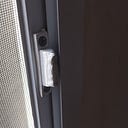
Back to #nontransparentthings. I imagine the project of writing about these photographs as practicing a better quality of slowness, blandness, or of a pause. The idea of a pause here is that I consider the photographs and try to sink, this time voluntarily, into them. Although, some are very interesting too, like a photo of a bird’s nest with two hatchlings and an unhatched egg that was taken in my bathroom window in April last year. Other photos in the collection include a photograph of a slightly-opened bathroom revealing a peek into it; a neon light portrait of a woman in afro on the walls of a nightclub; palm fronds lashing at the burglary proof of a window up a storey building; a window slide handle (I used this as the profile picture of my Blue Sky account, and image for this post). There are also photos of silly lovers walking down a pavement, a silly sunset ahead of them. Or even bare laterite roads. Etc. The non-transparent things.++
Kindly check out my metafictional short story “The Trial of Mr. Orvangegbilin” here, where I tried to explore the problem of the first sentence.
You can also check out my photography essay “An Affordance” here.