Fail Fast: Becoming a learning organisation

Learn how we introduced Fuckup Nights to share our failures in a supportive forum and turn them into learning experiences.
by Martin Heckmann, Head of Classifieds Product mobile.de

Many companies claim to be a learning organisation, by which they mean acquiring knowledge, trying things out, succeeding, or even failing from time to time. To fail is to learn, and sharing your failures, in turn, strengthens the learning — but that’s only possible if the right framework exists and there’s a supportive corporate culture. This is the story of “Fail Fast” at mobile.de, the format we created to share, learn and move towards becoming a “learning organisation”.
Once upon a time in Mexico
Legend has it that five friends, during a night of drinking and exchanging entrepreneurial stories in Mexico, wondered why people only ever talk about the successes of the Zuckerbergs and Gates of this world, but nobody ever talks about their own failures. From this, Fuckup Nights was born, and within just a few years, it would become a worldwide movement.
From Mexico back to Berlin
While the principle of Fuckup Nights is particularly well-suited to failed business models in the start-up scene, many established companies have also benefited. One example is the Otto Group, one of the market leaders in mail-order for over 70 years. Read about their first event and the “failures” they presented on their company blog.
Of course, we don’t have 70 years of experience to work with, but like every company, we must constantly develop and learn. The shift towards agile values and work methods has gained enormous momentum at mobile.de in recent years. This has led to us experimenting more: on our platform, in our organisational structure, in our communications and in our meeting and presentation formats.
The first steps
We kicked off in 2018 in our Product & Tech department. The more we talked about the need for a systematic agile transformation, the more we realised that we only talked about successes, and rarely about failures. There was simply no space and no format beyond internal team retrospectives for the latter. As an organisation, we were in danger of missing opportunities to improve and move away from a failure culture towards a learning culture.
As with agile product development, it’s important to follow the build-measure-learn principle when introducing new formats and events. In our case, we did a test run with a small group interested in the concept of learning organisations. We presented one “failure” each from the areas of UX, product and technology to find out whether and in what form (duration, presentation format and setting) we could establish a Fuckup Night at mobile.de.

Let’s get started
Get Tech Blog @ mobile.de’s stories in your inbox
Join Medium for free to get updates from this writer.
At the first “official” Fuckup Night a few weeks later, we focused on the Product & Tech departments. If the launch was successful, we would then integrate other departments step by step.
After the first test run we established the following criteria:
- Keep the context related to mobile.de (but not a must)
- Each story was given 7–10 minutes
- Story structure: 1. Background, 2. Details of the Failure, 3. Learnings
- No set format: PowerPoint, open dialogue, role play, etc.
- First and foremost: fun and interaction
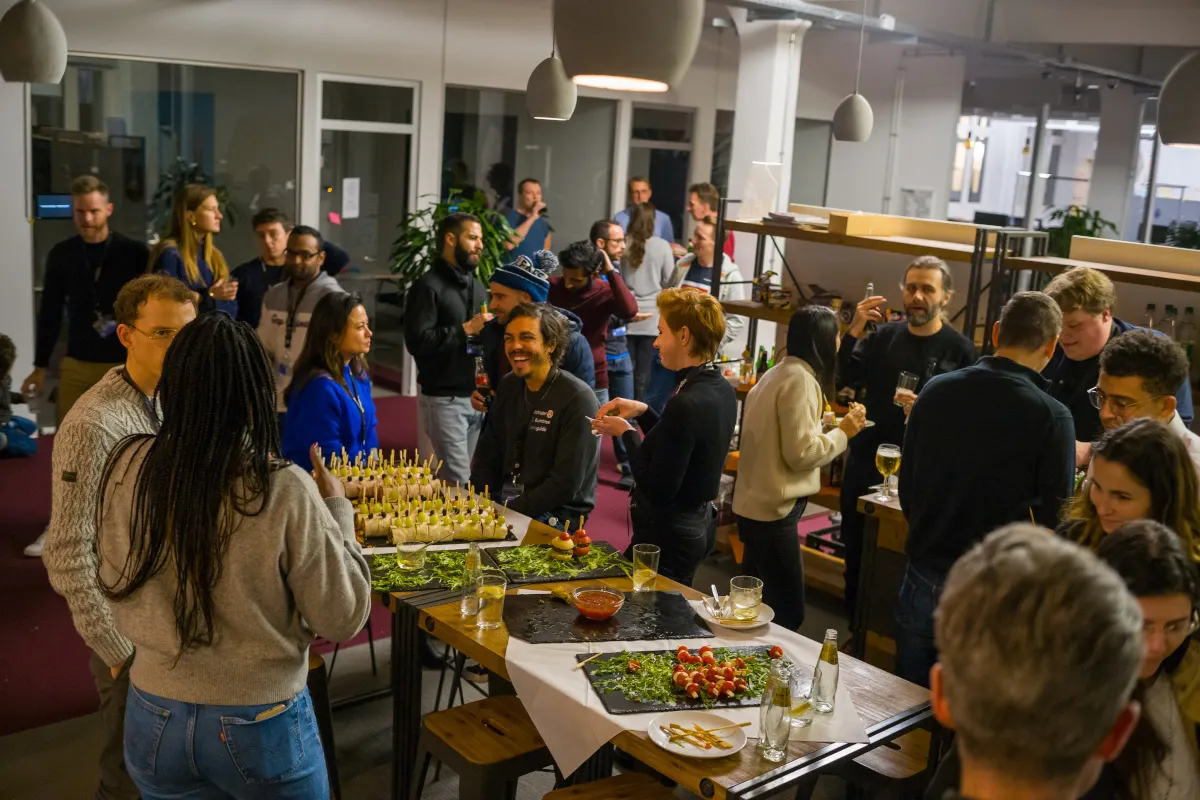
We allocated 60 minutes (three stories) plus a short panel discussion on the topic of “Learning Organisations”. To strengthen both the appeal of the format and the sense of community, we ordered drinks and pizza for everyone.
The anticipation within the planning team was high, as we didn’t know if anyone would be interested. In the end, the session was a great success. Thirty colleagues attended and we received a clear “go” to organise further Fuckup Nights.

Scaling up
For the first few sessions, we had to actively approach colleagues to gather stories about their “failures”. Over time, we received more and more enquiries from the teams and saw a greater willingness to share their stories with a larger group.
We settled on quarterly Fuckup Nights and invited stakeholders from other parts of the company to join; presentations and stories from team leaders created extra interest among attendees. In many organisations, managers, unfortunately, do not talk openly with their teams about their own mistakes, failures and weaknesses. Yet if management can lead by this example, a lot of positive energy can arise and failure will no longer be seen as a flaw, but as an opportunity.

Fuckup Night 2.0: Fail Fast
In 2020, Covid-19 presented us with the challenge of how to rethink the format. A crisis always means the opportunity to try something new. Instead of meeting in a confined space over beer and pizza, we met online, which in turn allowed us to roll out the concept across the rest of the company.
Today, up to 100 colleagues attend these sessions. Even upper management uses the framework to share their failures and learnings, which the employees have received extremely positively. After feedback, we changed the name from “Fuckup Night” to “Fail Fast”, to be more in line with the fundamental concept. Failing early means learning early, and thus reaching success sooner.
What did we learn?
Fail Fast has firmly established itself at mobile.de, providing us with a constructive platform to openly talk about our failures and share the lessons we learned from those failures. On its own, this format will not create a learning organisation, but it is an important building block alongside many others in creating a framework beyond agile team events — such as retrospectives and post-mortems — from which we can all learn.
With this approach, we learned what it takes to be successful with Fail Fast.
Here are our top five tips:
1. Start small (aka “MVP”) and then scale up
2. Appoint one or more owners to develop the format
3. Involve managers early on
4. Establish regularity (eg once a quarter)
5. Encourage discussion and interaction during the sessions
Have fun failing and learning!