Bittersuite (Week 7) — Micro UX

Last week ahead! We received valuable feedback from our classmates and tutors, who tested our low-fidelity prototype last Thursday. We still had a few days left to improve the end experience.
Get Sebastian Ervi’s stories in your inbox
Join Medium for free to get updates from this writer.
Designers: Kate Chernysheva, Ula Rodakowska, Sebastian Ervi
Making the installation more immersive
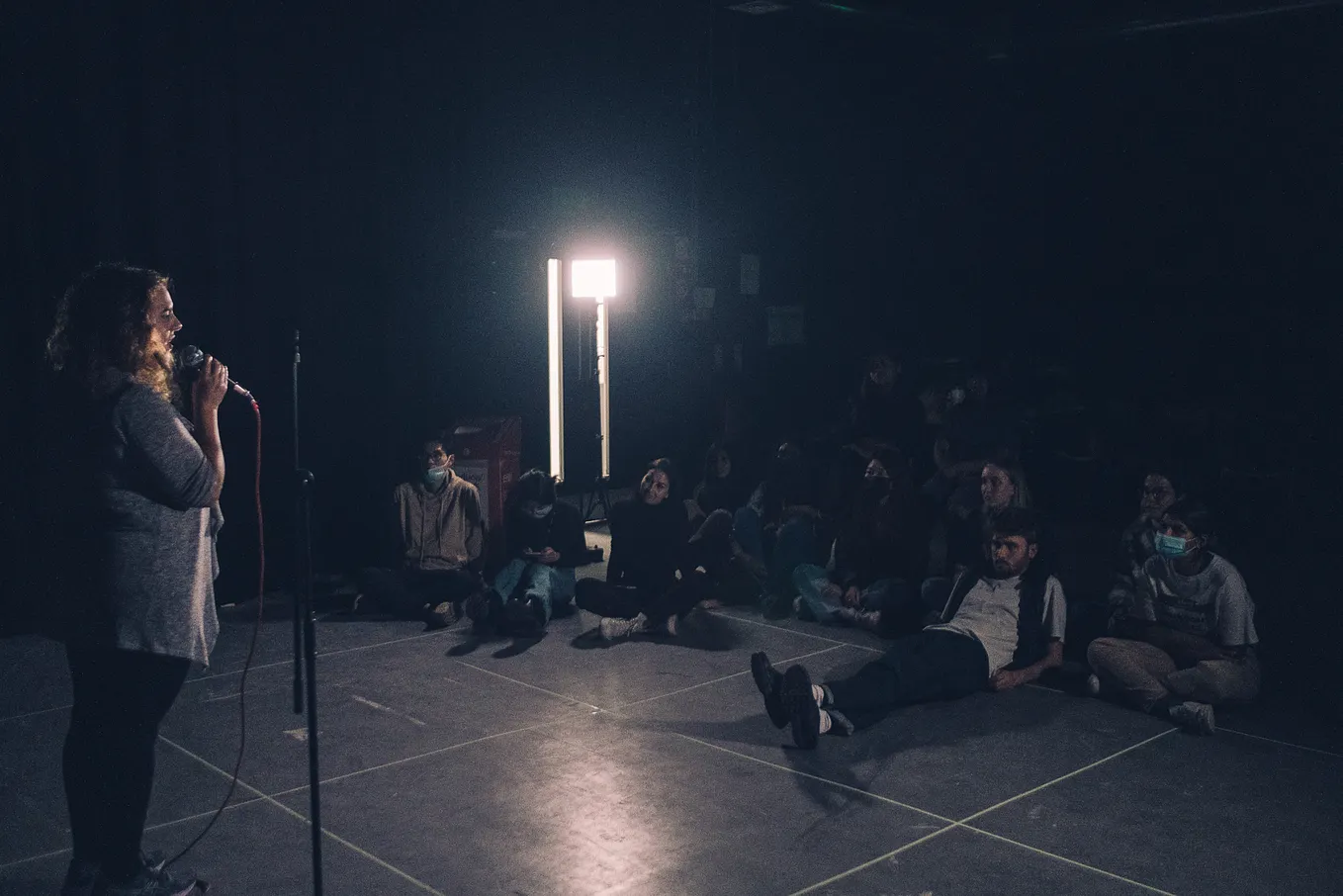
To improve last week’s prototype, Kate got the idea of an experience taking place in the dark, instead of using blindfolds. The room needed to be as dark as possible to allow people to focus on what they hear, instead of what they see. After having explored our campus building, we decided to set the experience in the Black Box room, which we managed to book for the presentation and for the evening before. Regarding the feedback we received previously, I got the idea of using fluorescent tape to mark the grid in the room, and Ula suggested using sunglasses, which we also decided to tape.

All in all, these changes ensured that the installation would be more immersive, both for the participants and for the audience. On top of that, we spent time writing a script and recording our voices, with the intention of playing the tracks on a speaker during the experience as well as giving instructions directly to participants’ headphones.
Improving the controller
We knew that the experience couldn’t be automatised because of the time that we had left. Instead, I figured out how to fix some issues that we had when prototyping the controller that we used on ProtoPie. Instead, we used Unity, a powerful tool to visually produce software. Using Unity allowed us to use the sounds that we wanted at first, and Ula took the time to ensure that the mixes would be coherent across the grid.

Last week, controlling the volume up and down according to proximity wasn’t comprehensive enough for our testers. Kate got the idea of participants hearing each other’s heartbeat. We all agreed to set it up, but it required a more complex technical installation. With the help of the Sound Arts department, I set up MIDI controllers with knobs that could be used to control the sound coming from Unity, and the separate sound for the heartbeat.

Setting up the experience
Because Kate and Ula would be in another room to control the sounds (in order to keep the room completely dark), the camera we previously used wasn’t enough anymore. Luckily, we managed to make an Intel RealSense camera work, using its infrared technology. With the use of a (very!) long extension cord, we taped the camera on the ceiling of the room and plugged it in a computer in the other room.

I was charged to set up Unity, the controllers and the computers. Unfortunately, Unity exports stopped working at a crucial moment, which made us work until late the night before the presentation, and made us cancel our testing session..! We worked hard until the last moment!
Final presentation
We didn’t have time to practice or test the experience before the presentation because of many last-minute difficulties, which made me really stressed. Luckily, everything worked (nearly) as expected and the presentation was a success. Our classmates Max and David, as well as our course leader John Fass and our partner representative Stephanie Singer were willing to test the experience in front of the audience. The feedback we got was positive, and many shared that we managed to do a lot during the final week. Stephanie precised that the next step would be to work on the details of the experience, such as how people are guided during the experience.
Reflections
Overall, I am satisfied with the project and the outcome that we produced. Once we figured out what we wanted to do, we worked really well as a team and everyone managed to equally contribute to the project with their own skills and knowledge. We might have spent too much time on our exploration phase, but we learnt continuously along the way and the process was iterative. I personally learnt a lot about sound, and I find myself being more careful of my sonic surroundings in my daily life. We also managed to collaborate with the Creative Technology Lab and the Sounds Arts department, which was really helpful along the project. To make the project better, I would have involved more testing throughout the project, especially with people outside from the course to better understand our outputs.
Images my own unless stated otherwise