American V
Sam Farahmand on the otherworldliness of Angel Olsen’s “All Mirrors” and on mirroring Albert Camus on a movie set in Mexico.


at least at times it knew me
at least at times it knew me
at least at times it knew me
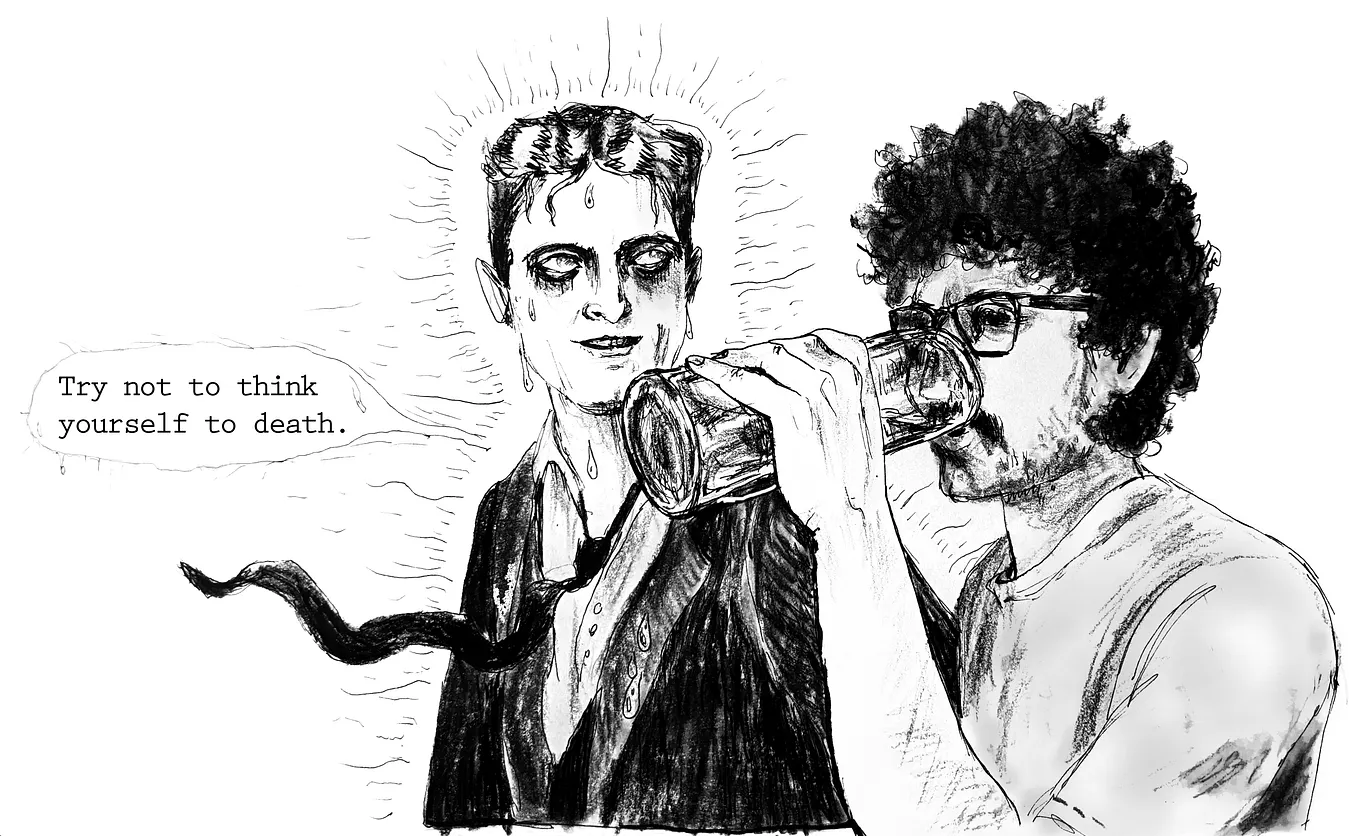
Superman is who he says I look like when I’m looking at myself in the mirror before we head out to shoot for the night, knowing afterwards we’ll likely end up in the nightclub we’ve been ending most of our nights in Mérida. He is Albert, half-an-hour into brushing and brandishing one of the enviably-better-if-not-inevitably-best things to come out of his head, other than what he just said to me through the mirror, while the night is three years ago when Santa Ana, the director, Adam, the actor, Albert, the translator but really anything on any given day, and I, the sound man but really anything else on any given day, were all in Mexico to shoot Santa Ana’s third film, Out of Sight, Out of Mind. Since then the film has been screened at several film festivals and Santa Ana has already started working on a fourth feature, but at the time, Albert and I were merely looking at ourselves in the mirror, knowing afterwards we’d likely end up in the nightclub we’d been ending most of our nights in Mérida.
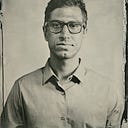
You won the lottery with that chin, Albert says through the mirror. I finish with my face and I go back to the dresser in the deluxe room the four of us have for only a handful of pesos each per night in the hostel just south of the square in the center of Mérida, picking up my ID again, not to remember who I am but forget who I am. It makes you look like Superman.
I stare at my ID to try to see who he says I look like, but all I see is a listed height of 6' 0” and weight of 155 pounds when the photograph was taken of this person with a first, middle, and last name. The photograph would have been taken two months before I turned twenty-five years old, while the next time I’d need to renew my ID wouldn’t be until after I’ve moved to Tennessee and when I turn thirty years old. In Mexico I see the blue-and-gray checkered shirt worn in the ID is the same one I am wearing at the time too, the same shirt I’ll leave with Santa Ana when I leave Mexico, because, in true Santa Ana fashion, he must have only brought the shirt on his back and of course would ask for the one off of mine. The three of them would stay to finish shooting, though even after being back in America for some time, Santa Ana still hasn’t given me back the shirt. I wouldn’t know if I’d want it back, but I’ve seen him wearing it several times since, with one of them being the next time the four of us are together again in Los Angeles for someone’s birthday, which I wrote about the afterwards in an essay I called The Sun Also Rises.
Because I ended the night being out of my mind in front of Albert, I try not to think too much about him since, but he comes to mind again, three years later, because I am looking at myself in the mirror while shaving in Tennessee. Maybe it’s also because I just bought another copy of The Stranger, which must be at least the dozenth time I’ve bought the book and maybe the tenth time I’ve read the book, but then I think of how much longer it takes to shave with a cleft chin, maybe not too much with each shave, though adding it up over the years, maybe my unsure sense of self is the result of how much more time in my life that I’ve had to spend looking at myself in the mirror. Turning the three-blade razor back and forth into a series of V’s to shave my chin, I think of this razor made by that French manufacturer of pens and other disposable products and I remember reading somewhere Camus once told Sartre not to try so hard with a woman who was into him at some party, to which Sartre told him, You’ve seen my face.
I don’t know if Albert would say I look more like Camus than I do Sartre, but I know that as I get older I look more and more or less like the latter. The more we see of ourselves, the less sure we are of who we are. The more we see of others, the surer we are of ourselves. I wouldn’t know what it was the mirror saw in me when I started to write this essay on Camus’ one-hundred-and-sixth birthday, falling on a Thursday in the second-to-last month of the year, but at the very least, it saw me looking better than Camus for the time being, which might have made him smile, though the dead are always smiling.
All Mirrors is the song I’ve been listening to on repeat off of the album of the same name by Angel Olsen, a song not unlike A Day in the Life or Desperados Under the Eaves in being a song in an album as much as an album in a song, with a bass line that lives in the background for most of the song before it truly comes to life, much like the song, toward the end of itself, a bass line that sounds as much like a heartbeat as it is a cliché to suggest a bass line sounds like a heartbeat. But the line comes to life, and the lyrics, surrounded by a string of synthesizers, feel like what it feels like to stare at oneself in the mirror, somewhere between derealization and coming to terms with the truth of your beauty being somewhere in the past. Maybe the most terrifying and most beautiful sensation of time is when and where it will sometimes turn into space, as any addict or astrophysicist would tell you, but neither as otherworldlyingly as Angel Olsen in All Mirrors.
Get Sam Farahmand’s stories in your inbox
Join Medium for free to get updates from this writer.
At this vivisection of time and space is the music video for All Mirrors, beginning with Angel Olsen in black and white, a spotlight on her through all the dark, resembling one of those immortal sea creatures floating outside of time and space, before the video takes a turn for the allegorical and the archetypal with a stairway into smoke and mirrors and more smoke, shrouded figures, and, if not being born for the first time, Angel Olsen being reborn for the nth time, until the song reaches its own synthesized synthesis when she comes face to face with herself as a postmordial being or some sort of God.
The song, after I see the music video, reminds me of how I keep having dreams I’m dying, the ones as of late being while driving in the night and being tangled in then taken up by the oncoming headlights. I wouldn’t know how many more takes it’ll take before it takes, but what I can tell is it’s been taking its toll on my sleep.
When I wake up to work on this essay before I have to go into work I see there is a ladybug in my mug, floating in the little bit of black leftover from yesterday’s coffee and still alive as I wash it out and watch as it spins around but doesn’t go down the drain, so I let it be, knowing there are many more of them from where this one came from, in the countryside where I live half-an-hour outside of Nashville, thousands around the house and hundreds having made their way in, though I wouldn’t know how they’re getting inside, but here they are. Maybe I’m still dreaming, because the scene feels about as Lynchian as it is Lynchian that David Lynch’s name has been turned into an adjective, which is the same with any artist whose last name becomes the same as their work. All an artist can hope for is to be on a last name basis.
While I won’t watch the music video again because of those dreams, I am reminded of when I first moved into the house a year ago and I spent the morning, after I’d finished working on writing, on cleaning my room of the hundreds of dead ladybugs, which looked like scarabs to me and which I supposed left me to make my sarcophagus to lie in. I would watch the music video again, but I already am reminded of the ladybugs, dying or dead or drying in the drain, while I still don’t know how to die.
Mexico is where Santa Ana says he and Adam are headed again toward the end of the year and I remember I should tell him I might be back in Los Angeles toward the end of the year myself if I end up there to record an interview to promote my first novel, Chimero.
The last time I was in Los Angeles would have been the last time I reread The Stranger, while waiting in a bar off of Ventura for some woman who is now a mother. I would have been reading a copy of The Stranger with the black and white cover designed by Helen Yentus for some series of rereleases of books by Camus, some of the most beautiful covers I’ve ever seen. I thought The Mother and I might be good together because she seemed to read Camus as much as me and also because we would head up to a mountain afterwards to drink beers out of brown bags.
Some time later The Mother took us to a writing gala for emerging writers who I hadn’t heard of and where I didn’t try too hard to remember their names. I figured if all it is is who you know, the time will come when no one will know who you are, but the audience applauded for them all the same. Maybe in another life a little more like theirs, I might have been the Iranian-American author S. Sasan Farahmand and maybe I would have been onstage myself and I would have even abstained from the alcohol instead of buying the overpriced white wine to try to get the red wine stains out of my stomach, which I only got when someone gave me the red wine they didn’t want but I’m allergic to because of the sulfites.
In between and during most of the reading I would end up heading down to the smoking section and sometimes The Mother would come with me too, though she wanted to listen to some of the readers, so we would head back and forth to the reading, but then they all started to sound the same to me. I wondered what it meant that I was there with her, since she’d told me that she also liked my writing, the gala all glossolalia to me, though if my writing has ever struck a chord with someone it might only be because it has more in line with an Alberti bass than a straightforward chord. I listened to the readers and I realized how much of what we say isn’t even what we want to say, just something to say so we have something to say, but worse than having nothing to say, all the readers seemed to be short story writers.
The Mother and I would stay until the staff, dressed in black and white, started to break down the setup for the gala. We would head down to the smoking section one last time before heading back to the valley, on the way The Mother reading me some short story she told me she’d wrote, which I had a hard time following but tried to listen to because I knew when I dropped her off at her car at a bar where we met up before the gala, the bar where Santa Ana and I would always go to whenever I was in Los Angeles, I knew she might want to kiss with me some more before she headed home, so to make a long story short, The Mother is a mother now and I still sound more or less the same, though all the same, life is a verse to death’s chorus.
Sam Farahmand is a writer from Los Angeles.
Britt McDermott is an artist and art educator in Nashville, Tennessee.