On the Ending of Euripides’s Alcestis
Sadly, remarriage is not a happy ending; it's the starting point of estrangement and misfortune.


Public Domain Dedication
Some quick background:
Alcestis is “the wife of Admetus, king of Thessaly: she offers her life to save that of her husband but is rescued from Hades by Hercules.” (the Collins English Dictionary). More details about Euripides’s Tragedy Alcestis can be found on Wikipedia.
Halleran [1988] points out that the ending of Alcestis, especially 1111–22, provides references to the ceremonies of betrothal and wedding, which reinforces the tragicomic tone of the play. It is unsurprising to the audience that Alcestis will finally return to the house at the end because the play has already planted such an expectation at the beginning. This expectation, although being challenged and made doubtful several times, reflects that Euripides "clearly cared about shaping the reactions of his audience." (Hamilton [1978])
It is interesting, however, that the play concludes with such an ironic scene in which Admetus betrays his promise (from 328: Ἄδ. ἔσται τάδ᾽, ἔσται, μὴ τρέσῃς…) that he would never remarry any woman. By the remarriage of Admetus, however, Euripides deconstructs the heroism of Alcestis and Heracles. In addition, Euripides also describes and foresees the estrangement of the couple by deliberately characterizing the return of Alcestis as a wedding scene and providing hints in the last five lines of Alcestis.
The Wedding Scene and the Deconstruction of Heroism
The entire play has a parallel structure (Hamilton [1978]), so every important aspect in the first half is supposed to have a counterpart in the second half, with some kind of irony or conflict. In particular, heroism is established in the first half and deconstructed by the second half.
Etymology first provides hints and creates some ironic effects. Two main characters, Admetus and Alcestis, at first behave in a way that is consistent with their names. Admetus is, by definition, ἄδμητος (genitive of ἀδμής, "unwedded maiden"). He is a man who is supposed to be powerful and courageous, but he is so afraid of death and demands the renewal of his current life. Therefore, his manliness is reduced, and what he does is actually the same as a maiden instead of a man. Alcestis, on the other hand, whose action shows ἀλκή (strength or courage), saves his husband and children by sacrificing herself (though she might not be willing to do so, see Luschnig [2003]). Her death literally makes her a representative of ἀλκή and makes Admetus ἄδμητος.
At the end of the play, however, their names become the source of irony. With the return of Alcestis, the ἀλκή within herself is canceled (not of ἀλκή) because she is still alive and did not die. The agreement between Admetus and Alcestis specifies that Admetus cannot remarry, so Admetus is supposed to be ἄδμητος ("unmarried"); now, with the remarriage of Admetus, he dissipates his promise and becomes "not unmarried" (not ἄδμητος). The couple is now behaving inconsistently with their names.
The story of Alcestis is not new to the audience, but the way Euripides presents it is new — he emphasizes the wedding scene (see below) to reveal the conflicts between the characters' names and deeds.
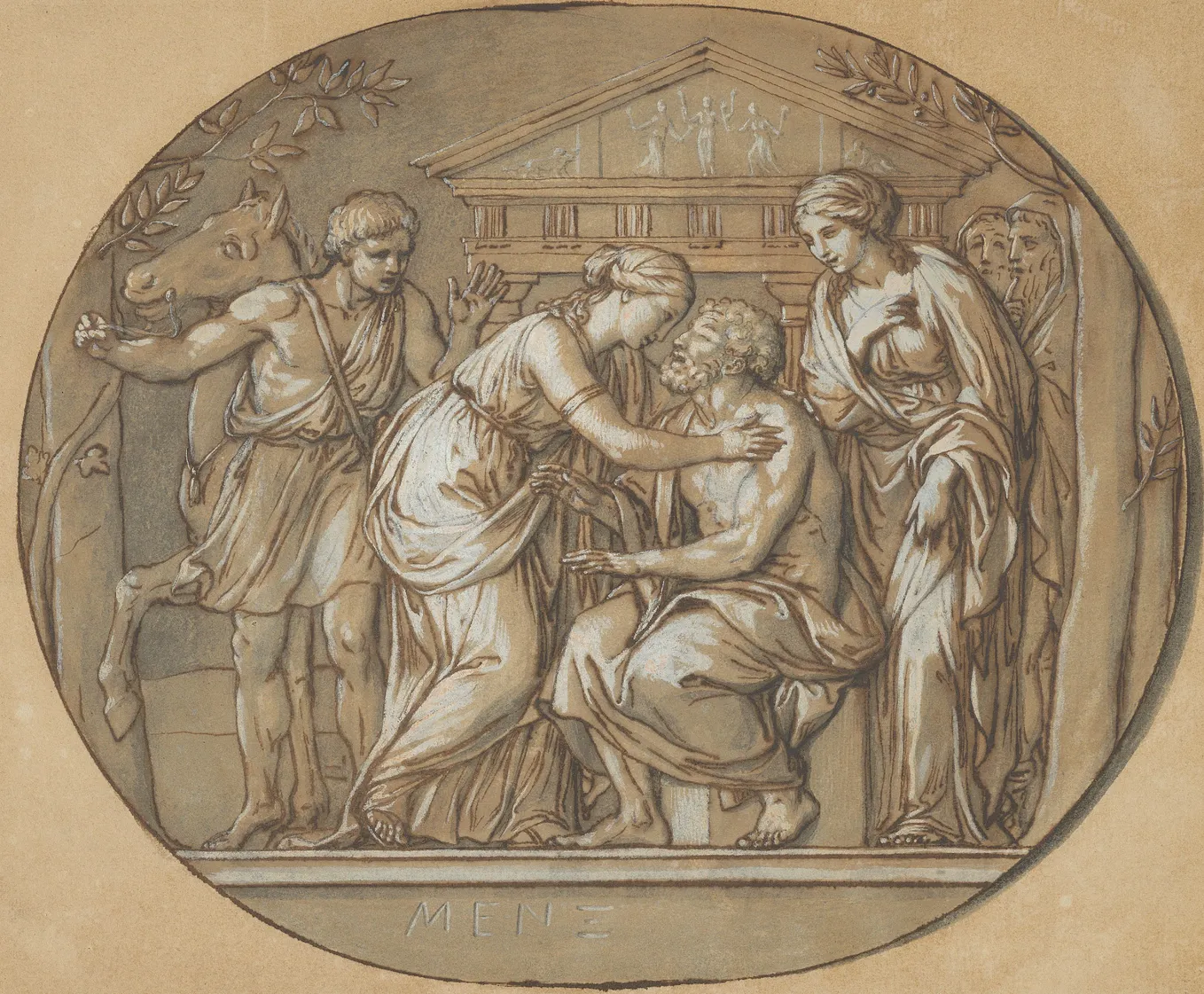
The recognition of Alcestis is just one of the recognition scenes composed by Euripides. Admetus, in this scene, betrays his wife by remarrying his (same) wife. Horace wants to put Alcestis (still unknown to Admetus at that time) into his hands (1113: ἐς σὰς… χέρας.). That reminds the audience of an earlier scene in the first half (376):
Admetus received their children from Alcestis’ hand (δέχομαι, φίλον γε δῶρον ἐκ φίλης χερός.), “in the same gesture that seals a property transfer (Luschnig [2003]);”
and the word δῶρον (gift) reinforces this impression. Heracles repeats this request in 1113 and emphasizes the right hand in 1115 (τῇ σῇ… χειρὶ δεξιᾷ μόνῃ.), and that makes the scene part of a commonly seen wedding; therefore, it is concluded without any doubt, that Admetus remarries. In addition, the marriage, just as the previous transfer of children by the hand, is now reduced to another property transfer: the return of Alcestis is just another "gift" for Admetus.
It is also noticeable that Heracles introduces Alcestis to Admetus in such a weird manner — At first, Alcestis is not recognized by Admetus. Some commentators suggest that Alcestis is transformed because she has been to Hades. This may be true. But there could be more reasons: if Admetus is aware that he would remarry his wife and actually remarries, then it is hard to come to a solid conclusion on whether he betrays his wife or not (should remarrying one's own wife be considered betrayal? It's hard to tell).
Moreover, Alcestis talked for a long time just before she died (e.g., 280–325); but now, after she has recovered from death, Euripides does not allow her to say anything (1143: Ἄδ. τί γάρ ποθ᾽ ἥδ᾽ ἄναυδος ἕστηκεν γυνή;). This rules out the possibility that Admetus can detect her true identity by her voice.
Therefore, Euripides deliberately designs this weird recognition scene in order to eliminate the grounds on which Admetus may justify his remarriage and substantiate Admetus's betrayal without any ambiguity.
With Admetus's clearly defined remarriage and betrayal, Euripides deconstructs any type of heroism that may exist in this play. Heracles (the name literally means "the hero of glory") was a hero because he fought with Thanatos and saved Alcestis, but now he is no longer a hero because of the deceptive reception of Alcestis into the house. Alcestis was a heroine because she died for his husband and saved his life, but now she is not because she is still alive and has to accept her husband, who just betrayed her.
The Last Five Lines
Get Dog Dodo’s stories in your inbox
Join Medium for free to get updates from this writer.
As mentioned in the introduction, Euripides has been building and challenging the expectations of the audience. Alcestis has been rescued by Heracles, and the audience is expecting a happy ending. But at the very end, the expectation of the reunion and happiness of the couple is challenged by the chorus (1159–1163):
πολλαὶ μορφαὶ τῶν δαιμονίων,
πολλὰ δ᾽ ἀέλπτως κραίνουσι θεοί:
καὶ τὰ δοκηθέντ᾽ οὐκ ἐτελέσθη,
τῶν δ᾽ ἀδοκήτων πόρον ηὗρε θεός.
τοιόνδ᾽ ἀπέβη τόδε πρᾶγμα.
(There are many shapes of divinity, and many things the gods accomplish against our expectation. What men expect is not brought to pass, but a god finds a way to achieve the unexpected. Such was the outcome of this story. [Kovacs 1994] )
The play is brought to an end with a subtle and sudden change in tone. Luschnig [2003] points out that such a "low-key" song at the end of Alcestis hints at surprises in the future and encourages the audience to think about more possibilities.
The chorus, in fact, makes the prediction that the life of the couple in the future will still experience a painful farewell or estrangement at least. These last five lines signal the transition between present and future.
There are "many shapes (μορφαὶ)" of the divine will; μορφαὶ, here as an example of paronomasia, refers to not only the transformation of Alcestis (because of which Admetus did not recognize her) but also the uncertainty in the future (three days later, τρίτον… φάος, to be specific). The μορφαὶ may be a good one, and thus the couple will live a happy life; but it is more likely that the μορφαὶ is an undesirable one because of the following two lines (1161–1162), where τὰ δοκηθέντ᾽ οὐκ and δ᾽ ἀδοκήτων create confusion and ambiguity. The similarity between the pronunciations of τ and δ (They are both dental stops; the former is voiceless and the latter voiced.) makes "τὰ δοκηθέντ᾽" sound like "δ' ἀδοκηθέντ᾽" and "δ᾽ ἀδοκήτων" sound like "τὰ δοκήτων." Without looking at the text, the audience may confuse one with the other by just listening to the voice of the actors on the stage.
This is another form of interaction with the audience; euripides is probably asking the audience to pay special attention to the subtext — what seems to be expected may not be really expected, and what seems to be unexpected may not be really unexpected.
Specifically, it seems that Admetus expects (hopes) that his wife will return, but actually, he only expects that his own life can continue. The evidence is 1134 (Ἄδ. ἔχω σ᾽ ἀέλπτως, οὔποτ᾽ ὄψεσθαι δοκῶν.), where Admetus clearly states that the return of Alcestis is "unexpected." He, however, hopes that his own life be rescued and he "will never see her." The subtext is that if Alcestis never comes back, he will live a long life (which he expected) for sure; now, with the return of Alcestis, the question arises as to whether he can escape the inevitable death after three days when Alcestis can talk and to live a life as a normal human.
The crucial point here is that according to the dialogue between Apollo and Thanatos, there must be someone serving as a substitute if the death of Admetus is to be postponed. Therefore, three days later, everything goes back to the initial point: Admetus will need a substitute in order to live in the upper world, and he knows his parents won't help him (and in that sense, too, Heracles is not a hero because he has not solved the problem but just granted a three-day "extension" for the inevitable death, no matter whose death it will be.); so will Alcestis die for him again? No one knows, but probably not. It is obvious that Alcestis does not trust his husband, and the estrangement of the couple has already existed even before her death.
One should notice that there was no word for Admetus in Alcestis' farewell (Luschnig [2003]), and Admetus said μὴ τρέσῃς in 328, which clearly shows that Admetus is aware of the fact that her wife does not trust him. It seems that Alcestis died for his husband only because she had no other choices, and she had to accept her fortune, not because of altruism or anything else. Maybe her return is also against her will, but again, she has no other choices.
Concluding Remarks
Within an Ancient Greek background, one is considered a hero if he successfully does something beyond his fortune. According to this criterion, no one is a hero in Alcestis. In the end, the play comes to the following conclusion: everything depends on fortune, and will still depend on a fortune in the future. The return of Alcestis takes the form of "remarriage," which, ironically, is the starting point of the estrangement and misfortune of the couple in the future. The distrust between them has existed since the play's beginning and will last forever.
An interesting question for future research: it is always taken as given that Admetus wants to live a long life, but what justifies his demand for life?
References
Halleran, Michael R. “Alkestis Redux.” Harvard Studies in Classical Philology 86 (1982): 51–53.
Halleran, Michael R. "Text and Ceremony at the Close of Euripides' Alkestis." Eranos 86 (1988): 123–129.
Hamilton, Richard. "Prologue prophecy and plot in four plays of Euripides." American Journal of Philology (1978): 277–302.
Kovacs, David. "Euripides: Cyclops, Alcestis, Medea [Loeb Classical Library]." (1994).
Luschnig, Cecelia AE, and Hanna Roisman, eds. Euripides' Alcestis. Vol. 29. the University of Oklahoma Press, 2003.
Smith, Wesley D. "The Ironic Structure in" Alcestis." Phoenix 14.3 (1960): 127–145.